
E-Invoicing Introduced for RCM Self-Invoices
Page Contents
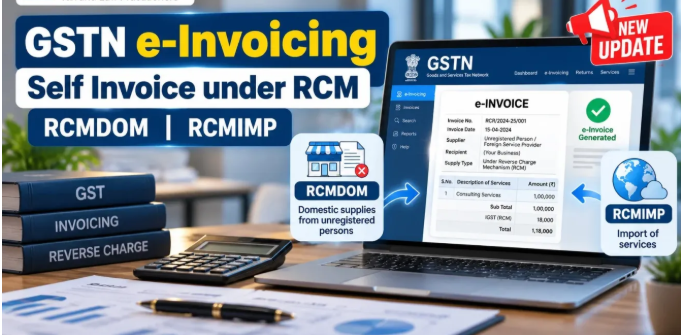
New GST Advisory 2026: E-Invoicing Introduced for RCM Self-Invoices
The GST Network, based on the recommendations of the GST Council in its 57th Meeting, has announced a significant enhancement to the e-Invoicing framework. Registered taxpayers with an Aggregate Annual Turnover of INR 5 crore or more will now be able to generate Invoice Reference Numbers for self-invoices issued under the Reverse Charge Mechanism.
Key Highlights E-Invoicing Introduced for RCM Self-Invoices
✅ Two New E-Invoice Categories Introduced
- RCMDOM (Reverse Charge Mechanism – Domestic)
- Applicable where a registered recipient procures specified goods or services from an unregistered person and is liable to pay GST under Reverse Charge Mechanism.
- The recipient can generate a self-invoice and obtain an Invoice Reference Numbers through the e-Invoice system.
- RCMIMP (Reverse Charge Mechanism – Import of Services)
- Applicable where a registered recipient receives services from a supplier located outside India and is liable to pay GST under RCM.
- Self-invoices for such import of services can now be reported on the e-Invoice portal.
Applicability E-Invoicing Introduced for RCM Self-Invoices
- Applicable to taxpayers covered under the existing e-Invoicing regime (currently having AATO of INR 5 crore or above).
- The scope, applicability, and effective date will be governed by the notifications issued under the GST law.
Reporting Procedure E-Invoicing Introduced for RCM Self-Invoices
Under the enhanced e-Invoice framework:
- Taxpayers will generate self-invoices for eligible RCM transactions.
- While uploading the invoice to the Invoice Registration Portal, taxpayers must select:
- RCMDOM for domestic RCM transactions from unregistered suppliers.
- RCMIMP for import of services under RCM.
- Upon successful validation, the Invoice Registration Portal will generate an Invoice Reference Number (IRN) and QR Code.
System Readiness
GSTN has already enabled these functionalities in the Sandbox Environment across all six authorized Invoice Registration Portals to facilitate testing by Taxpayers, GST Suvidha Providers (GSPs), ERP Vendors and Application Service Providers (ASPs)
Compliance Impact
This development represents a major compliance change because:
✔ Self-invoices under RCM will now become part of the e-Invoicing ecosystem.
✔ Enhanced transparency and digital audit trail for RCM transactions.
✔ Better reconciliation between GST returns, books of accounts, and self-invoiced transactions.
✔ Businesses should review ERP systems and accounting processes to ensure timely implementation.
Action Points for Businesses
🔹 Identify all transactions liable to RCM from unregistered suppliers.
🔹 Review import of services transactions requiring self-invoicing.
🔹 Upgrade ERP/Tally/SAP systems to capture RCMDOM and RCMIMP transaction types.
🔹 Coordinate with GST consultants and ERP vendors for testing in the IRP sandbox environment.
🔹 Train finance and GST compliance teams on the revised reporting process.
Conclusion
The introduction of e-Invoicing for RCM self-invoices marks a significant step towards strengthening GST compliance and traceability. Taxpayers falling under the e-Invoicing regime should proactively assess the impact on their accounting and GST processes and be prepared for the rollout once the effective date is officially notified by GST Network.