
E-Invoicing for RCM & Imported Services from 1st Jan 2027
Page Contents
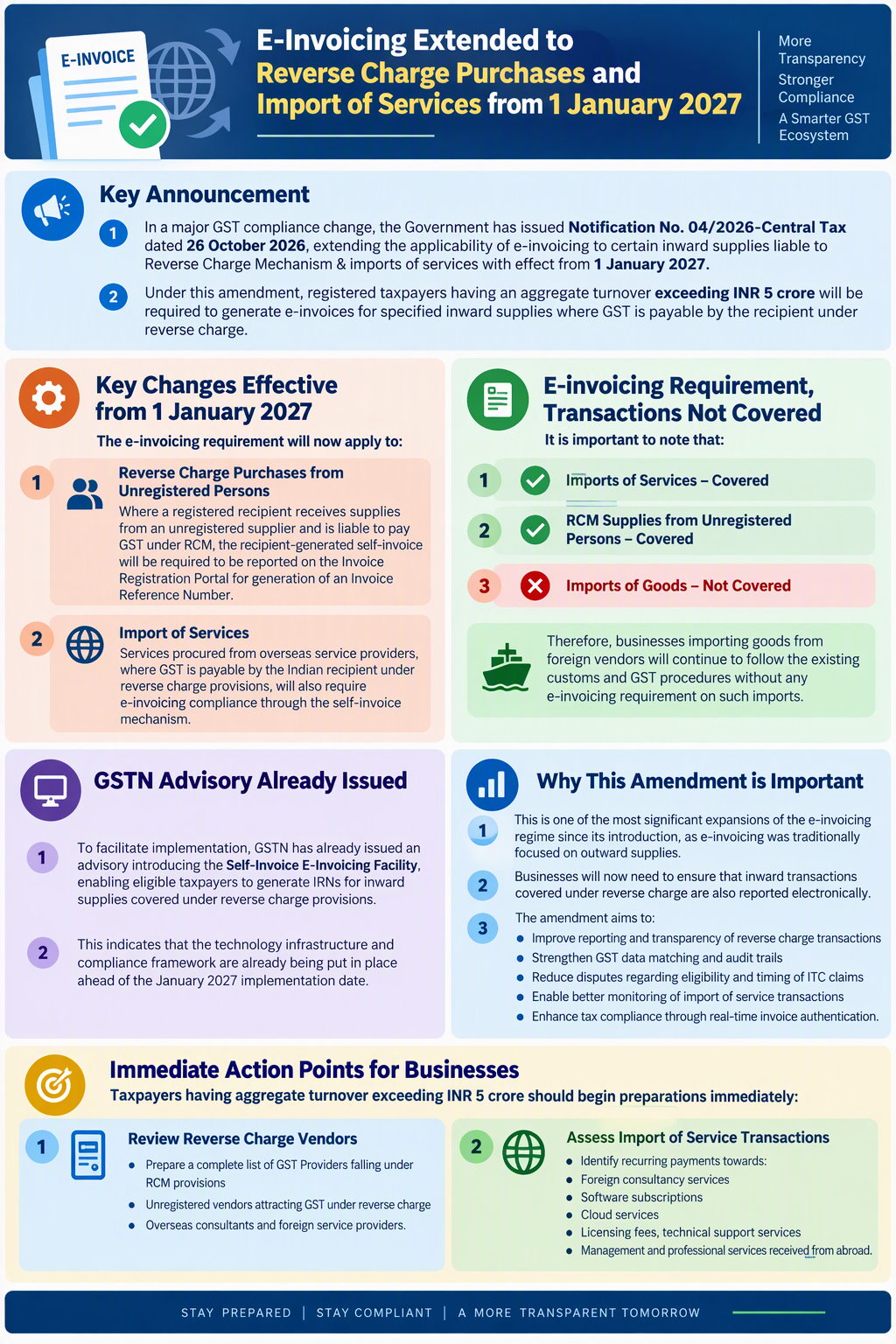
E-Invoicing Extended to Reverse Charge Purchases and Import of Services from 1 January 2027
- In a major GST compliance change, the government has issued Notification No. 04/2026-Central Tax dated 26 October 2026, extending the applicability of e-invoicing to certain inward supplies liable to the Reverse Charge Mechanism & imports of services with effect from 1 January 2027.
- Under this amendment, registered taxpayers having an aggregate turnover exceeding INR 5 crore will be required to generate e-invoices for specified inward supplies where GST is payable by the recipient under reverse charge.
Key Changes Effective from 1 January 2027
The e-invoicing requirement will now apply to:
- Reverse Charge Purchases from Unregistered Persons: Where a registered recipient receives supplies from an unregistered supplier and is liable to pay GST under RCM the recipient-generated self-invoice will be required to be reported on the Invoice Registration Portal for the generation of an Invoice Reference Number.
- Import of Services: Services procured from overseas service providers, where GST is payable by the Indian recipient under reverse charge provisions, will also require e-invoicing compliance through the self-invoice mechanism.
E-invoicing requirement, transactions not covered
It is important to note that
- Imports of Services—Covered
- RCM Supplies from Unregistered Persons – Covered
- However, Imports of Goods—Not Covered
Therefore, businesses importing goods from foreign vendors will continue to follow the existing customs and GST procedures without any e-invoicing requirement on such imports.
GSTN Advisory Already Issued
- To facilitate implementation, GSTN has already issued an advisory introducing the Self-Invoice E-Invoicing Facility, enabling eligible taxpayers to generate IRNs for inward supplies covered under reverse charge provisions
- This indicates that the technology infrastructure and compliance framework are already being put in place ahead of the January 2027 implementation date.
Why This Amendment is Important
- This is one of the most significant expansions of the e-invoicing regime since its introduction, as e-invoicing was traditionally focused on outward supplies.
- Businesses will now need to ensure that inward transactions covered under reverse charge are also reported electronically.
- The amendment aims to improve reporting and transparency of reverse charge transactions, strengthen GST data matching and audit trails, reduce disputes regarding eligibility and timing of ITC claims, and enable better monitoring of import of service transactions. and enhance tax compliance through real-time invoice authentication.
Immediate Action Points for Businesses: Taxpayers having aggregate turnover exceeding INR 5 crore should begin preparations immediately:
Review Reverse Charge Vendors: Prepare a complete list of GST. Providers falling under RCM provisions, unregistered vendors attracting GST under reverse charge. and Overseas consultants and foreign service providers.
Assess Import of Service Transactions: Identify recurring payments towards foreign consultancy services, software subscriptions, cloud services, licensing fees, technical support services, and management and professional services received from abroad.
Check ERP and Accounting Software Readiness
- Organizations covered under e-invoicing should not wait until December 2026 to begin preparations.
- A comprehensive review of all reverse charge transactions and overseas service arrangements should be undertaken immediately so that self-invoicing and IRN generation processes are fully operational from day one.
- Failure to implement appropriate controls may lead to compliance gaps, reconciliation issues, and potential disputes during GST audits and assessments.
Businesses should confirm with their software vendors that the accounting system can:
- Generate self-invoices for RCM transactions.
- Integrate with the Invoice Registration Portal.
- Generate Invoice Reference Numbers.
- Maintain separate records for inward RCM e-invoices.
- Support reconciliation with GST returns.
Update Internal Compliance Processes
- Finance and GST teams should establish procedures for timely identification of RCM transactions and preparation of self-invoices and IRN generation before claiming input tax credit. and documentation and record maintenance.
- Preparation Window Available: Since the amendment comes into force on 1 January 2027, businesses have slightly over two months to evaluate systems, train staff, test software integrations, and ensure complete compliance readiness.
- GST Turnover exceeding INR 5 crore: GST Taxpayers with turnover exceeding INR 5 crore should immediately identify all RCM vendors and foreign service providers and verify that their ERP/accounting software is capable of generating IRNs for self-invoices before the new compliance requirement becomes effective from 1 January 2027.