
Complete Guide for Companies Annual Report
Page Contents
Annual Report under the Companies Act, 2013: A Complete Guide for Companies
The Annual Report is one of the most significant corporate documents prepared by a company every financial year. It serves as a comprehensive communication tool between the company, its shareholders, investors, regulators, lenders, and other stakeholders. Through the Annual Report, companies disclose their financial performance, governance practices, management outlook, compliance status, and future business strategy. The framework governing annual reports is prescribed under the Companies Act, 2013, SEBI (LODR) Regulations, 2015, and various allied rules and standards.
What is an annual report?
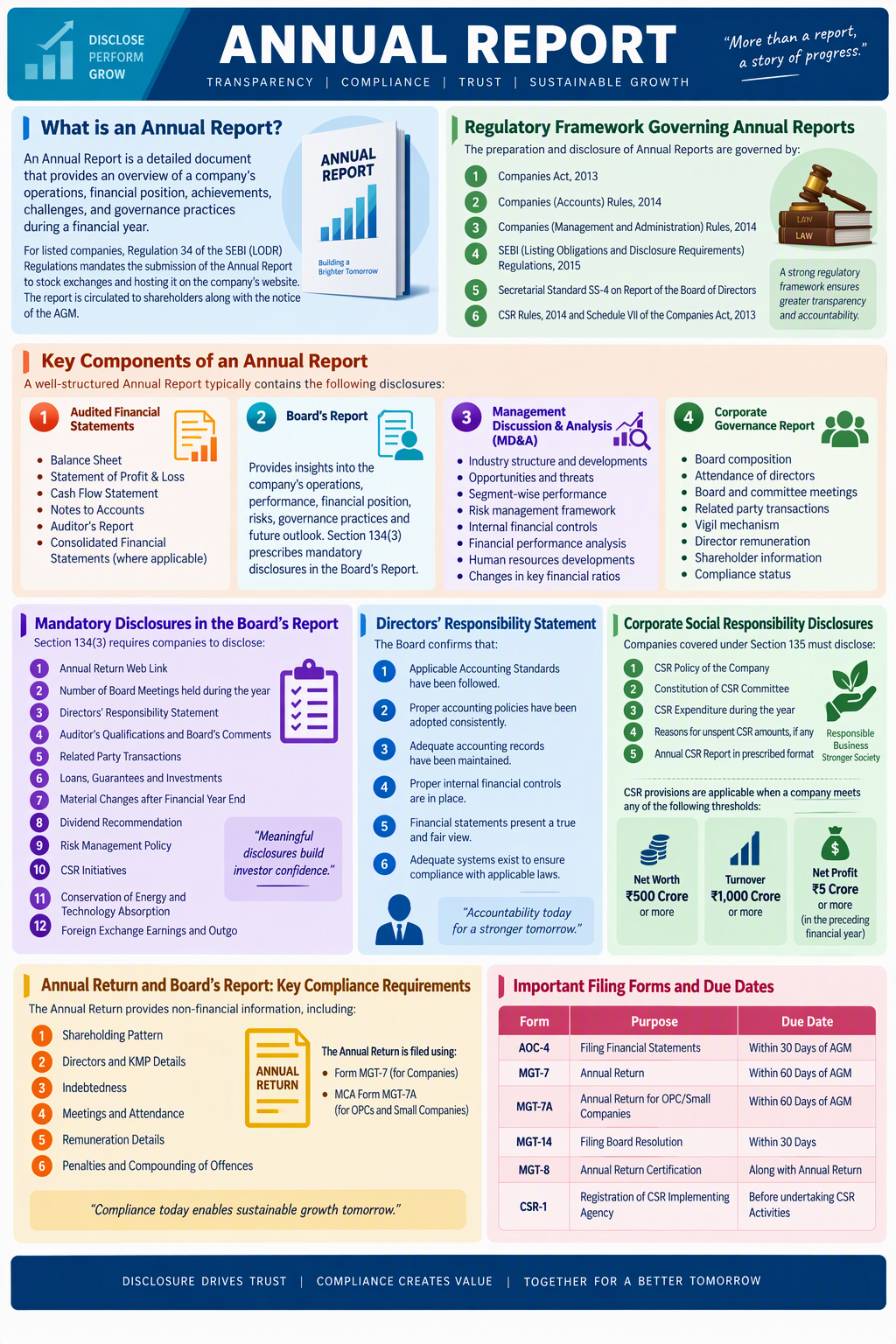
An annual report is a detailed document that provides an overview of a company’s operations, financial position, achievements, challenges, and governance practices during a financial year. For listed companies, Regulation 34 of the SEBI (LODR) Regulations mandates the submission of the Annual Report to stock exchanges and hosting it on the company’s website. The report is circulated to shareholders along with the notice of the Annual General Meeting (AGM).
Regulatory Framework Governing Annual Reports
The preparation and disclosure of annual reports are governed by various legal provisions, including
- Companies Act, 2013
- Companies (Accounts) Rules, 2014
- Companies (Management and Administration) Rules, 2014
- SEBI (Listing Obligations and Disclosure Requirements) Regulations, 2015
- Secretarial Standard SS-4 on Report of the Board of Directors
- CSR Rules 2014, and Schedule VII of the Companies Act, 2013
Key Components of an Annual Report
A well-structured annual report typically contains the following disclosures:
- Audited Financial Statements: These include the Balance Sheet, Statement of Profit & Loss, Cash Flow Statement, Notes to Accounts, Auditor’s Report, and Consolidated Financial Statements, wherever applicable
- Board’s Report : The Board’s Report is the most important narrative section of the Annual Report. It provides shareholders with insights into the company’s operations, performance, financial position, risks, governance practices, and future outlook. Section 134(3) of the Companies Act, 2013 prescribes mandatory disclosures required in the Board’s Report.
- Management Discussion and Analysis (MD&A) : MD&A enables investors to understand management’s perspective regarding industry structure and developments, Opportunities and threats, segment-wise Performance, Risk Management Framework, Internal Financial Controls, Financial Performance Analysis, Human Resources Developments, changes in Key Financial Ratios
- Corporate Governance Report : Listed companies are required to provide a detailed Corporate Governance Report covering Board Composition, Attendance of Directors, Board and Committee Meetings, Related Party Transactions, Vigil Mechanism, Director Remuneration, Shareholder Information and Compliance Status
Mandatory Disclosures in the Board’s Report
Section 134(3) requires companies to disclose several critical matters, including:
- Annual Return Web Link
- Number of Board Meetings held during the year
- Directors’ Responsibility Statement
- Auditor’s Qualifications and Board’s Comments
- Related Party Transactions
- Loans, Guarantees, and Investments
- Material Changes after Financial Year End
- Dividend Recommendation
- Risk Management Policy
- CSR Initiatives
- Conservation of Energy and Technology Absorption
- Foreign Exchange Earnings and Outgo
Directors’ Responsibility Statement
The Directors’ Responsibility Statement is a declaration by the Board confirming that:
- Applicable Accounting Standards have been followed.
- Proper accounting policies have been adopted consistently.
- Adequate accounting records have been maintained.
- Proper internal financial controls are in place.
- Financial statements present a true and fair view.
- Adequate systems exist to ensure compliance with applicable laws.
Corporate Social Responsibility Disclosures
Companies covered under Section 135 must disclose:
- Corporate Social Responsibility Policy of the Company
- Constitution of Corporate Social Responsibility Committee
- CSR Expenditure during the year
- Reasons for unspent Corporate Social Responsibility amounts, if any
- Annual Corporate Social Responsibility Report in prescribed format
Corporate Social Responsibility provisions become applicable when a company meets any of the following thresholds:
- Net Worth of INR 500 Crore or more
- Turnover of INR 1,000 Crore or more
- Net Profit of INR 5 Crore or more during the immediately preceding financial year
Annual Return and Board’s Report: Key Compliance Requirements
The Annual Return provides non-financial information regarding the company, including:
- Shareholding Pattern
- Directors and KMP Details
- Indebtedness
- Meetings and Attendance
- Remuneration Details
- Penalties and Compounding of Offences
The Annual Return is filed using:
- Form MGT-7 (for Companies)
- MCA Form MGT-7A (for OPCs and Small Companies)
Important Filing Forms and Due Dates
| Form | Purpose | Due Date | |
| AOC-4 | Filing Financial Statements | Within 30 Days of AGM | |
| MGT-7 | Annual Return | Within 60 Days of AGM | |
| MGT-7A | Annual Return for OPC/Small Companies | Within 60 Days of AGM | |
| MGT-14 | Filing Board Resolution | Within 30 Days | |
| MGT-8 | Annual Return Certification | Along with Annual Return | |
| CSR-1 | Registration of CSR Implementing Agency | Before undertaking CSR Activities |
Importance of an Annual Report
The annual report acts as a powerful transparency and governance tool. It helps:
- Investors assess business performance.
- Regulators monitor legal compliance.
- Banks and lenders evaluate financial stability.
- Shareholders make informed decisions.
- Management communicates future plans and growth strategies.
Conclusion
An annual report is much more than a statutory compliance document. It reflects the financial health, governance standards, accountability, and strategic direction of a company. Companies must ensure that their annual report is accurate, comprehensive, and compliant with the provisions of the Companies Act, 2013, and applicable SEBI regulations. A well-prepared annual report not only fulfills legal obligations but also enhances stakeholder confidence and strengthens corporate credibility in the marketplace.