
ITR: Can we file Income tax Return without Form16?
Page Contents
ITR: Do you want to file Income tax Return without Form 16? Then you have to know about it
- According to New FY 2023-24 begins, In India, salaried person must file their income tax returns (ITR). Form 16 is commonly used by the salaried class to file Income Tax Return, but it is not always required. Income tax Form 16 offers a detailed account of the employee’s taxable income, but some employees do not use it. Income tax Form 16 is an essential document for filing income tax returns because it details the individual’s total income, Investments, chapter VI deductions, and TDS information.
- If the Income Tax Form 16 might not receive it if their monthly salary does not fall under taxable income. In that cases, Income tax Return could be filed without Form 16.
- A person those who don’t have income tax Form 16 could obtain Tax collection at source & Tax deducted at Source information through Form 26AS. This form offers information on high-value transactions, other important information, and advance tax payments. To File ITR without Form 16, Individual would also need their Proof of investment U/s 80C and 80D of the Income Tax Act, proof of home loan payments, HRA slip and salary slip.
How to download Form 26AS ?
- To download Income Tax Form 26AS, those who want to file Income tax Return but don’t get a taxable salary could visit the IT website and click on the E-File Portal. Then, select the My Account option and click on the View Form 26AS link.
- Then, select the AY & click on the view Time button. And then final, click on the download option, and the form shall be downloaded. The Form 26AS could be see in HTML format and can be downloaded in text, excel or in PDF format.
What’s the function of Form 26AS?
- Form 26AS is essentially a strengthened tax credit statement that contains all of the information of various taxes deducted at source from your income. Based on the TAN number, this data is divided into quarters and clients. If you work, Form 26AS shall map your employer based on your Tax Deduction Account Number. Form 26AS is available on the Tax dept. website. Several banks also offer account holders with access to Form 26AS. If you have internet access to your bank account, you can directly get your Form 26AS from the secured area of the bank login.
- In simple word, Form 26AS is like a tax passbook, as it provides information on the taxes deposited on the taxpayer’s behalf during the fiscal year. Tax Deducted at Source, Tax Collected at Source, advance tax, & Self-Assessment Tax are all examples of these taxes. All types of Taxes that paid against your permanent account number are captured in this report in a very kind manner.
Below is why you required to verify & ensure with your Form 26AS.
- GST Taxpayers have to assure that the Income tax return is in synchronized with Form 26AS. In the instance of any difference, the Tax Dept might circulate tax notice to seek explanation for such inconsistency in the figures of Income or Tax deducted at Souses appearing in Form 26AS and Income tax return. The Income tax department utilizes Form 26AS as the standard for all of its examination and authentication, and notices are issued if there is a difference.
- As per Income tax Rule, to avoid receiving a notice from the Income tax Dept, the Income tax taxpayer have to make sure that each entry showing in Form 26AS belongs to him and that any data mismatch should be corrected before filing the income tax return.
- Form 26AS serves another function. There are some transactions that are need to be stated by the financial institutions or banks right away to the Tax dept based on the mapped permanent account number. For instance, buying a house property, deposit of cash in bank account above a threshold, etc, is naturally reported to the Income Tax Department. These transactions shall display in your Form 26AS under Annual Information Return (AIR) column only if it exceeded the threshold limit.
How to tackle any difference in the Form 26AS?
- In terms of the tax department, Form 26AS shall be accepted as a genuine document. If there is a difference between the amount of Tax deducted at souses claimed in the income tax return and the amount of Tax deducted at souses displayed on Form 26AS, the assessing officer will solely credit the amount shown on Form 26AS. That is why you should always double-check Form 26AS before filing your Income tax return. Differences might arise because you failed to pay tax on some capital gains, or because your employer or client deducted but did not deposit tax. In either case, you must act quickly to correct the situation.
Form 16 vs 26AS – Know the Difference Before Filing Your ITR!
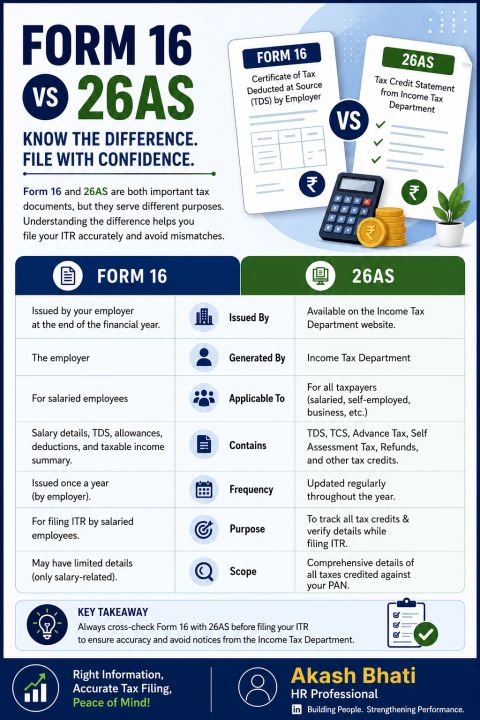
Many taxpayers mistakenly believe that Form 16 & Form 26AS are interchangeable documents. While both are important for income tax return filing, they serve different purposes and are issued by different authorities. Understanding the distinction can help you avoid reporting errors, claim the correct tax credits, and prevent future notices from the Income Tax Department.
What is Form 16?
Form 16 is a TDS certificate issued by your employer. It serves as proof that tax has been deducted from your salary and deposited with the government on your behalf.
Form 16 generally contains:
- Salary income details
- Exemptions claimed (HRA, LTA, etc.)
- Deductions under Chapter VI-A (Section 80C, 80D, etc.)
- Taxable salary computation
- TDS deducted and deposited by the employer
- PAN and TAN details
For salaried employees, Form 16 is often the starting point for ITR preparation.
What is Form 26AS?
Form 26AS is an annual tax credit statement maintained by the Income Tax Department. It provides a consolidated view of taxes linked to your PAN.
Form 26AS may include:
- TDS deducted by employers
- TCS (Tax Collected at Source)
- TDS deducted by banks and other deductors
- Advance tax paid
- Self-assessment tax paid
- Income tax refunds received
- High-value transactions reported to the tax department
Unlike Form 16, Form 26AS is not limited to salary income and reflects tax credits from multiple sources.
Form 16 vs Form 26AS: Key Differences
| Particulars | Form 16 | Form 26AS |
|---|---|---|
| Issued By | Employer | Income Tax Department |
| Purpose | Salary TDS certificate | Consolidated tax credit statement |
| Covers | Salary income and salary TDS | All tax credits linked to PAN |
| Contains Deductions | Yes | No |
| Contains Advance Tax | No | Yes |
| Contains TCS Details | No | Yes |
| Income Sources | Primarily salary | Multiple income sources |
| Use in ITR Filing | Salary reporting | Verification of tax credits |
Why Should You Compare Form 16 and Form 26AS?
Simply relying on Form 16 may result in errors if the tax deducted by your employer has not been correctly reported or deposited.
Before filing your ITR, compare:
- Salary and TDS shown in Form 16
- TDS reflected in Form 26AS
- Interest income reflected in AIS/26AS
- Tax credits claimed in the return
- Advance tax and self-assessment tax payments
This reconciliation helps identify Missing TDS credits, Incorrect tax deductions, Income omissions, PAN reporting errors and Mismatches that may trigger notice
Best Practice Before Filing Your ITR
Before clicking “Submit” on your ITR:
- Review Form 16.
- Download Form 26AS.
- Verify AIS (Annual Information Statement).
- Reconcile all income sources.
- Match TDS credits.
- Compare Old Tax Regime and New Tax Regime benefits.
- Claim only eligible deductions.
Key Takeaway
Form 16 helps you report your salary income, while Form 26AS helps you verify your tax credits. Both documents serve different but equally important purposes. Filing your return based solely on Form 16 can lead to omissions and mismatches. Always reconcile Form 16 + Form 26AS + AIS before filing your ITR. A few minutes spent reviewing these documents can help ensure accurate tax reporting, faster processing of refunds, and reduced chances of receiving notices from the Income Tax Department. Remember: Accurate ITR filing begins with verifying the information, not just submitting Form 16.