
New TDS Framework for Purchase of Property from NRIs
Page Contents
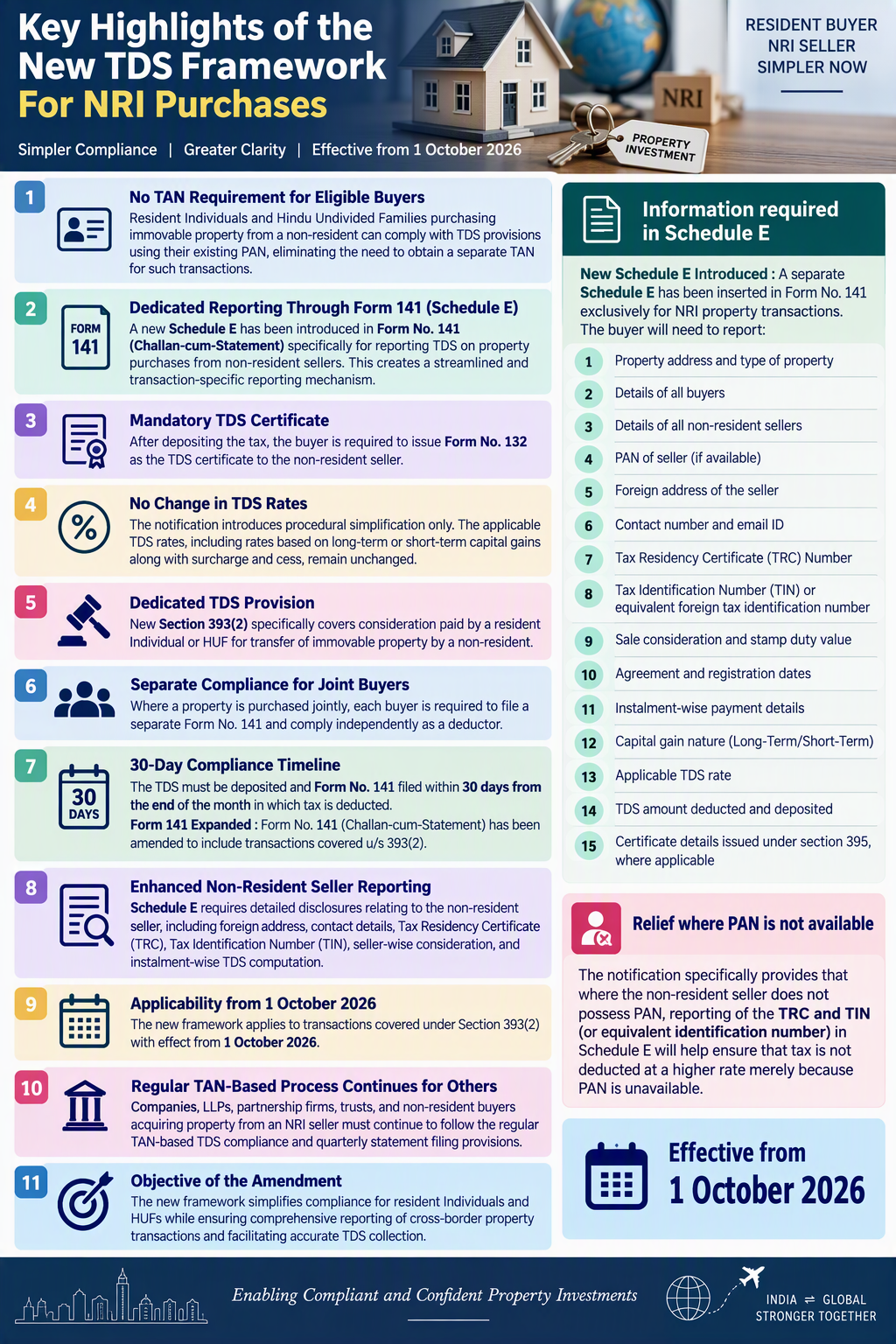
New TDS Framework for Purchase of Property from NRIs Effective 1 October 2026
Income Tax Notification:
The CBDT has notified the Income-tax (Fifth Amendment) Rules, 2026, introducing a specific TDS compliance framework under Section 393(2) for cases where a resident Individual or HUF purchases immovable property from a non-resident seller. The amendment becomes effective from 1 October 2026.
What has changed?
Earlier, resident buyers purchasing property from a non-resident seller were required to obtain a TAN and follow the regular TDS procedures applicable to payments made to non-residents. The new rules now create a separate compliance mechanism u/s 393(2) specifically for such transactions.
Key Highlights of the New TDS Framework For NRI Purchases
- No TAN Requirement for Eligible Buyers
Resident Individuals and Hindu Undivided Families purchasing immovable property from a non-resident can comply with TDS provisions using their existing PAN, eliminating the need to obtain a separate TAN for such transactions. - Dedicated Reporting Through Form 141 (Schedule E)
A new Schedule E has been introduced in Form No. 141 (Challan-cum-Statement) specifically for reporting TDS on property purchases from non-resident sellers. This creates a streamlined and transaction-specific reporting mechanism. - Mandatory TDS Certificate
After depositing the tax, the buyer is required to issue Form No. 132 as the TDS certificate to the non-resident seller. - No Change in TDS Rates
The notification introduces procedural simplification only. The applicable TDS rates, including rates based on long-term or short-term capital gains along with surcharge and cess, remain unchanged. - Dedicated TDS Provision : New Section 393(2) specifically covers consideration paid by a resident Individual or HUF for transfer of immovable property by a non-resident.
- Separate Compliance for Joint Buyers
Where a property is purchased jointly, each buyer is required to file a separate Form No. 141 and comply independently as a deductor. - 30-Day Compliance Timeline
The TDS must be deposited and Form No. 141 filed within 30 days from the end of the month in which tax is deducted. Form 141 Expanded : Form No. 141 (Challan-cum-Statement) has been amended to include transactions covered u/s 393(2). - Enhanced Non-Resident Seller Reporting
Schedule E requires detailed disclosures relating to the non-resident seller, including foreign address, contact details, Tax Residency Certificate (TRC), Tax Identification Number (TIN), seller-wise consideration, and instalment-wise TDS computation. - Applicability from 1 October 2026
The new framework applies to transactions covered under Section 393(2) with effect from 1 October 2026. - Regular TAN-Based Process Continues for Others
Companies, LLPs, partnership firms, trusts, and non-resident buyers acquiring property from an NRI seller must continue to follow the regular TAN-based TDS compliance and quarterly statement filing provisions. - Objective of the Amendment
The new framework simplifies compliance for resident Individuals and HUFs while ensuring comprehensive reporting of cross-border property transactions and facilitating accurate TDS collection.
Information required in Schedule E
New Schedule E Introduced : A separate Schedule E has been inserted in Form No. 141 exclusively for NRI property transactions. The buyer will need to report:
- Property address and type of property
- Details of all buyers
- Details of all non-resident sellers
- PAN of seller (if available)
- Foreign address of the seller
- Contact number and email ID
- Tax Residency Certificate (TRC) Number
- Tax Identification Number (TIN) or equivalent foreign tax identification number
- Sale consideration and stamp duty value
- Agreement and registration dates
- Instalment-wise payment details
- Capital gain nature (Long-Term/Short-Term)
- Applicable TDS rate
- TDS amount deducted and deposited
- Certificate details issued under section 395, where applicable
Relief where PAN is not available
The notification specifically provides that where the non-resident seller does not possess PAN, reporting of the TRC and TIN (or equivalent identification number) in Schedule E will help ensure that tax is not deducted at a higher rate merely because PAN is unavailable
The amendments are applicable from 1 October 2026. Transactions up to 30 September 2026 will continue to be governed by the existing procedure.
Practical Impact – TDS for Purchase of Property from NRIs
This notification simplifies compliance for resident Individuals and HUFs purchasing property from NRIs by providing a dedicated reporting framework, standardized disclosure requirements, and a specific TDS reporting form instead of relying solely on the broader non-resident TDS procedures. The focus is on capturing foreign tax residency details, ensuring appropriate treaty benefits, and facilitating accurate TDS computation and reporting.
Source: containing CBDT Notification G.S.R. 830(E) dated 22 September 2026