
ICAI Guidance on Auditors Examining VDA Transactions
Page Contents
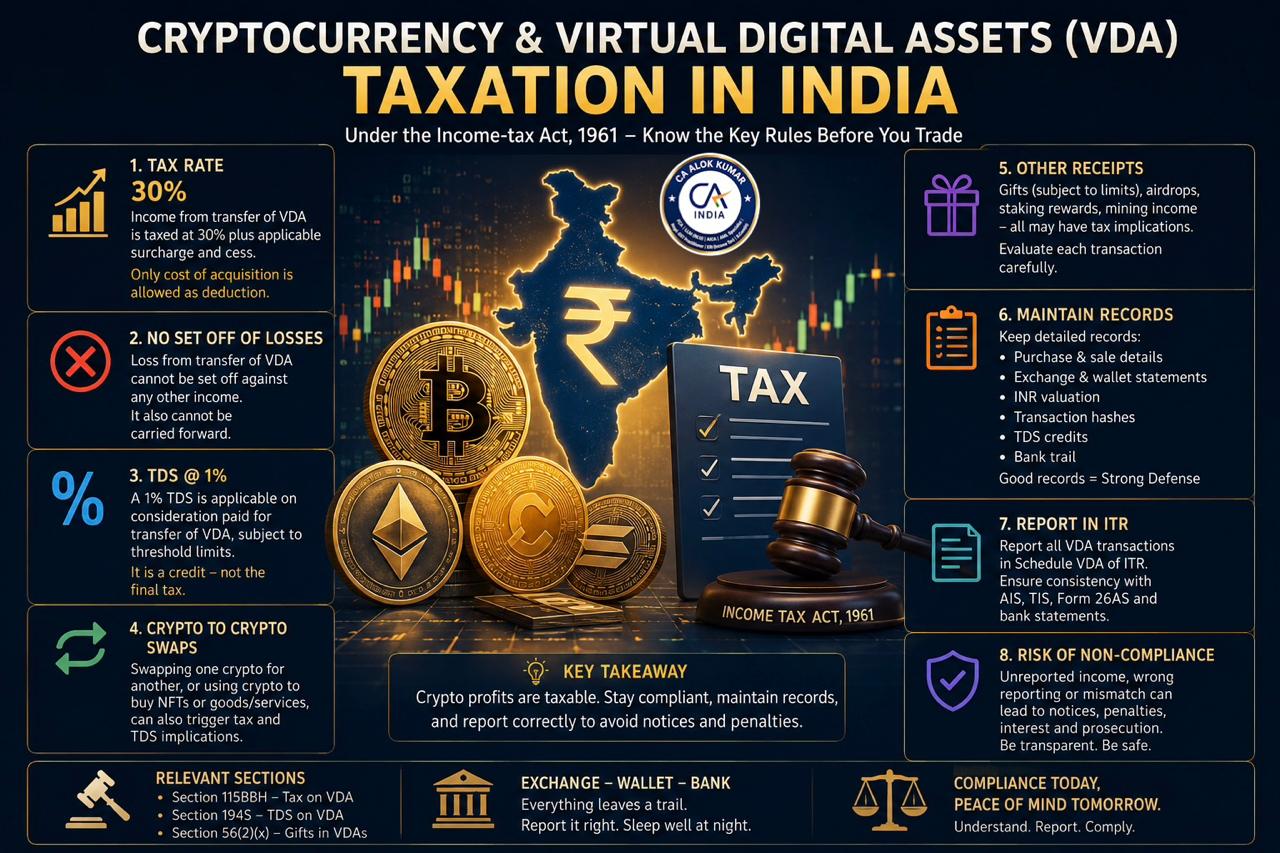
ICAI Guidance on Auditors Examining VDA Transactions
The ICAI Exposure Draft expects auditors to examine VDA transactions through existing Form 3CD clauses and proposed VDA-specific disclosures. The objective is to ensure that crypto, NFTs, tokenized carbon credits, and DeFi transactions are properly reported and reconciled.
Form 3CD Clause-by-Clause Verification for VDAs
| Form 3CD Clause | Requirement | VDA Audit Focus |
| Clause-13 | Method of Accounting | Verify valuation methodology adopted for VDAs such as FIFO, WAC (Weighted Average Cost), or Mark-to-Market. |
| Clause-19 | Amounts not deductible | Verify that no prohibited VDA expenses have been claimed as a deduction under Section 115BBH. |
| Clause-26 | Particulars of TDS | Verify Section 194S compliance and reconcile TDS deducted on VDA transfers. |
| Clause-32 | Speculation / Deemed Profit | Examine whether VDA activity is investment, capital asset, or business trading. |
| Clause-36 | Exempt Income | Verify basis of exemption claimed for carbon credits or other digital assets. |
| Clause-44 | GST Break-up | Segregate VDA turnover and carbon credit turnover wherever relevant. |
| Proposed VDA Clause | New ICAI Disclosure | Report wallets, exchanges, asset types, transaction values, and FMV methodology. |
Clause-13 – Method of Accounting
Auditor should verify Whether the taxpayer consistently follows FIFO (First-In First-Out), WAC (Weighted Average Cost) and Any other recognized valuation method. For Example
| Transaction | Quantity | Cost |
| Buy BTC | 1 | INR 20 lakh |
| Buy BTC | 1 | INR 30 lakh |
| Sell BTC | 1 | ? |
Under FIFO, cost = INR 20 lakh.
Under WAC, cost = INR 25 lakh.
The auditor should ensure consistency and adequate documentation.
Clause-19 – Amounts Not Deductible
Section 115BBH permits deduction only of the cost of acquisition in computing income from the transfer of VDAs. The auditor should check that the assessee has not claimed exchange fees, wallet fees, gas fees, mining expenses, advisory expenses, and internet/server expenses against VDA income. For Example
| Particulars | Amount |
| Sale Value | INR 10,00,000 |
| Acquisition Cost | INR 6,00,000 |
| Trading Fee | INR 25,000 |
Only INR 6,00,000 is generally deductible while computing VDA gains.
Clause 26 – Particulars of TDS
Section 194S requires TDS on transfer of VDAs subject to prescribed thresholds. The auditor should verify exchange-wise TDS deduction, Form 26AS reconciliation, P2P transaction compliance, and OTC transaction compliance. And crypto-to-crypto swap transactions. For Example
| Exchange | Sale Value | TDS |
| Binance | INR 5,00,000 | INR 5,000 |
| CoinDCX | INR 3,00,000 | INR 3,000 |
The auditor should verify that TDS appears in Form 26AS and matches exchange reports.
Clause 32 – Speculation / Profit Characterization:
The auditor should determine the nature of VDA activity. The following factors are considered:
| Investor | Trader |
| Occasional transactions | Frequent transactions |
| Long holding period | Short holding period |
| Capital appreciation motive | Trading profit motive |
| Limited activity | Organized business activity |
Importance classification influences accounting treatment, disclosure requirements, and Tax audit reporting. Even though Section 115BBH applies to VDA transfers, proper characterization remains important for audit purposes.
Clause-36 – Exempt Income:
Where carbon credit income is claimed as exempt, the auditor should obtain supporting evidence. Documentation may include government notification, advance rulings, judicial precedents, and registry documentation. For Example,
| Carbon Credit Type | Auditor Action |
| Traditional CER | Verify basis of exemption/treatment |
| Blockchain tokenized credit | Assess VDA implications |
| Voluntary credits | Verify classification note |
Clause-44 – GST Turnover Break-up:
The auditor should separately identify:
| Category | Amount |
| VDA turnover | INR XX |
| Carbon credit turnover | INR XX |
| Exempt turnover | INR XX |
This helps reconcile GST returns, Books of account and Form 3CD disclosures
Proposed New VDA Clause: The proposed clause may require disclosure of
- Wallet details like wallet addresses and custodial and self-custodial wallets. Exchange details like Binance, CoinDCX, Coinbase, WazirX, and Kraken.
- Asset Details like Bitcoin, Ethereum, NFTs, gaming tokens, and Carbon-credit tokens
- Valuation Basis like FMV source, Exchange rates used and Acquisition-cost methodology
FEMA & Foreign Exchange Compliance
Many taxpayers hold VDAs on overseas platforms, creating an additional FEMA risk.
Foreign Exchange Checklist
- Foreign exchanges, for example, Binance, Coinbase, Kraken, and Bybit. Auditor should identify Assets held abroad, Foreign wallet balances and Cross-border transfers
- FEMA Compliance: Auditor verifies whether reporting obligations arise for overseas holdings, foreign exchanges, and overseas investments. Additional documentation may include Foreign exchange remittance records, bank statements, and FEMA declarations
-
- Carbon Credit Exports: Carbon credits sold to foreign buyers may generate foreign currency receipts. The auditor should verify Foreign inward remittance, FEMA compliance and Realisation documentation
- The Cross-Border DeFi Activities: Examples include foreign liquidity pools, overseas lending protocols, and international staking platforms. Risk areas include Permanent Establishment (PE), Dependent Agent PE (DAPE), and DTAA implications. A separate tax note is advisable for material exposures.
Audit Workpaper Standards:
Good VDA audits should be supported by comprehensive workpapers.
| Workpaper | Purpose |
| WP-1 | Master VDA transaction register |
| WP-2 | Exchange reconciliation |
| WP-3 | TDS reconciliation |
| WP-4 | Carbon credit classification matrix |
| WP-5 | Wallet balance reconciliation |
| WP-6 | DeFi income computation |
| WP-7 | Form 3CD disclosure support |
| WP-8 | Management Representation Letter |
WP-1: Master VDA Register; Should contain Date, Token, Quantity, FMV, INR value, Wallet, Exchange and TDS status
WP-2: Exchange Reconciliation: Purpose:
Exchange Statement
↓
Books
↓
Tax Computation
↓
Schedule VDA
Every difference should be explained.
WP-3: TDS Reconciliation: Reconcile: Transaction Register vs Form 26AS, Auditor Identify Missing TDS, short deduction, and Excess deduction
WP-4: Carbon Credit Matrix
| Credit Type | Classification |
| UNFCCC CER | Traditional |
| Verra Credit | Further review |
| Toucan Credit | Potential VDA |
| KlimaDAO Token | Potential VDA |
WP-5: Wallet Reconciliation: The auditor must verify: Opening Balance + Additions − Sales / Transfers = Closing Balance for each wallet.
WP-6: DeFi Income Schedule: Capture staking rewards, Yield farming rewards, liquidity pool income, and airdrops along with FMV and tax treatment.
WP-7: Form 3CD Support File: Audit Should contain Clause-wise disclosures, Working papers, reconciliations, and Auditor conclusions
WP-8: Management Representation Letter: Management should confirm All wallets disclosed, All exchanges disclosed, No undisclosed VDA activity, and completeness of information provided.
Step 10: Technology Tools Used in VDA Audits
| Tool | Purpose |
| Koinly / CoinTracker / ZenLedger | Aggregates transactions and computes gains |
| Etherscan / BSCScan / Polygonscan | Blockchain verification of wallet transactions |
| CBDT AIS Portal | Compare exchange-reported transactions with taxpayer disclosures |
| GST Portal (GSTR-2B) | Verify ITC relating to carbon-credit transactions |
| Chainalysis / Elliptic | AML and risk assessment of crypto transactions |
Practical Takeaway
A robust VDA audit should allow an assessing officer to trace a transaction from Wallet/Exchange → Transaction Register → Books of Account → Schedule VDA → Form 26AS → Form 3CD → ITR with complete supporting evidence at every stage. This is the core objective behind the proposed VDA-focused audit documentation framework
Quick Audit Snapshot on VDA Transactions
Minimum Documents Every VDA Assessee Should Maintain: Wallet list, exchange statements, Form 26AS, AIS, transaction register, FMV valuation records, TDS reconciliation, Schedule VDA reconciliation, DeFi income records, and carbon credit classification note (where applicable).
A Section 44AB VDA audit should be capable of tracing every digital asset transaction from the wallet/exchange level → books of account → tax computation → Schedule VDA → Form 3CD disclosures
Section 44AB VDA audit should be capable of tracing every digital asset transaction from the wallet and exchange level to the books of account, tax computation, Schedule VDA, Form 3CD disclosures, and the final Income Tax Return with a complete and verifiable audit trail.