
ICAI Exposure Draft (July 2026) on Tax Audit Guidance Note
Page Contents

ICAI Exposure Draft (9 July 2026) on Tax Audit Guidance Note
The ICAI Direct Taxes Committee has released an exposure draft proposing revisions to the Guidance Note on Tax Audit under Section 44AB of the Income Tax Act, 1961. Comments were invited up to 25 July 2026. Importantly, this is expected to be the last Guidance Note under the 1961 Act, as the Income Tax Act, 2025, has come into force from 1 April 2026, shifting tax audit provisions to Section 63 of the new law.
Key Changes at a Glance
| Area | What Has Changed? | Impact on CAs & Tax Auditors |
| Transition to IT Act, 2025 | Section 44AB replaced by Section 63 | Auditors must prepare for new law-based reporting |
| VDA & Carbon Credits | Included in “gross receipts from business” | Crypto and carbon-credit dealers may cross audit thresholds more easily |
| DPDP Act Compliance | New data privacy expectations | Stronger controls over client data required |
| Audit Assignment Counting | Branches treated as one assignment | Easier assignment-count computation |
| Management Representation Letter | Format revised | Firms should adopt updated MRL templates |
| Form 3CD Reporting | Enhanced scrutiny of disclosures | More robust audit documentation needed |
Transition to the Income Tax Act, 2025
- What the Exposure Draft Says This is the final Guidance Note under the Income Tax Act, 1961. Tax audits going forward will be governed by Section 63 of the Income Tax Act, 2025. And Section 536 for transition provisions.
- Practical Impact: For most taxpayers, audit concepts remain broadly similar; existing audit thresholds largely continue. And reporting references must gradually shift from updating tax audit manuals to training audit teams on the new act numbering. And revise internal checklists and templates.
Expansion of “Gross Receipts in Business”
Major Change: The draft specifically includes Virtual Digital Assets (VDAs) and Carbon Credits within gross business receipts where the taxpayer deals in such assets. For Example
| Business Activity | Included in Gross Receipts? |
| Crypto trading | Yes |
| NFT trading | Yes |
| Carbon credit trading | Yes |
| Tokenized carbon credits | Yes |
Clarification Given
The following are not treated as business gross receipts for audit-threshold purposes: Recovery of old bad debts already written off, Remission of liability under Section 41 and Capital receipts from sale of fixed assets not credited to P&L
Practical Impact: Businesses trading in crypto assets, NFTs, and carbon credits may cross audit limits sooner due to inclusion in turnover calculations.
DPDP Act, 2023 Compliance Expectations:
New Focus Area Tax auditors routinely handle PAN details, Aadhaar details, salary information, bank account information, and personal financial records. The draft emphasizes stronger compliance with the:
Digital Personal Data Protection (DPDP) Act, 2023.
- Expected Controls Need-to-know access, password-protected systems, secure cloud storage, data retention policies and confidentiality controls.
- Engagement Letters: Firms should update engagement letters to include data-processing clauses and privacy obligations. Confidentiality provisions, Data breach responsibilities
- Practical Impact: Tax audit quality now includes not just tax compliance but also data-governance compliance.
Tax Audit Assignment Counting
- Clarification Issued: Branch Audits If one auditor audits one tax audit assignment, separate UDINs may be generated.
- Revised Tax Audit Where Auditor A conducted the original audit. And Auditor B performs a revised tax audit. The revised audit will count towards Auditor B’s assignment limit.
- Practical Impact of it More clarity in assignment counting, better compliance with ceiling limits, and reduced ambiguity for multi-branch entities.
Revised Management Representation Letter (MRL)
The sample MRL has been updated and aligned with: Auditing and Assurance Standards Board (AASB) format. The purpose of the MRL is to be revised. The MRL seeks management confirmation regarding the completeness of records, tax disclosures, related-party information, VDA disclosures, and carbon-credit transactions. And compliance representations. The v=basic practical impact of MRL is that firms should replace older MRL formats and use the revised ICAI-compliant version.
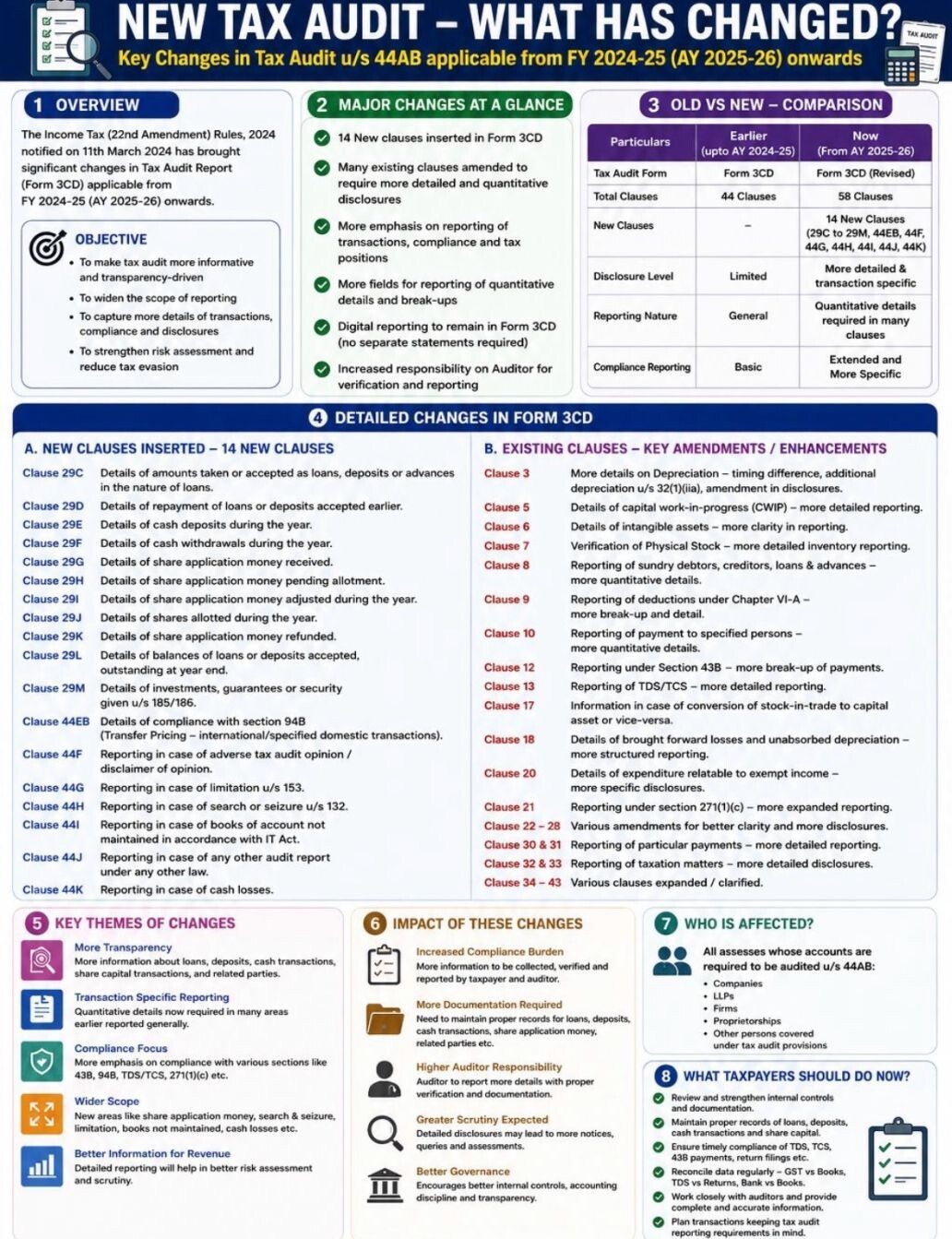
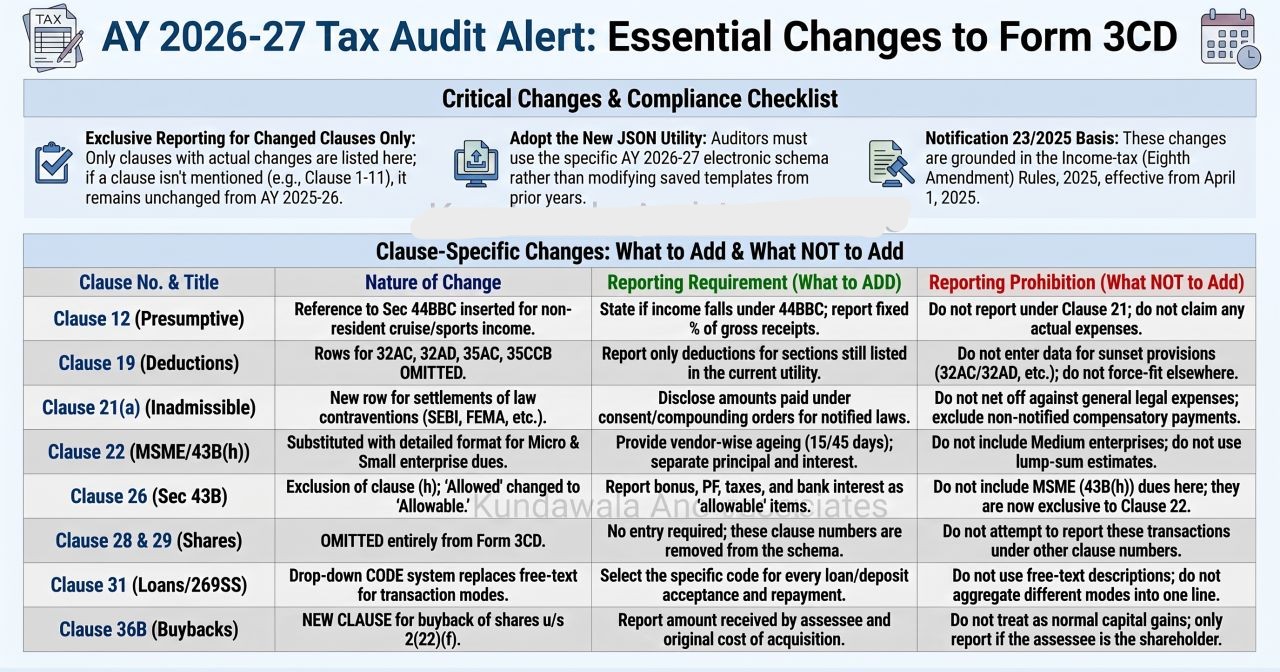
Enhanced Form 3CD Reporting Expectations:
The draft expects greater scrutiny in areas such as:
| Reporting Area | Auditor Focus |
| VDA Turnover | Verify inclusion in business receipts |
| Carbon Credit Turnover | Proper classification |
| GST RCM Liability | Section 43B reporting |
| Clause 17 | Accuracy of disclosures |
| Clause 35(a) | Stock-related reporting |
| Clause 38 | Tax compliance checks |
The guidance also incorporates observations from the Tax Audit Quality Review Board (TAQRB) to reduce recurring reporting errors.
Enhanced Form 3CD Reporting Expectations
The exposure draft signals heightened scrutiny of disclosures in Form 3CD. Areas Receiving Particular Attention
| Reporting Area | Auditor Focus |
|---|---|
| VDA Turnover | Verification of inclusion in business receipts |
| Carbon Credit Turnover | Proper classification and disclosure |
| GST RCM Liability | Accurate Section 43B reporting |
| Clause 17 | Correct reporting and consistency |
| Clause 35(a) | Inventory and stock disclosures |
| Clause 38 | Tax compliance verification |
The draft also incorporates observations from the Tax Audit Quality Review Board (TAQRB) to reduce recurring reporting deficiencies.
Compliance Implications for Firms
- Immediate (Short-Term) Tax Audit Firms Should Update engagement letters, Revise Form 3CD checklists, Incorporate VDA and carbon-credit verification procedures, Strengthen DPDP compliance processes. Adopt the revised management representation letter format.
- Medium-Term: Firms Should Prepare For Full migration to the Income Tax Act, 2025, Section 63-based tax audit reporting and enhanced audit quality controls. And Better documentation standards for VDAs, Carbon Credits, GST reporting and Data governance
Conclusion
The ICAI Exposure Draft (9 July 2026) represents far more than an update to the Tax Audit Guidance Note. It serves as a transition roadmap from the Income Tax Act, 1961, to the Income Tax Act, 2025, while simultaneously raising expectations around audit quality, documentation, technology usage, and compliance governance. For chartered accountants, the most important changes are the following:
- VDA and carbon-credit receipts now receive explicit recognition in turnover computations.
- Tax auditors must adopt DPDP-compliant data-handling practices.
- Assignment-counting rules have been clarified.
- A revised Management Representation Letter must be used.
- Form 3CD reporting will involve greater scrutiny and documentation.
In short, the draft pushes tax audit practice towards a more technology-driven, documentation-intensive, and compliance-focused framework, particularly for emerging areas such as crypto assets, carbon credits, and digital-business transactions.
tax audits are becoming increasingly documentation-intensive, technology-enabled, and compliance-focused, particularly in emerging sectors such as cryptocurrency, NFTs, tokenized assets, carbon credits, and digital businesses. Firms that adapt early will be better positioned to meet future regulatory expectations and audit-quality standards.