
Commercial Courts Act: Transforming Commercial Litigation in India
Page Contents
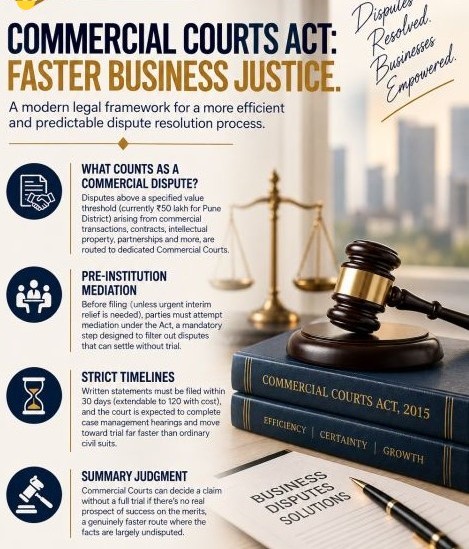
Key Provisions, Jurisdiction, Mediation under Commercial Courts Act 2015
Introduction
The Commercial Courts Act, 2015 marked a significant reform in India’s judicial framework by creating specialized courts for the adjudication of commercial disputes. The objective of the Act is to ensure faster resolution of business-related litigation, reduce judicial delays, improve ease of doing business, and strengthen investor confidence.
Initially, the Act applied to commercial disputes involving a specified value of INR 1 crore or more. However, through the Commercial Courts, Commercial Division and Commercial Appellate Division of High Courts (Amendment) Act, 2018, the threshold was reduced to INR 3 lakh, thereby expanding the scope and accessibility of Commercial Courts across the country. The Central Govt has also been empowered to frame rules for implementing the provisions of the Act, including the procedure for Pre-Institution Mediation U/s 12A.
Objectives of the Act
The Act seeks to achieve the following objectives:
- Establish a specialized and efficient judicial mechanism for resolving commercial disputes.
- Promote investor confidence and support economic growth.
- Reduce the backlog of commercial litigation pending before ordinary civil courts.
- Ensure speedy disposal of commercial matters.
- Improve India’s business environment through efficient dispute resolution.
Purpose of the Act
The Commercial Courts Act, 2015 provides for the establishment of Commercial Courts at the district level; Commercial Divisions in High Courts; and Commercial Appellate Divisions in High Courts for adjudicating commercial disputes involving a specified value of not less than INR 3 lakh. Commercial Courts Act, 2015 applicability & effective Date on 23 October 2015.
Impact of the Act
Since its implementation, the Act has contributed significantly to commercial jurisprudence and business litigation by:
- Accelerating disposal of commercial disputes.
- Enhancing judicial specialization in commercial law.
- Encouraging alternative dispute resolution mechanisms.
- Bringing greater consistency and clarity in commercial law.
- Improving India’s image as a business-friendly jurisdiction.
Important Definitions
- Commercial Court [Section 2(1)(b)] : “Commercial Court” means a Commercial Court constituted U/s 3 of the Act.
- Commercial Dispute [Section 2(1)(c)] : A “commercial dispute” refers to disputes arising from various business and commercial transactions, including:
-
- Transactions of merchants, bankers, financiers and traders.
- Export and import of goods or services.
- Admiralty and maritime matters.
- Aircraft transactions, leasing and financing.
- Carriage of goods.
- Construction and infrastructure contracts.
- Commercial use of immovable property.
- Franchise agreements.
- Distribution and licensing agreements.
- Management and consultancy agreements.
- Joint venture agreements.
- Shareholders’ agreements.
- Subscription and investment agreements.
- Partnership agreements.
- Technology development agreements.
- Intellectual Property Rights (IPR), including Trademarks, Copyrights, Patents, Designs, Domain names and Geographical indications
-
- Agreements for sale of goods or provision of services.
- Oil, gas and natural resource exploitation.
- Insurance and reinsurance disputes.
- Agency contracts related to commercial transactions.
- Any other commercial disputes notified by the Central Govt.
- Specified Value: “Specified Value” means the value of the subject matter of the commercial dispute as determined u/s 12 of the Act and shall not be less than INR 3 lakh or such higher amount as may be notified by the Central Govt.
The Commercial Courts Act, 2015: Transforming Commercial Litigation in India
Section 6: Jurisdiction of Commercial Courts
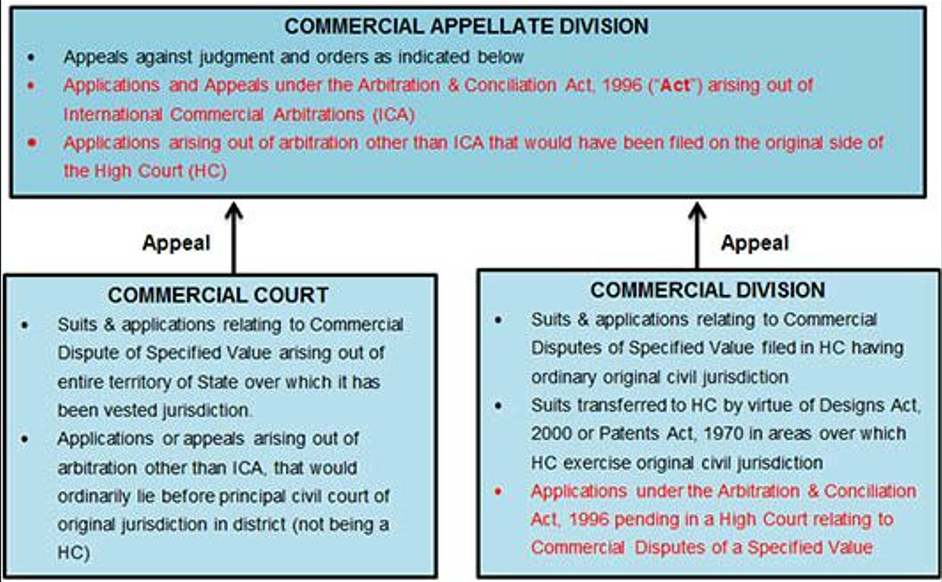
Commercial Courts have jurisdiction over all suits and applications relating to commercial disputes of the specified value arising within their territorial limits. The objective is to ensure specialized adjudication and quicker disposal of commercial matters at the district level.
Section 7: Jurisdiction of Commercial Divisions of High Courts
Commercial Divisions of High Courts are empowered to hear and dispose of commercial disputes of specified value where the High Court possesses ordinary original civil jurisdiction. The Commercial Division also handles Matters statutorily required to be filed before courts not lower than a District Court. Matters transferred u/s 22(4) of the Designs Act, 2000 & Section 104 of the Patents Act, 1970. Such disputes are adjudicated by the Commercial Division of the High Court concerned.
Section 10: Jurisdiction in Arbitration Matters
Where the subject matter of arbitration involves a commercial dispute of specified value:
- International Commercial Arbitration: Applications and appeals under the Arbitration and Conciliation Act, 1996 filed before a High Court shall be heard by the Commercial Division of the High Court.
- Domestic Arbitration before High Court: Where arbitration matters are filed on the original side of the High Court, they shall be heard by the Commercial Division.
- Domestic Arbitration before District-Level Courts: Applications and appeals that would ordinarily lie before the Principal Civil Court of Original Jurisdiction shall be filed before the Commercial Court having territorial jurisdiction.
Section 12A: Pre-Institution Mediation and Settlement
- To reduce unnecessary litigation and encourage amicable settlement, Section 12A mandates Pre-Institution Mediation before filing certain commercial suits. A party intending to initiate a commercial suit may submit an application for mediation in Form-1 under the Commercial Courts (Pre-Institution Mediation and Settlement) Rules, 2018. The application can be filed Online, By post, By hand delivery along with a fee of INR 1,000.
- Timeline for Mediation: Initial mediation period: 3 months and Extension: 2 additional months with consent of both parties. Maximum Duration: Total period = 5 months
- Limitation Benefit: The period spent in Pre-Institution Mediation is excluded while calculating the limitation period under the Limitation Act, 1963.
- Mediation Fee Structure
| Quantum of Claim | Mediation Fee |
| INR 3 lakh to INR 10 lakh | INR 15,000 |
| Above INR 10 lakh up to INR 50 lakh | INR 30,000 |
| Above INR 50 lakh up to INR 1 crore | INR 40,000 |
| Above INR 1 crore up to INR 3 crore | INR 50,000 |
| Above INR 3 crore | INR 75,000 |
The mediation fee is payable as a one-time charge and is shared equally between the parties unless otherwise agreed.
Section 13: Appeals
Any person aggrieved by a judgment or order passed under the Act may prefer an appeal as follows:
- Appeal from Commercial Court below District Judge : Appeal lies before the Commercial Appellate Court and Must be filed within 60 days from the date of judgment or order.
- Appeal from Commercial Court at District Judge Level or Commercial Division of High Court: Appeal lies before the Commercial Appellate Division of the High Court. And Must be filed within 60 days from the date of judgment or order.
Section 14: Expeditious Disposal of Appeals
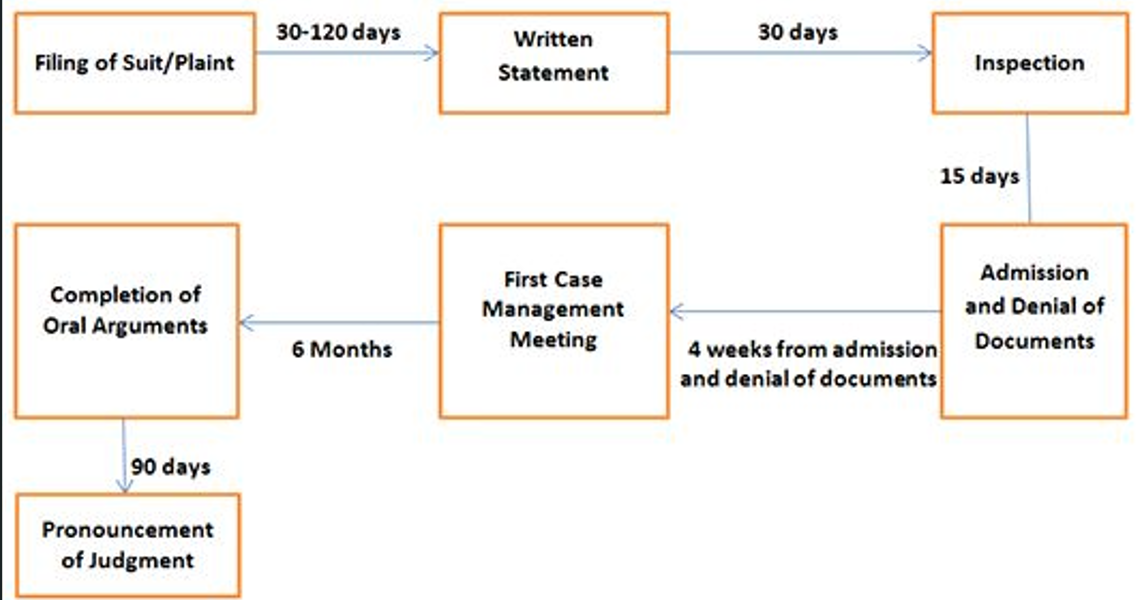
The Commercial Appellate Court and Commercial Appellate Division are required to endeavor to dispose of appeals within 6 months from the date of filing of the appeal. This provision reflects the Act’s core objective of ensuring speedy and effective commercial justice.
Professional Opportunities Under the Commercial Courts Act, 2015
The enactment of the Commercial Courts Act has opened significant opportunities for professionals operating in the legal and corporate sectors. Following Key Opportunities for professional:
- Commercial Litigation Practice: Growing demand for lawyers specializing in Commercial litigation, Contract law, corporate law, international trade law and Intellectual Property Rights (IPR)
- Arbitration and Mediation: Increased requirement for Arbitrators, Mediators, Conciliators and Dispute resolution specialists
- Contract Management: Professionals engaged in Drafting commercial agreements, Contract negotiations and Legal advisory services
- Corporate Dispute Resolution: Organizations increasingly seek professionals skilled in corporate governance, Compliance management, Risk mitigation and Litigation strategy
- Judicial and Academic Opportunities: The specialized commercial court system has created opportunities for Judicial officers, Legal researchers, Law professors and Commercial law trainers
- Consulting and Advisory Services; Law firms and consulting organizations now offer Commercial litigation support, Regulatory advisory, Legal risk assessment and corporate restructuring assistance
- Legal Technology (LegalTech) : The emphasis on efficient dispute resolution has accelerated growth in Online Dispute Resolution platforms, AI-based legal research, Digital case management systems and Legal process automation
Conclusion
The Commercial Courts Act, 2015 is a landmark legislation designed to expedite the resolution of commercial disputes in India. By establishing specialized Commercial Courts, Commercial Divisions, and Commercial Appellate Divisions, the Act aims to ensure faster adjudication of business disputes, reduce litigation delays, strengthen investor confidence, and improve India’s ease of doing business. Following the 2018 amendment, commercial disputes with a specified value of INR 3 lakh or above fall within the ambit of the Act, making it a crucial legal framework for businesses, professionals, and investors.
The Commercial Courts Act, 2015 represents a landmark reform in India’s commercial justice system. By establishing dedicated forums for commercial disputes and promoting mediation, arbitration, and swift adjudication, the Act has significantly improved the efficiency of dispute resolution. It not only strengthens business confidence and economic growth but also creates substantial professional opportunities across legal, corporate, consulting, compliance, and technology sectors. As commercial litigation continues to evolve, the role of Commercial Courts will remain central to India’s vision of becoming a globally competitive business destination.
Disclaimer
Every effort has been made to ensure the accuracy of the information contained herein. However, inadvertent errors or omissions may occur. Readers are advised to refer to the relevant statutory provisions, rules, notifications, and judicial pronouncements before taking any action. The author shall not be liable for any loss or damage arising from the use of this material.