
Donated Excess 500k to political party under Investigation
Page Contents
Tax Dept. Crackdown on fake political donations

Taxpayers who have donated more than Rs. 500,000/- to political parties under strict Income Tax surveillance
This scrutiny by the Income Tax authorities highlights potential misuse of Section 80GGC, which allows individuals to claim a 100% deduction on donations made to political parties. The investigation seems to revolve around round-tripping where individuals issued large donations via cheques or bank transfers but allegedly received the same amount back in cash, minus a commission. This essentially laundered unaccounted cash while providing donors with illegitimate tax deductions.
Taxman Sends Tough Questions to Individuals on Political Donations
The Income Tax Department has issued notices to thousands of individuals who claimed deductions u/s 80GGC for political donations of INR 5 lakh or more, particularly for financial year 2020-21. Key Highlights
Income Tax scrutiny of political donations
- Tax authorities are verifying whether claimed political donations were genuine.
- The focus is particularly on donations made to lesser-known or unrecognized political parties.
Questions being asked by the department
- Who contacted the donor?
- How was the political party chosen?
- Did the donor conduct any due diligence?
- How was the donor connected with the party or electoral trust?
- What was the source of funds used for the donation?
Income tax surveillance—Crackdown on fake political donations

Key Points of Investigation: on Taxpayers who have donated more than Rs. 5L to political parties under strict Income Tax surveillance
- Large-Scale Tax Evasion: Nearly 9,000 individuals donated at least INR 5 lakh in financial year 2020–21 and claimed deductions u/s 80GGC. This provision allows unlimited donations to political parties, making it a potential loophole for tax evasion.
- Money Laundering Mechanism: Reports indicate that certain political entities functioned as money laundering conduits, charging a 1-3% commission. Donors issued cheques, claimed tax deductions, and later received cash refunds, effectively washing black money.
- I-T Department’s Inquiry: The department has sent notices seeking detailed explanations from donors. Key questions likely include:
- Source of funds for donations.
- Proof of actual donation (bank statements, receipts).
- Political affiliation and purpose of donation.
- Details of refunds (if any) received in cash.
- Implications for Donors & Political Entities: If found guilty of tax fraud, individuals may face penalties, interest, and potential prosecution. Political outfits acting as laundering channels may come under ED and IT Act scrutiny.
Reason for scrutiny
- Authorities suspect some donors may have:
- Donated through banking channels,
- Claimed deduction u/s 80GGC, and
- Subsequently received cash back from the political party after a commission was deducted.
Tax benefit u/s 80GGC
- Individuals can claim a deduction for political contributions made through permitted modes.
- There is no monetary ceiling on the deduction, subject to fulfilling legal conditions.
Risk for taxpayers
- If a taxpayer cannot prove that the donation was genuine:
- The deduction may be disallowed.
- Additional income may be added back to taxable income.
- Interest and penalties may be levied.
Documents sought by the department
- Bank statements.
- Source of income details.
- Audited financial statements.
- Details of political parties and electoral trusts.
- Evidence supporting the contribution.
This investigation underscores increasing vigilance on political funding, a topic that has long been opaque in India. With electoral bonds now scrapped, authorities appear to be cracking down on indirect money-laundering routes. It will be interesting to see how enforcement agencies proceed against both donors and political outfits involved in this scheme.
Advisory from tax experts
- Genuine donors with proper documentation need not worry.
- Taxpayers who made non-genuine claims should consider correcting their tax position and paying applicable taxes and interest.
Political donations eligible for deduction u/s 80GGC are under increased scrutiny. Taxpayers should maintain complete documentary evidence proving the genuineness of donations, source of funds, and compliance with tax laws to defend their deduction claims.
Provocative comparison of effective tax rates across different types of entities in India
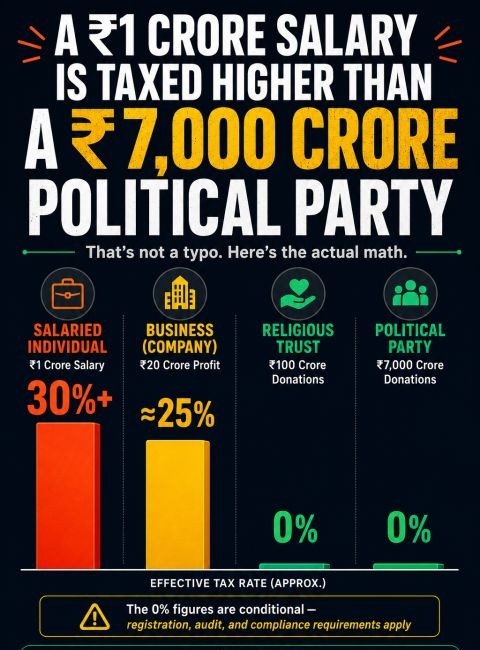
Provocative comparison of effective tax rates across different types of entities in India and highlights how a high-income salaried individual can face a higher tax burden than certain organizations that may qualify for tax exemptions.
Salaried Individual:
Salary Income: INR 1 crore, Tax Rate Shown: 30%+. above suggests that an individual earning ₹1 crore as salary falls in the highest income-tax slab and may pay tax at rates exceeding 30% after surcharge and cess.
Business Company:
Profit: INR 20 Crore and Tax Rate Shown: ≈25%. above highlights that domestic companies may be taxed at concessional corporate tax rates, resulting in an effective tax burden lower than that of high-income salaried individuals.
Religious Trust:
Donations Received: ₹100 Crore and Tax Rate Shown: 0% above indicates that registered charitable or religious trusts can claim tax exemptions on qualifying income, subject to compliance with Income Tax Act provisions.
Political Party:
Donations Received: INR 7000 Crore and Tax Rate Shown: 0%. Recognized political parties can claim exemption on income, including donations, subject to prescribed conditions such as maintaining books of account, audit requirements, and reporting obligations.
“The 0% figures are conditional—registration, audit, and compliance requirements apply.” This is a crucial point because neither religious trusts nor political parties automatically enjoy tax exemption.
- Religious Trusts: Tax exemptions generally depend upon registration under applicable provisions of the Income Tax Act, application of income for charitable/religious purposes, and maintenance of books of account. and audit and return filing requirements.
- Political Parties: Tax exemptions are generally subject to registration as a political party, maintenance of prescribed records, audit requirements, filing of contribution reports and income tax returns, and compliance with election and tax laws. primarily comparing income amounts. Instead, it is comparing effective tax treatment of different categories:
| Category | Income/Receipts | Tax Treatment (as shown) |
|---|---|---|
| Salaried Individual | INR 1 Crore Salary | Highest slab tax rate |
| Company | INR 20 Crore Profit | Corporate tax rate |
| Religious Trust | INR 100 Crore Donations | Potential exemption subject to conditions |
| Political Party | INR 7,000 Crore Donations | Potential exemption subject to conditions |
The underlying argument is that salary income is generally taxed directly at slab rates. Companies may enjoy lower corporate tax rates. Certain exempt entities can pay little or no tax if statutory conditions are satisfied.
Key Tax Law Perspective comparison of effective tax rates across different types of entities in India
- Here is a simplified complex subject. The comparison should not be interpreted to mean that Every religious trust pays 0 tax. Every political party pays 0 tax. Corporate tax is always 25%. A INR 1 crore salaried person always pays exactly 30%.
- Actual tax liability depends on Applicable tax provisions, Surcharge and cess, Exemptions and deductions, Registration status, audit compliance, and Nature and utilization of funds
Tax liability is determined not only by the amount of money received but also by the legal nature of the recipient and the specific tax framework applicable to that recipient. A salaried individual, a company, a charitable/religious trust, and a political party are taxed under entirely different provisions of the law.