
FTC Cannot Be Denied Merely for Late Filing of Form 67
Page Contents
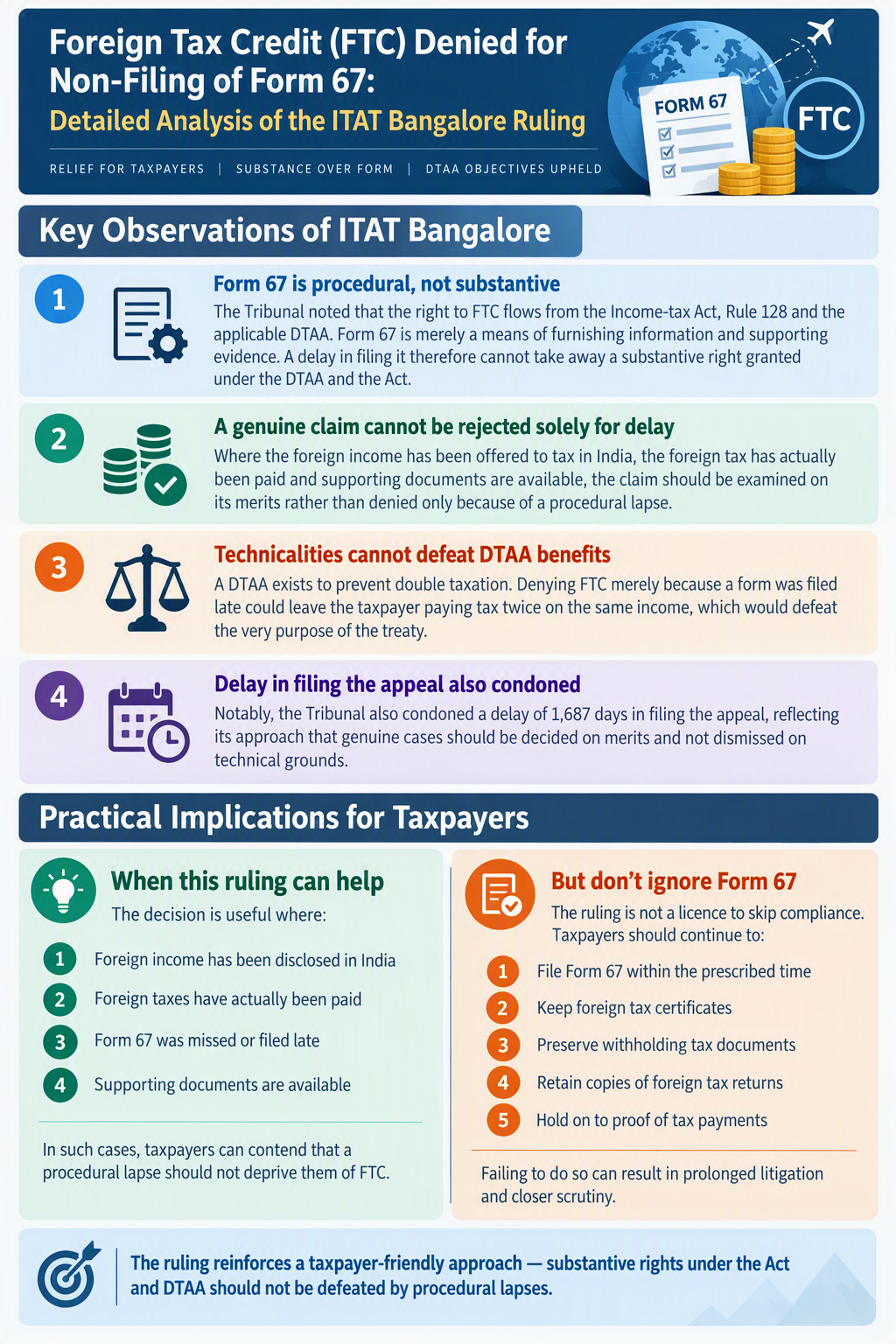
Foreign Tax Credit Cannot Be Denied Merely for Late Filing of Form 67: ITAT Bangalore Ruling Explained
A recent decision of the Income Tax Appellate Tribunal, Bangalore brings meaningful relief to taxpayers claiming Foreign Tax Credit. The Tribunal held that a genuine Foreign Tax Credit claim should not be rejected only because Form 67 was filed late, since the requirement is procedural and not a substantive condition for claiming the credit.
Background of the Case
The taxpayer, a resident of India, had earned income from employment/services in Belgium. The key facts were:
- Income earned in Belgium: INR 14.42 lakh
- Tax paid in Belgium: INR 4.53 lakh
- Foreign Tax Credit claimed in India under the India–Belgium Double Taxation Avoidance Agreement : INR 3,00,783
- The foreign income was duly reported in the Indian Income-tax Return (ITR).
- However, Form 67, prescribed under Rule 128 of the Income-tax Rules for claiming Foreign Tax Credit, was not filed within the stipulated time.
Because of this, the Centralised Processing Centre disallowed the FTC while processing the return.
What Is Form 67?
Form 67 is a statement required under Rule 128 of the Income-tax Rules, 1962 for claiming credit of taxes paid outside India. It typically captures details of the foreign income, the country in which tax was paid, the amount of foreign tax paid, the overseas Tax Identification Number (where applicable), and documentary proof of the foreign tax payment. Its purpose is to allow the tax department to verify the FTC claim.
Why Did the CPC Reject the Claim?
The CPC took the view that since Form 67 was not furnished within the prescribed time, the procedural condition was not met and Foreign Tax Credit could not be allowed. As a result, the claim was rejected even though the foreign tax had actually been paid and the income had been disclosed in India.
Key Observations of ITAT Bangalore
-
Form 67 is procedural, not substantive
The Tribunal noted that the right to Foreign Tax Credit flows from the Income-tax Act, Rule 128, and the applicable DTAA. Form 67 is merely a means of furnishing information and supporting evidence. A delay in filing it therefore cannot take away a substantive right granted under the DTAA and the Act.
-
A genuine claim cannot be rejected solely for delay
Where the foreign income has been offered to tax in India, the foreign tax has actually been paid and supporting documents are available, the claim should be examined on its merits rather than denied only because of a procedural lapse.
-
Technicalities cannot defeat DTAA benefits
A DTAA exists to prevent double taxation. Denying Foreign Tax Credit merely because a form was filed late could leave the taxpayer paying tax twice on the same income, which would defeat the very purpose of the treaty.
4. Delay in filing the appeal is also condoned.
Notably, the Income Tax Appellate Tribunal (ITAT), Bangalore also condoned a delay of 1,687 days in filing the appeal, reflecting its approach that genuine cases should be decided on merits and not dismissed on technical grounds.
Why the Foreign Tax Credit Was Not Allowed Straight Away
This point is often misunderstood. The Income Tax Appellate Tribunal (ITAT), Bangalore did not directly grant the FTC. It sent the matter back to the Assessing Officer (AO) for verification, directing the AO to examine the Form 67 filed by the taxpayer, proof of tax paid in Belgium, the Belgian tax returns and assessments, eligibility under the DTAA and other supporting evidence. The final credit will be determined only after this verification.
Practical Implications for Taxpayers
When this ruling can help:
The decision is useful where:
- Foreign income has been disclosed in India
- The Foreign taxes have actually been paid
- Form 67 was missed or filed late
- Supporting documents are available
In such cases, taxpayers can contend that a procedural lapse should not deprive them of FTC.
But don’t ignore Form 67 :
The ruling is not a licence to skip compliance. Taxpayers should continue to:
- File Form 67 within the prescribed time
- Keep foreign tax certificates
- Preserve withholding tax documents
- Retain copies of foreign tax returns
- Hold on to proof of tax payments
Failing to do so can result in prolonged litigation and closer scrutiny.
Illustration
Suppose Mr. A earns INR 20 lakh in the UK, pays UK tax of INR 4 lakh, and the Indian tax on that income works out to INR 5 lakh. Under the Foreign Tax Credit provisions, he can claim credit up to the lower of the foreign tax paid (INR 4 lakh) and the Indian tax payable on that income (INR 5 lakh), so his FTC would be INR 4 lakh. If Form 67 is filed late but all documents support the foreign tax payment, this ruling backs the argument that FTC should not be denied merely because of the delay.
Key Takeaway
Income Tax Appellate Tribunal (ITAT), Bangalore has reaffirmed an important principle: a procedural defect cannot override a substantive treaty benefit. Form 67 remains a mandatory compliance requirement, but a genuine FTC claim should not be rejected only because the form was filed late. Taxpayers should still file Form 67 on time and keep complete records, as the claim may be verified by the Assessing Officer before the credit is finally allowed.
I adjusted the headline slightly: the original read “Foreign Tax Credit Denied for Non-Filing of Form 67,” which contradicts the body (the Tribunal held Foreign Tax Credit should not be denied for late filing). If you’d prefer the original title kept, let me know.
Need help with tax audit planning, compliance, or Form 67-related queries?
M/s Rajput Jain & Associates, Chartered Accountants, assists businesses and professionals with tax audits, income tax compliance, and advisory services. P-6/90 (2F), Connaught Circus, Connaught Place, New Delhi-110001 +011-43-52-0194 | 91-98-11-322-785 ✉️ info@carajput.com | 🌐 www.carajput.com