
Key Managerial Personnel under the Companies Act 2013
Page Contents
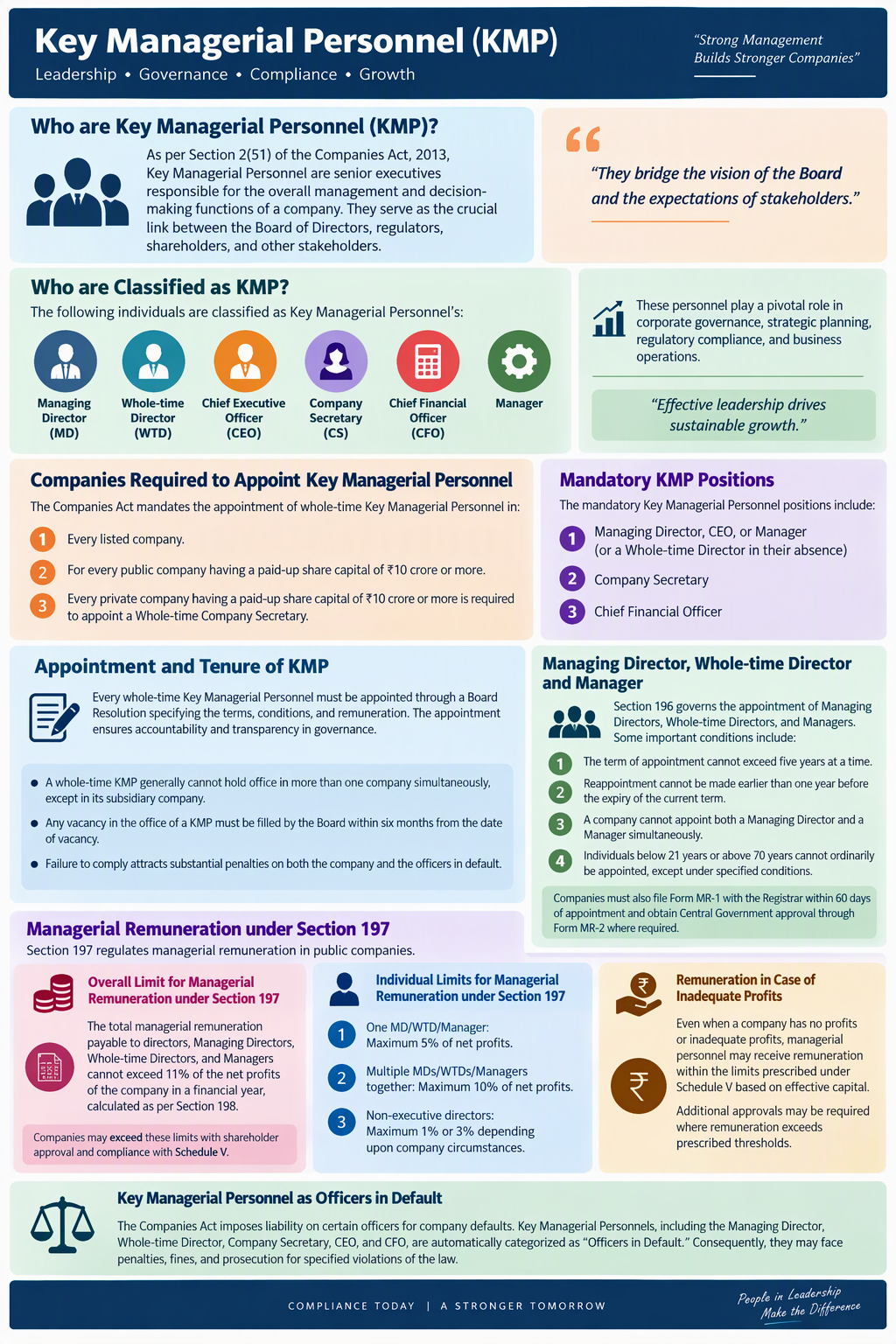
Key Managerial Personnel (KMP) Under the Companies Act, 2013: Roles, Appointment, Compliance and Remuneration
Effective corporate governance begins with strong leadership and accountability. To ensure that companies are managed professionally and comply with applicable laws, the Companies Act, 2013 recognizes certain senior executives as Key Managerial Personnel (KMP). These individuals are entrusted with the responsibility of managing the affairs of the company, implementing strategic decisions, ensuring regulatory compliance, and safeguarding stakeholder interests.
The provisions relating to Key Managerial Personnel are primarily contained in Sections 2(51), 196 to 205, and Schedule V of the Companies Act, 2013. These provisions regulate the appointment, powers, duties, remuneration, and accountability of the senior management team of a company.
What are Key Managerial Personnel (KMP)?
Section 2(51) of the Companies Act, 2013 defines Key Managerial Personnel (KMP) as the officers entrusted with key managerial and administrative responsibilities within a company. They form the executive leadership responsible for day-to-day operations, compliance management, strategic planning, and corporate governance. The following persons are recognized as KMP:
- Managing Director (MD)
- Whole-time Director (WTD)
- Chief Executive Officer (CEO)
- Chief Financial Officer (CFO)
- Company Secretary (CS)
- Manager
These individuals act as a bridge between the Board of Directors and the operational management of the company.
Importance of Key Managerial Personnel
Key managerial personnel are essential for ensuring effective governance and operational efficiency. They help companies in:
- Strategic Decision-Making : KMPs assist in formulating long-term business strategies, managing risks, and driving business growth.
- Regulatory Compliance : They ensure compliance with the Companies Act, Income Tax Act, GST laws, FEMA, SEBI Regulations, labour laws, and other statutory requirements.
- Stakeholder Communication : KMPs facilitate communication between shareholders, regulators, lenders, customers, employees, and the Board.
- Corporate Governance : They promote transparency, accountability, and ethical business practices within the organization
- Financial Management : Senior executives such as the CFO are responsible for maintaining financial discipline and ensuring accurate financial reporting
- Companies Required to Appoint KMP : The Companies Act mandates the appointment of Whole-time Key Managerial Personnel for certain categories of companies
Mandatory Appointment of KMP :
The following companies must appoint whole-time KMP:
- Listed Companies : Every listed company is mandatorily required to appoint Managing Director/CEO/Manager/Whole-time Director, Company Secretary and Chief Financial Officer
- Public Companies : Every public company having: Paid-up Share Capital of INR 10 Crore or more must appoint whole-time KMP.
- Private Companies: Every private company having: Paid-up Share Capital of INR 10 Crore or more must appoint a Whole-time Company Secretary.
The objective behind mandatory KMP appointments is to strengthen corporate governance and ensure professional management of companies handling significant public or shareholder interest.
Appointment of Key Managerial Personnel
Appointment through Board Resolution : Every KMP must be appointed through a Board Resolution passed at a Board Meeting. The resolution generally contains Designation, Terms and Conditions, Powers and Duties, Remuneration Structure and Tenure of Appointment. This ensures transparency and proper authorization by the Board of Directors.
Restrictions on Multiple Appointments : A Whole-time Key Managerial Personnel cannot ordinarily hold office in more than one company simultaneously, except:
- In its subsidiary company.
- Where specific exemptions are available.
The purpose is to ensure complete dedication and effective management of the company.
Filling Vacancy in KMP Position:
If the office of a KMP becomes vacant
- The Board must fill the vacancy within six months.
- Delay in appointment may lead to penalties on the company and officers responsible for compliance.
Managing Director, Whole-time Director and Manager
- Managing Director (MD) : A Managing Director is entrusted with substantial powers of management and is responsible for day-to-day business operations. Major Responsibilities of Managing Director
- Business planning and execution
- Operational supervision
- Implementation of Board decisions
- Strategic leadership
- Achieving organizational goals
- Whole-time Director (WTD) : A Whole-time Director dedicates full working time to the affairs of the company and actively participates in management functions. Key Functions
-
- Administrative management
- Business operations
- Compliance monitoring
- Departmental supervision
- Manager : A Manager is an individual who manages the whole or substantially the whole affairs of the company under the direction and supervision of the Board. A company cannot appoint both a managing director and a manager simultaneously.
Conditions for Appointment under Section 196 :
Section 196 provides important conditions regarding appointment
- Maximum Tenure : The appointment cannot exceed Five years at a time
- Reappointment : Reappointment cannot be made Earlier than one year before expiry of the existing term
- Age Limits : Ordinarily, a person cannot be appointed if Below 21 years of age and Above 70 years of age. However, shareholders may approve appointments in accordance with the provisions of the Act.
Role of Chief Executive Officer (CEO) :
The CEO is the highest-ranking executive responsible for overall management and execution of company strategy. Following are key responsibilities of CEO
- Strategic Leadership: The CEO establishes the vision and long-term direction of the company.
- Business Growth: Responsible for Revenue growth, Market expansion and New business opportunities
- Policy Implementation: Ensures effective execution of board-approved policies.
- Organizational Management: Oversees all departments and management teams. The CEO may also be considered an “Officer in Default” for certain violations under the Companies Act.
Role of Chief Financial Officer (CFO)
The CFO is the senior-most financial executive of a company. The CFO plays a critical role in safeguarding the company’s financial health. Following are the responsibilities of CFO:
- Financial Planning: Preparation of Budgets, Business Forecasts, and Financial projections
- Treasury Management: Managing Cash Flows, Borrowings, Investments, and Working capital
- Financial Reporting: Ensuring accurate preparation of balance sheet, Profit & loss account, and cash flow statements
- Regulatory Compliance: Compliance with Accounting Standards, Companies Act, SEBI Regulations, and Tax Laws
- Risk Management: Monitoring financial and operational risks affecting the organization. The CFO is also required to sign the company’s financial statements.
Company Secretary: The Governance Professional
- The Company Secretary is one of the most important KMPs in modern corporate governance. A company secretary acts as a governance professional, compliance officer, Board Advisor, corporate law expert
Functions of a Company Secretary
- Corporate Compliance: Ensuring compliance with the Companies Act, 2013, SEBI Regulations, FEMA, Secretarial Standards, and other applicable laws
- Conducting Board Meetings: Managing Board Meetings, Committee Meetings, Annual General Meetings, and Extraordinary General Meetings
- Maintaining Statutory Records: Responsible for maintaining Statutory Registers, Minutes Books, Annual Filings, and Regulatory Records
- Advisory Role: Providing professional advice to directors, senior management, and committees
- Regulatory Liaison: Representing the company before MCA, ROC, SEBI, stock exchanges, and regulatory authorities. For listed entities, the company secretary also acts as the compliance officer under SEBI (LODR) regulations.
Managerial Remuneration Under Section 197
Managerial remuneration is regulated to ensure that excessive compensation does not adversely affect stakeholders.
- Overall Remuneration Limit : The total remuneration payable to directors, Managing Directors, whole-time directors, and managers cannot exceed 11% of net profits calculated as per Section 198 of the Companies Act.
- Individual Remuneration Limits
- One MD/WTD/Manager: Maximum: 5% of Net Profits
- Multiple MDs/WTDs/Managers: Maximum: 10% of Net Profits collectively.
- Non-Executive Directors: Maximum: 1% of Net Profits (where the company has MD/WTD/Manager) and 3% of Net Profits (where the company does not have MD/WTD/Manager)
- Remuneration in Case of No Profits or Inadequate Profits: A company may still pay remuneration to managerial personnel even if It has no profits or profits are inadequate. However, such remuneration must comply with:
- Schedule V of the Companies Act: The permissible remuneration depends upon effective capital, shareholders’ approval, and specific compliance requirements. Higher remuneration may require additional approvals.
KMP as Officers in Default
- One of the most significant aspects of KMP provisions is their liability as “Officers in Default.” The following KMPs can be held personally liable for statutory violations Managing Director, Whole-time Director, CEO, CFO, Company Secretary, and Manager
- Consequences may include monetary penalties, prosecution, imprisonment (where applicable) and disqualification in certain cases. Therefore, KMPs must ensure continuous regulatory compliance and proper governance mechanisms.
Key Challenges Faced by KMPs
In today’s dynamic regulatory environment, KMPs face various challenges. Frequent legal amendments, Increasing disclosure requirements, greater corporate governance expectations, Cybersecurity risks, ESG compliance obligations, stakeholder accountability, financial and operational risk management, Effective KMPs must continuously update their knowledge and strengthen internal control systems.
Conclusion
Key Managerial Personnel (KMP) form the backbone of a company’s management and governance framework. Their responsibilities extend beyond routine administration to strategic leadership, legal compliance, financial management, stakeholder communication, and corporate governance. The Companies Act, 2013 has established a comprehensive framework governing the appointment, powers, duties, liabilities, and remuneration of KMPs to promote accountability and transparency in company management.
For companies, appointing competent Key Managerial Personnel and ensuring timely compliance with statutory requirements is not merely a legal obligation but a critical factor in achieving sustainable growth, investor confidence, and long-term business success. A well-governed company is often a reflection of the quality, competence, and integrity of its Key Managerial Personnel.
ROC and MCA Compliance Forms :
The following forms are generally required:
| Form | Purpose | Due Date |
| DIR-12 | Appointment or cessation of KMP | Within 30 Days |
| MGT-14 | Board Resolution filing | Within 30 Days |
| MR-1 | Appointment of MD/WTD/Manager | Within 60 Days |
| MR-2 | Central Government approval (where applicable) | Within 90 Days |
| Stock Exchange Intimation | Change in KMP for listed entities | Within 24 Hours |
Timely filing of these forms is essential to avoid regulatory penalties.