
SC Protect CA: Issue 15CB Certificate Isn’t Money Laundering
Page Contents

Supreme Court Ruling protecting practicing CA’s on issuing form 15cb is not money laundering under PMLA
The Supreme Court has delivered an important ruling protecting practicing chartered accountants from unwarranted criminal prosecution under the Prevention of Money Laundering Act (PMLA). This recent Supreme Court ruling brings significant clarity for chartered accountants. The Court has held that issuing Form 15CB under the Income Tax Act does not amount to abetment of money laundering under PMLA. This means that CAs performing their statutory duty of certifying foreign remittances are not liable for criminal charges related to money laundering.
Background of the Case
A chartered accountant issued a certificate under Form 15CB for foreign remittances connected with imports of goods. Later, the ED alleged that the company had illegally transferred funds overseas & claimed the chartered accountant had abetted money laundering under the PMLA. Following the verdict of the Madras High Court’s Finding. Key Points from the Madras High Court’s Reasoning Judgment.
A CA had certified Form 15CB for outward remittances related to import of goods, a standard compliance requirement by banks. Later, the Enforcement Directorate alleged that the importing company was involved in illegal foreign transfers and attempted to prosecute the CA under Prevention of Money Laundering Act for issuing the certificate.
Madras High Court’s Reasoning (Affirmed by SC):
The Madras High Court had granted relief to the CA, making critical observations that a Chartered Accountant issuing Form 15CB is not required to verify the genuineness of every document submitted by the client. The High Court had granted relief to the CA, making critical observations that a chartered accountant is not required to verify the genuineness of every document provided by the client for issuing Form 15CB.
The role of a chartered accountant while issuing Form 15CB is similar to that of a panel lawyer who gives a legal opinion on title documents but is not responsible for verifying their authenticity. Professionals performing statutory duties cannot be prosecuted merely because the client later turns out to be involved in wrongdoing.
Supreme Court’s Stand : on CA’s on issuing form 15cb
The Supreme Court of India upheld the High Court’s reasoning in the case (SLP (Criminal) Diary No. 8123/2024) by dismissing the Enforcement Directorate’s appeal. It reaffirmed that issuing Form 15CB, in compliance with statutory tax obligations, does not constitute abetment of money-laundering unless there is evidence of conscious involvement or intent.
Supreme Court Clarifies CA’s Role in Issuing Form 15CB

Performing Statutory Duty ≠ Criminal Liability : The Supreme Court has upheld that merely issuing Form 15CB, as required under the Income Tax Act for foreign remittances, does not amount to abetment or assistance in money laundering.
Significance of SC Court Decision on Issuing Form 15CB Isn’t Money Laundering:
- SC Court Decision on Issuing Form 15CB Isn’t Money Laundering highlights that liability will depend on the degree of involvement, intent, or knowledge of wrongdoing not mere certification or compliance act.
- This judgement offers important reassurance for practicing CA’s, confirming they won’t automatically be held criminally liable under Prevention of Money Laundering Act, 2002 for performing their statutory duties.
- The Supreme Court of India’s court decision reinforces professional independence and delineation of practicing Chartered Accountants’ roles: doing one’s due certification work is distinct from investigations into underlying fraud or illegal transactions.
- Honrable Supreme Court upheld the above reasoning & confirmed that “A CA cannot be held criminally liable under Prevention of Money Laundering Act merely for issuing Form 15CB in good faith as part of his professional role”
This judgment provides much-needed clarity and protection to practicing professionals, especially CAs who perform statutory certifications based on documents furnished by clients. It reinforces that professional duties under tax law cannot be stretched into criminal liability under the Prevention of Money Laundering Act unless active involvement or knowledge is proven.
Foreign Remittances Under the Income Tax Department’s Scanner
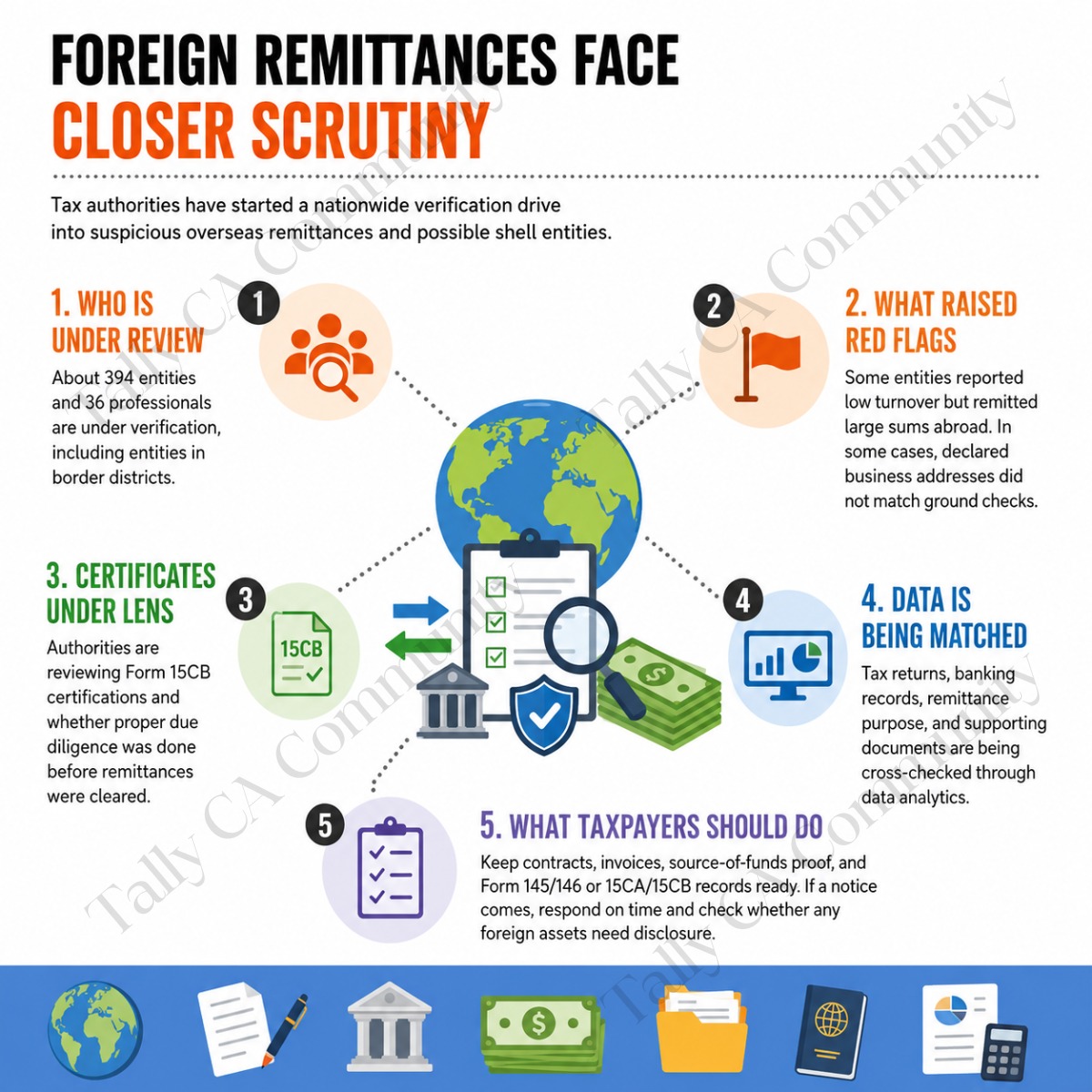
The Tax Dept. has initiated a nationwide verification drive targeting suspicious foreign remittances and the entities and professionals associated with them. The exercise highlights the increasing use of data analytics and cross-verification mechanisms in tax administration.
Key Findings from the Verification Drive
- 394 entities and 36 professionals are currently under verification, including 117 entities located in land-border States.
- Several entities with low turnover, negligible business activity, or non-filing status were found to have remitted substantial amounts overseas.
- In certain cases, the stated purpose of remittance appeared inconsistent with the financial profile and business activities of the remitter.
- Authorities have identified a small group of professionals who issued an unusually high number of Form 15CB certifications, leading to closer scrutiny.
Form 15CB (Now Form 146 under the Income-tax Act, 2025)
- Professionals should note that Form 15CB/Form 146 is not a mere procedural formality. Before certification, adequate due diligence should be undertaken, including verification of:
- Nature and taxability of the remittance.
- Underlying agreements, contracts, invoices, and supporting documents.
- Applicability of relevant DTAA provisions.
- Consistency with books of account, income tax returns, and banking records.
What Taxpayers Should Do
- Maintain complete documentation supporting foreign remittances.
- Preserve contracts, invoices, source-of-funds evidence, and Form 15CA/15CB (or Form 145/146, as applicable).
- Ensure that remittance purposes align with business records and tax filings.
- Respond promptly to any departmental notices or verification requests.
Takeaway
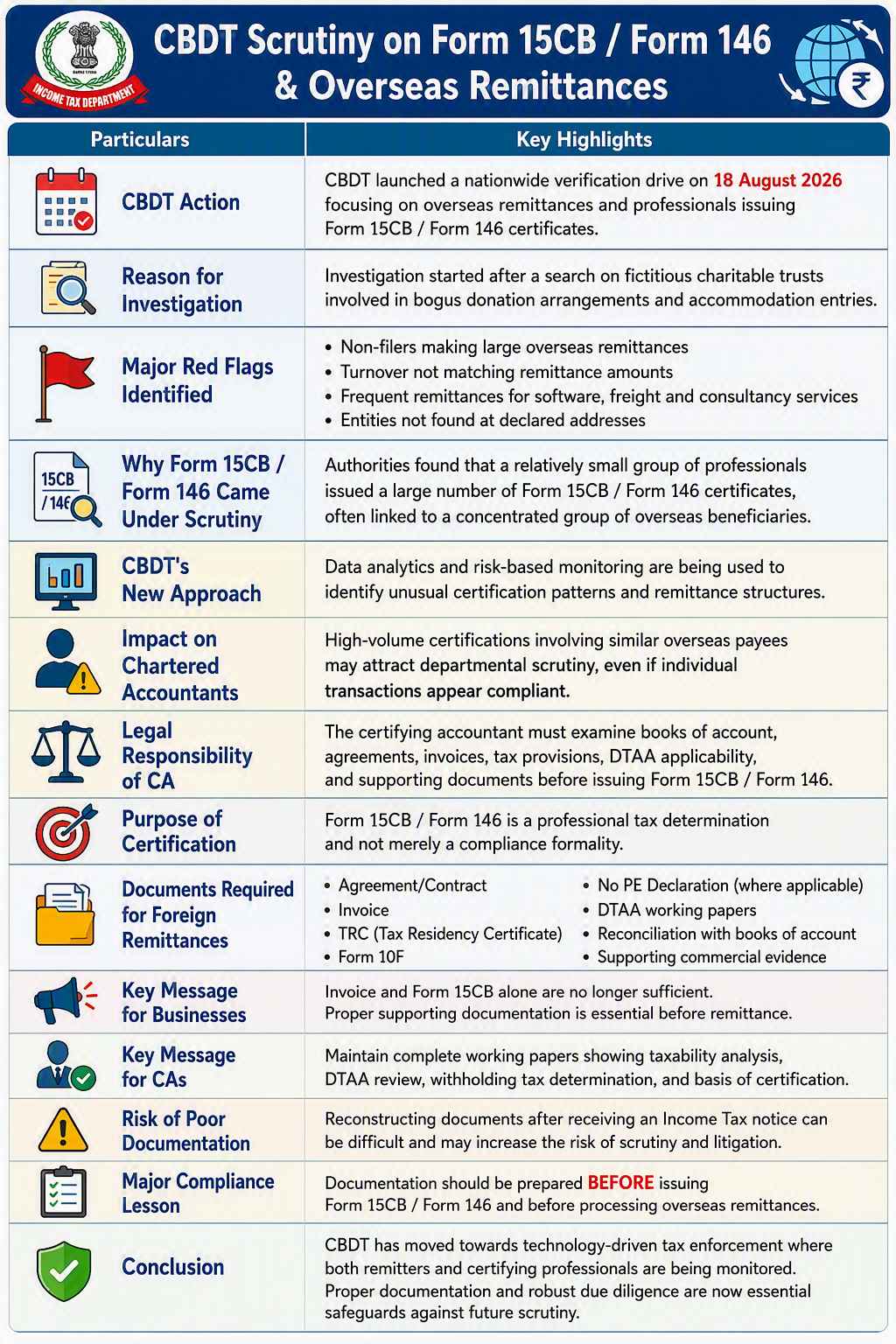
The Department is increasingly leveraging data analytics, banking information, tax return data, and remittance records to identify inconsistencies. Any mismatch between remittance transactions, underlying documentation, and tax filings can become a trigger for scrutiny. Proper documentation and due diligence have never been more important.
While this is a welcome relief, Rajput Jain and Associates continue to emphasize the importance of maintaining proper documentation and compliance with RBI and FEMA regulations for all foreign remittances. For any queries or assistance regarding Form 15CB or related compliance, please feel free to reach out. us at : 9555 555 480