
Private Placement vs Preferential Allotment: Complete Guide
Page Contents
Private Placement vs Preferential Allotment: Detailed Explanation
In this blog we compare Private Placement (Section 42) and Preferential Allotment (Section 62(1)(c)) under the Companies Act, 2013, along with applicable SEBI regulations for listed companies. A common misconception is that both terms mean the same thing. While they are related methods of raising capital from selected investors, they have different legal requirements and compliance obligations.
What is Private Placement?
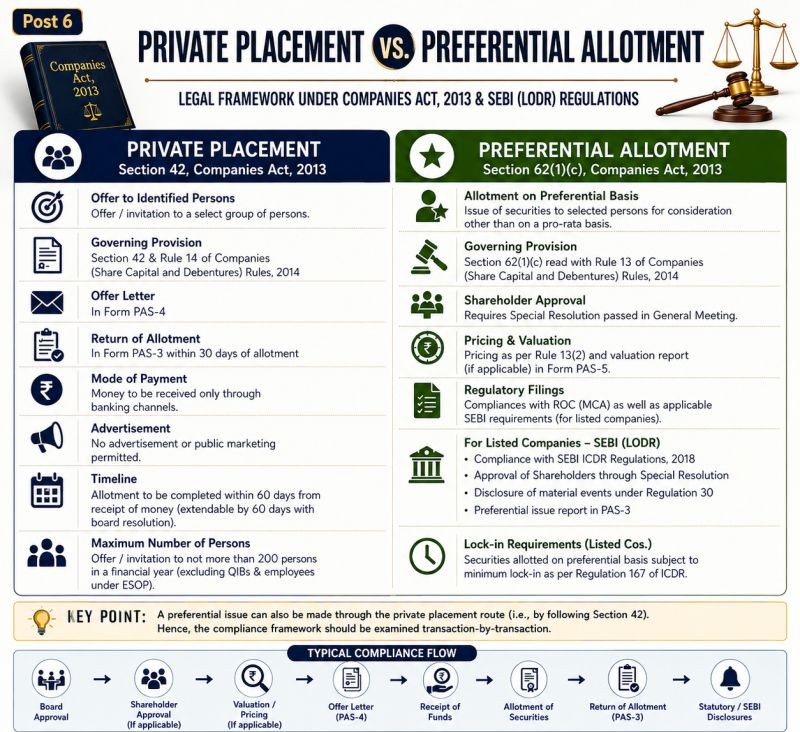
Private placement is governed by Section 42 of the Companies Act, 2013. It refers to an offer or invitation made by a company to subscribe to securities to a select group of identified persons, rather than offering securities to the public at large. Key Features of Private Placement
- Offer to Identified Persons: Securities can be offered only to specifically identified persons. And public invitations are prohibited.
- Governing Provisions: Section 42 of Companies Act, 2013, and Rule 14 of Companies (Prospectus and Allotment of Securities) Rules, 2014
- Offer Letter: Must be issued in Form PAS-4.
- Return of Allotment: Must file Form PAS-3 with ROC within 30 days of allotment.
- Mode of Payment: Subscription money must come through banking channels; checks, demand drafts, and electronic transfers and cash payments are not permitted.
- Advertisement Restriction: No public advertisement and no marketing through mass media.
- Timeline: Securities must be allotted within 60 days from receipt of application money. and If allotment is not completed, money must be refunded.
- Maximum Number of Persons : Maximum 200 persons in a financial year for each type of security. Excludes Qualified Institutional Buyers (QIBs) and Employees under ESOP schemes
What is Preferential Allotment?
Preferential Allotment is governed by Section 62(1)(c) of the Companies Act, 2013. It refers to the issue of shares or securities to selected persons on a preferential basis instead of distributing them proportionately among existing shareholders. Key Features of Preferential Allotment
- Allotment on Preferential Basis: The company chooses specific investors and allots securities to them. Examples: Promoters, Strategic investors, Private equity investors and Venture capital investors
- Governing Provisions: Section 62(1)(c), Rule 13 of Companies (Share Capital and Debentures) Rules, 2014
- Shareholder Approval: Requires Special Resolution and Approval in General Meeting
- Pricing and Valuation: Issue price must comply with valuation norms. A valuation report may be required to justify Fair Value and Issue Price
- Regulatory Filings : Companies must comply with ROC requirements, MCA filings and SEBI requirements (for listed companies)
Additional Requirements for Listed Companies
SEBI (ICDR) Regulations, 2018: Key requirements include the following:
- Shareholder approval through Special Resolution
- Disclosure of material events
- Pricing formula prescribed by SEBI
- Preferential issue disclosures
Lock-in Requirements
A unique feature of preferential allotment is the lock-in requirement. Shares allotted through a preferential issue may be subject to mandatory lock-in periods under SEBI regulations. This prevents the immediate sale of securities and promotes stability.
Differences Between Private Placement and Preferential Allotment
| Particulars | Private Placement | Preferential Allotment |
|---|---|---|
| Governing Section | Section 42 | Section 62(1)(c) |
| Purpose | Raising funds from select investors | Issue of securities to selected persons on preferential basis |
| Offer Letter | PAS-4 mandatory | Not specifically PAS-4 unless routed through private placement |
| Maximum Investors | 200 persons limit | No specific 200-person condition under Section 62(1)(c) itself |
| Shareholder Approval | Generally by Special Resolution in many cases | Special Resolution mandatory |
| Valuation Requirement | Depends on security issued | Valuation generally required |
| Advertisement | Not permitted | Not a public issue |
| Return of Allotment | PAS-3 | PAS-3 |
| Lock-in Requirement | Usually not applicable | Applicable for listed companies under SEBI regulations |
A Preferential Allotment Can Also Be Made Through Private Placement Route
This is the most important takeaway. A preferential issue can also be made through the private placement route by complying with Section 42. Therefore, in many transactions: Section 42 (Private Placement) and Section 62(1)(c) (Preferential Allotment). must be complied with simultaneously.
Typical Compliance Flow
following compliance sequence:
- Step-1: Board Approval
- Step-2: Shareholders’ Approval (if applicable)
- Step 3: Valuation / Pricing Determination
- Step-4 : Issue Offer Letter (PAS-4)
- Step 5: Receipt of Subscription Money
- Step-6: Allotment of Securities
- Step-7: File PAS-3 (Return of Allotment)
- Step-8: Make Statutory / SEBI Disclosures
Practical Example of Private Placement & Preferential Allotment
- Private Placement: ABC Pvt Ltd offers shares to 50 identified investors and issues PAS-4. Section 42 applies.
- Preferential Allotment: XYZ Ltd. issues shares exclusively to a private equity fund at a negotiated price after obtaining a special resolution and valuation report. Section 62(1)(c) applies.
Preferential Allotment Through Private Placement
- A listed company allots shares to promoters and strategic investors. Here Section 42 applies, Section 62(1)(c) applies, and SEBI ICDR Regulations apply.
- Private placement focuses on the method of offering securities to selected persons, while preferential allotment focuses on the manner of allotment to specific investors on a preferential basis.
- In practice, many preferential issues are carried out through the private placement route, requiring compliance with Section 42, Section 62(1)(c), ROC filings, valuation requirements, and SEBI regulations (for listed entities).
Key Takeaway on Private Placement & Preferential Allotment
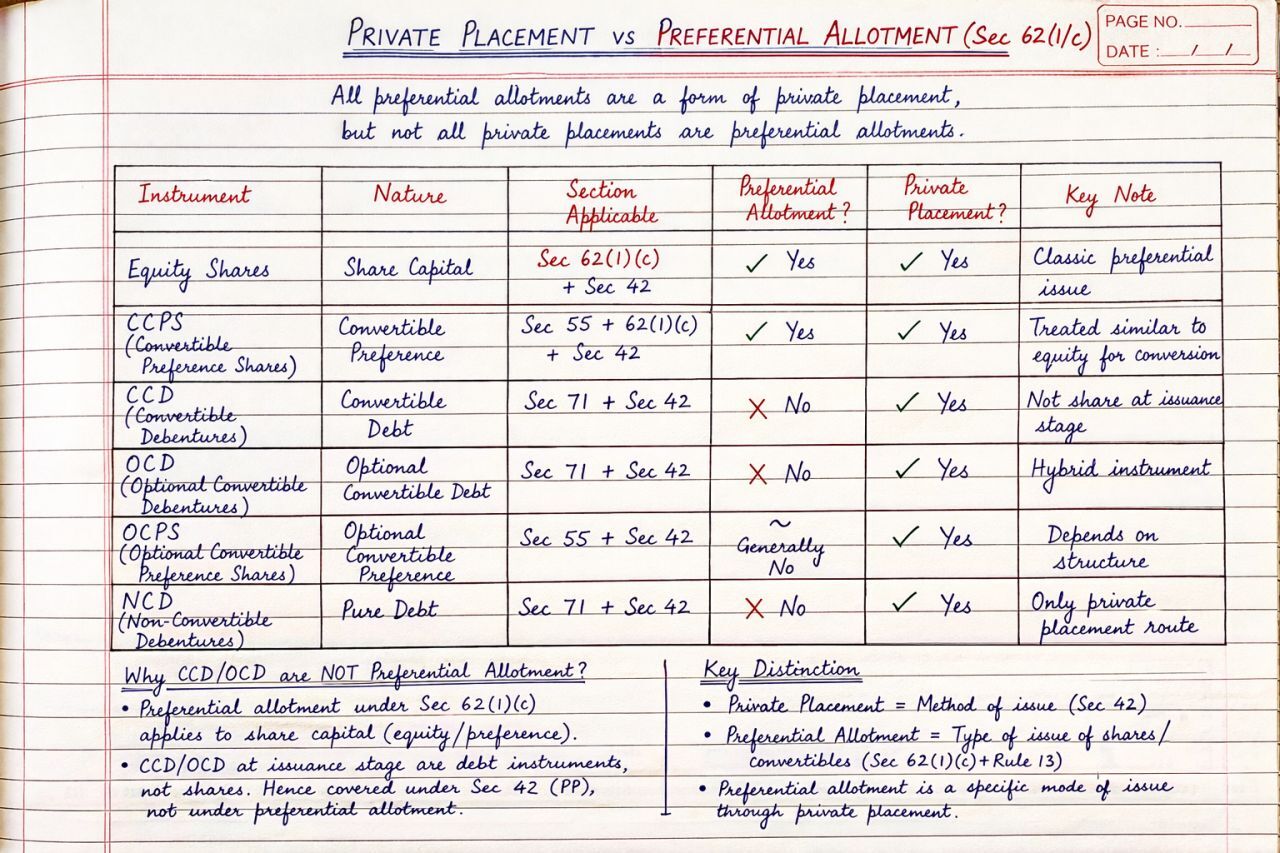
Private placement is the broader fund-raising mechanism under Section 42 covering various securities. Preferential Allotment under Section 62(1)(c) is a specific mode of issuing shares to selected investors.
- Section 42 = “How securities are offered”
- Section 62(1)(c) = “How shares are allotted”
Every preferential allotment of shares is typically carried out through the private placement route, but every private placement is not a preferential allotment because private placement can also involve debentures and other securities.
Quick Comparison in Private Placement & Preferential Allotment
| Basis | Section 42 (Private Placement) | Section 62(1)(c) (Preferential Allotment) |
|---|---|---|
| Governs | Mechanism of issue | Manner of allotment |
| Keyword | Securities | Shares |
| Scope | Broad | Narrow |
| Covers Debentures | Yes | No |
| Covers Equity Shares | Yes | Yes |
| Covers Preference Shares | Yes | Yes |
| Special Resolution | Depending on circumstances | Mandatory |
| PAS-4 | Applicable | Through Section 42 route |
| Maximum 200 Persons | Applicable | Via Section 42 compliance |