
Prevention of Sexual Harassment at Workplace & Compliance
Page Contents
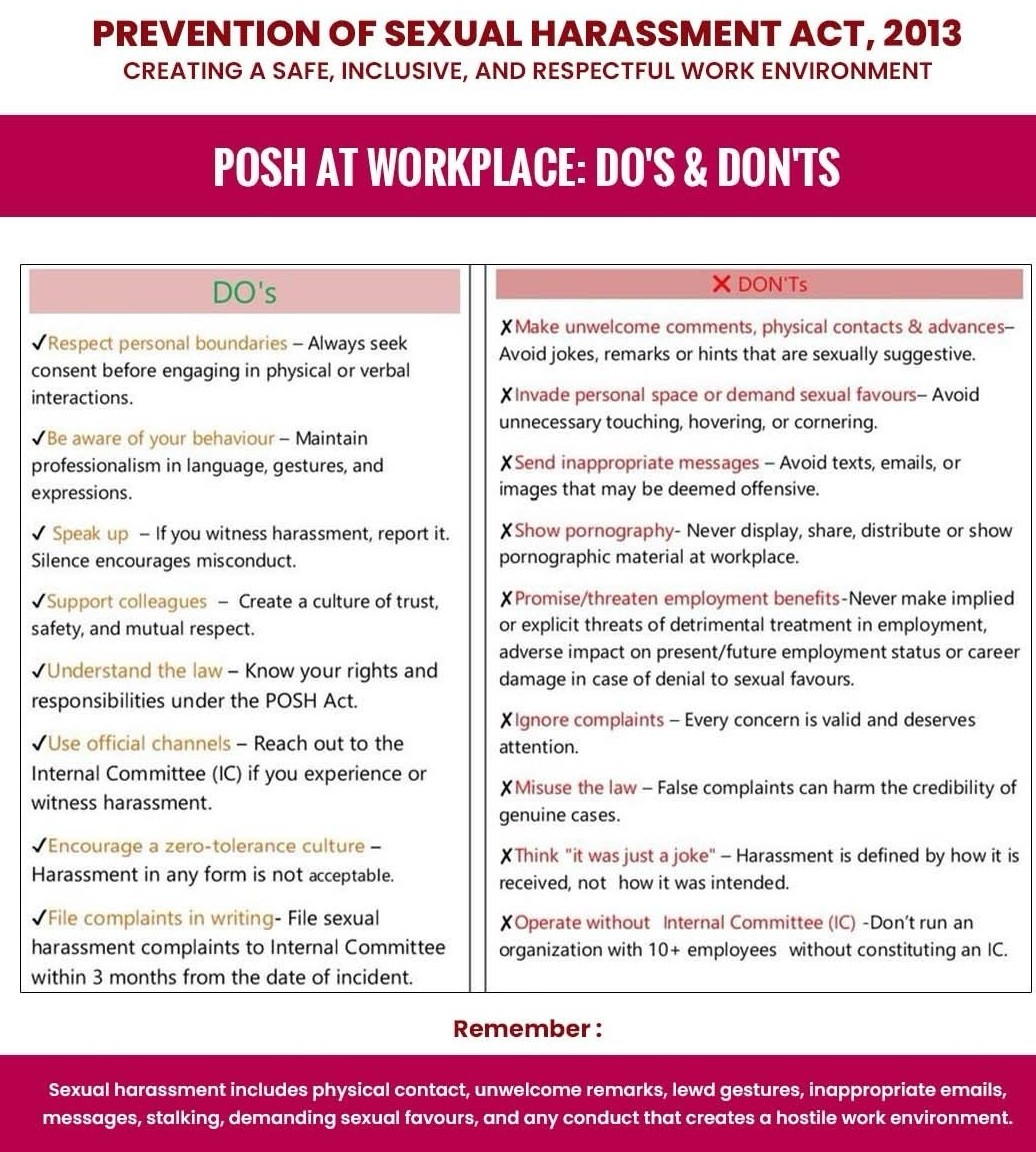
Prevention of Sexual Harassment at the Workplace: Beyond Compliance Towards a Culture of Dignity and Respect
Introduction
The workplace has undergone a remarkable transformation over the past few decades. It is no longer merely a place where individuals earn a livelihood; it has evolved into a space where ideas are exchanged, careers are built, and professional relationships are nurtured. For an organisation to truly flourish, it must ensure that every employee works in an environment free from fear, discrimination, and harassment.
Sexual harassment at the workplace strikes at the very foundation of an individual’s dignity and equality. It affects not only the physical and emotional well-being of the aggrieved person but also erodes trust, lowers productivity, and adversely impacts organisational culture. Recognising the need to address this issue comprehensively, Parliament enacted the Sexual Harassment of Women at Workplace (Prevention, Prohibition and Redressal) Act, 2013 (“POSH Act”), thereby creating a robust legal framework for ensuring safer and more inclusive workplaces.
The legislation signifies a paradigm shift in the approach to workplace governance by placing equal emphasis on prevention, prohibition, and redressal. It seeks to ensure that organisations do not merely react to incidents of harassment but proactively create an environment founded on respect and equality.
Evolution of the Law: From Vishaka Guidelines to the POSH Act
The origins of the POSH Act can be traced to the landmark judgment of the Supreme Court in Vishaka & Others v. State of Rajasthan (1997). In the absence of any specific legislation addressing sexual harassment at the workplace, the Supreme Court laid down comprehensive guidelines to protect women against such conduct and imposed obligations upon employers to provide safe working conditions.
For more than fifteen years, the Vishaka Guidelines served as the governing framework until the enactment of the POSH Act in 2013. The legislation codified the principles laid down by the Supreme Court and provided statutory backing to the rights and protections available to women at the workplace.
Understanding Sexual Harassment
The POSH Act defines sexual harassment broadly to include any unwelcome act or behavior of a sexual nature, whether directly or by implication. Such conduct may include:
- Physical contact and advances;
- Demands or requests for sexual favors;
- Sexually coloured remarks;
- Showing pornography;
- Any unwelcome verbal, non-verbal, or physical conduct of a sexual nature.
The law also recognises that sexual harassment often manifests in subtle forms. A hostile work environment, repeated inappropriate comments, suggestive messages, intimidation, or abuse of authority can be equally detrimental and may constitute sexual harassment. Similarly, situations involving a promise of preferential treatment in employment, a threat of adverse consequences, interference with work performance, humiliating treatment affecting health or safety, or the creation of an offensive or intimidating work environment may amount to sexual harassment under the Act.
Scope and Applicability of the POSH Act
The scope of the legislation is intentionally broad. The term “workplace” extends far beyond the traditional office setting and includes branch offices and administrative units, manufacturing facilities and factories, hospitals and educational institutions, client locations, transportation provided by the employer, work-related travel and events, and virtual workplaces and digital interactions arising out of employment.
Similarly, the term “employee” encompasses permanent employees, temporary employees, consultants, trainees, interns, probationers, and contractual personnel. The Act, therefore, recognises that workplace interactions are no longer confined within physical boundaries and extends protection to all forms of professional engagement.
Employer’s Responsibilities Under the POSH Act
The responsibility of creating a safe workplace rests primarily with the employer. The employer is required to:
- Formulate and communicate a policy against sexual harassment;
- Constitute an Internal Committee;
- Conduct awareness and sensitisation programmes;
- Display information relating to POSH at conspicuous places;
- Provide assistance during inquiries;
- Maintain confidentiality;
- Treat sexual harassment as misconduct under service rules; and
- Submit annual reports and disclosures in accordance with law.
The obligations of an employer extend beyond procedural compliance and require a genuine commitment towards creating a culture of mutual respect and inclusion.
Constitution of the Internal Committee: The Cornerstone of the POSH Framework
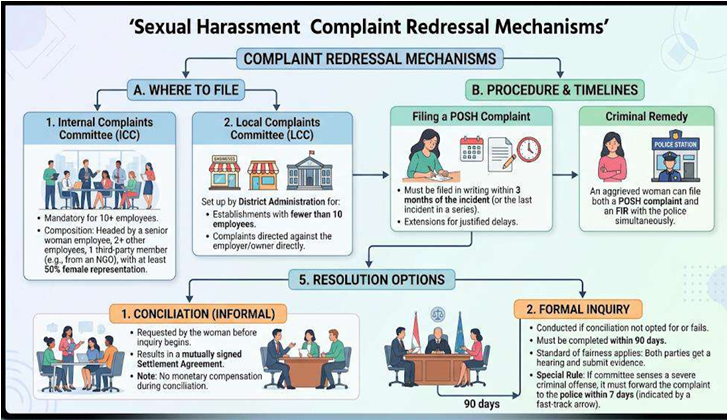
Perhaps the most significant feature of the POSH Act is the requirement to establish an Internal Committee (“IC”). Every organisation employing ten or more employees is mandated to constitute an internal committee at each office or administrative unit. The Committee acts as an independent body responsible for receiving complaints, conducting inquiries, and recommending appropriate action.
Composition of the Internal Committee
Presiding Officer: The Committee must be headed by a senior-level woman employee employed at the workplace. The rationale behind this requirement is to ensure sensitivity and inspire confidence in the complainant.
Employee Members: The Committee must include at least two employees who are committed to the cause of women, possess experience in social work, have knowledge of legal matters, or have experience in employee welfare or human resources. These members contribute to a balanced and informed decision-making process.
External Member: One of the most distinctive aspects of the POSH framework is the mandatory inclusion of an external member—a representative from a non-governmental organisation committed to the cause of women or a person familiar with issues relating to sexual harassment. The inclusion of an external member ensures independence and objectivity, brings specialised knowledge and experience, reduces organisational bias, and enhances confidence in the inquiry process.
Gender Composition and Tenure
The law mandates that at least one-half of the members of the Internal Committee shall be women, reflecting the legislative intent of ensuring adequate representation and creating an environment conducive to addressing sensitive issues with empathy and understanding. The Presiding Officer and every member of the Committee hold office for a period not exceeding three years from the date of nomination. At the end of the tenure, the committee must be reconstituted by the employer.
Powers and Functions of the Internal Committee
The Internal Committee possesses powers similar to those of a civil court while conducting an inquiry. It may summon witnesses, call for documents and records, examine evidence, conduct interviews, recommend interim relief, and submit inquiry reports and recommendations. Beyond adjudicating complaints, the Committee also plays a proactive role in conducting awareness programmes, promoting gender sensitisation, advising management on preventive measures, and strengthening workplace policies.
Complaint and Inquiry Procedure
A complaint may ordinarily be filed within three months from the date of the incident. Upon receipt of the complaint, the Committee may facilitate conciliation if requested by the complainant; however, monetary settlement cannot form the basis of conciliation. Where conciliation is not sought, the Committee proceeds with a formal inquiry in accordance with the principles of natural justice. The inquiry should ordinarily be completed within ninety days, and the employer is required to act upon the recommendations of the Committee within sixty days.
Confidentiality: The Foundation of Trust
One of the most critical safeguards under the POSH Act is confidentiality. The identity of the complainant, respondent, and witnesses and the contents of the proceedings cannot be disclosed to the public or media. The confidentiality provisions encourage reporting and protect the dignity and reputation of all parties involved.
Consequences of Non-Compliance
Failure to comply with the provisions of the POSH Act can expose an organisation to monetary penalties, cancellation or non-renewal of business licenses, reputational damage, employee dissatisfaction and attrition, and increased legal and regulatory scrutiny. In today’s environment, non-compliance with workplace safety norms can significantly affect stakeholder confidence and organisational credibility.
Building a Culture Beyond Compliance
The true spirit of the POSH Act lies not in the mere constitution of committees or implementation of policies. Its success depends upon the creation of workplaces where dignity, equality, and respect are embedded into everyday interactions. Organisations that invest in awareness programmes, encourage open dialogue, and empower their Internal Committees are better positioned to create environments where employees feel secure and valued. A workplace free from harassment is not merely a legal requirement—it is a reflection of an organisation’s values and its commitment towards fostering an inclusive and equitable future.
The Supreme Court’s Wake-Up Call: POSH Compliance Is No Longer Optional
Over a decade after the Sexual Harassment of Women at Workplace (Prevention, Prohibition and Redressal) Act, 2013 came into force, the Supreme Court of India has sent an unambiguous message to employers across the country: compliance with the POSH Act is a binding statutory obligation — and the judiciary is watching.
A series of landmark rulings and directives between 2024 and 2026 have fundamentally shifted the compliance landscape. For HR leaders, legal teams, and Internal Committee (IC) members, understanding these developments is no longer optional.
From Checkbox to Constitutional Duty
For years, many organisations treated POSH compliance as a paperwork exercise — draft a policy, form a committee on paper, and file an annual report. Courts are now dismantling that approach.
In Aureliano Fernandes v. State of Goa (2023, with further directions in 2025), the Supreme Court went beyond the facts of the case to issue detailed directions on IC constitution, member training, procedural rigour, and adherence to the principles of natural justice. Building on this, in August 2025, the Court reiterated that implementation of the POSH Act “cannot remain a formality” — it is a statutory duty enforceable through structured oversight. Labour authorities across states were directed to actively verify whether ICs have been constituted and are functioning, with a structured reporting chain running from District Labour Officers to State Chief Secretaries.
The signal is clear: POSH compliance is now public law compliance under judicial supervision.
Key Rulings Every Employer Must Know
-
IC Jurisdiction: The Complainant’s Workplace Prevails
Dr. Sohail Malik v. Union of India (December 2025) — one of the most consequential rulings of recent years — settled a question that had created significant confusion in cross-departmental and multi-organisation workplaces.
The Supreme Court held that an aggrieved woman has the right to approach the Internal Committee at her own workplace, even when the respondent belongs to a different department, office, or organisation entirely. The IC of the complainant’s organisation is competent to conduct the inquiry; its findings are then transmitted to the respondent’s employer for disciplinary action. The Court reinforced that “workplace” must be interpreted broadly — covering physical offices, field sites, client premises, digital platforms, and any location visited in the course of employment. Jurisdictional arguments cannot be used to deny or delay a woman’s access to redress.
What this means for employers: ICs must not reject complaints on the ground that the respondent works elsewhere. Review your internal procedures and train IC members accordingly.
-
Strict Timelines: Delays Can Be Fatal
Vaneeta Patnaik v. Dr. Nirmal Kanti Chakraborti (September 2025) — the Supreme Court upheld mandatory statutory timelines for filing sexual harassment complaints and introduced a Direct Nexus Test to determine whether subsequent administrative actions constitute an extension of past harassment.
The Court’s message on timelines was firm: delays in filing can be fatal to a complaint. While third-party complaints under Section 9(2) are not bound by the same limitation, complainants filing directly must act within prescribed timeframes. Notably, the Court also withdrew certain reputational directions it had initially issued against the respondent, clarifying that POSH proceedings must remain within the statutory remedies prescribed under the Act—courts will not impose penalties beyond what the law contemplates.
What this means for employers: Awareness sessions must emphasise filing timelines. Employees must know their rights — and their windows for action.
- District-Wide Compliance Surveys: No Organisation Is Invisible
By a Supreme Court order dated August 2025, all States and Union Territories were directed to conduct district-wise surveys within six weeks to verify whether employers have constituted valid ICs, maintained anti-harassment policies, and ensured trained committee members. Non-compliance carries consequences including potential regulatory action and refusal of licence renewals.
Separately, on 7 January 2026, the Court sought structured updates on POSH implementation across courts and tribunals, calling attention to statutory appointments such as District Officers and Nodal Authorities — roles that many states had left unfilled.
What this means for employers: An IC’s existence on paper is no longer sufficient. Whether the committee is properly constituted, active, and trained will be the benchmark.
-
IC Reports Must Withstand External Scrutiny
CDR Yogesh Mahla v. Union of India (January 2026) — the Supreme Court observed that an IC report under the POSH Act could be challenged before external forums, including the Armed Forces Tribunal, depending on jurisdictional circumstances. This affirms a broader principle: IC findings do not stay within the organisation — they can travel to tribunals and constitutional courts.
Conclusory findings without reasoning are increasingly vulnerable. IC inquiry reports must be evidence-based, reasoned, and reflective of natural justice principles.
What this means for IC members: Every inquiry report must be written with the rigour of a document that may be reviewed by a court. Quality of documentation is not an administrative detail—it is a legal safeguard.
The SHe-Box: Centralised Oversight
Complaints filed through the She-Box portal—the government’s centralised complaint routing and monitoring system—enter a traceable ecosystem beyond internal HR channels. Recent parliamentary data indicates that 254 workplace sexual harassment complaints were filed on SHe-Box in 2025, and 296 complaints were received since the portal’s revamp in August 2024. With state governments such as Rajasthan and Delhi mandating SHe-Box registration for all establishments with 10 or more employees, the era of self-reporting in isolation is over.
Organisations must be prepared to respond to complaints routed through official systems with documented timelines, structured acknowledgements, and complete inquiry records.
The Most Common Compliance Failure — and the Costliest
Courts and compliance experts consistently flag the same critical gap: the IC exists on paper but is not properly constituted. An expired term, a missing external member, or a Presiding Officer who has left the organisation can render an entire inquiry legally invalid.
Before anything else, employers should verify:
- Is the IC properly constituted with a valid Presiding Officer and an external member?
- Are all members within their three-year term?
- Has annual training been conducted?
- Has the annual report been filed with the District Officer?
- Is the organisation registered on SHe-Box?
National Conference on Workplace Safety and SHe-Box (14 February 2026)
At the National Conference on Safety of Women at Workplace held on 14 February 2026, the government highlighted the importance of making it easier for employees to report workplace sexual harassment and ensuring that complaints are handled fairly and effectively under the POSH law. The discussions suggested a stronger focus on centralised monitoring, better reporting practices, and greater accountability from organisations in addressing complaints and achieving meaningful outcomes.
For employers, the message is clear: POSH compliance is not a one-time requirement. Organisations should regularly review and strengthen their policies, processes, and governance systems to keep pace with evolving expectations and regulatory priorities.
Closing Thought
The Supreme Court’s interventions over the past two years have reinforced that the POSH Act is a remedial and protective legislation designed to safeguard women in the workplace. Procedural evasion, jurisdictional deflection, and paper-only compliance will no longer pass judicial scrutiny.
For organisations, this is not merely a compliance alert—it is an opportunity to build workplaces that genuinely protect dignity and access to justice. The institutions that rise to this standard will not merely avoid liability; they will earn the trust of the people who work within them.
Illustrative Examples of Conduct Amounting to Sexual Harassment
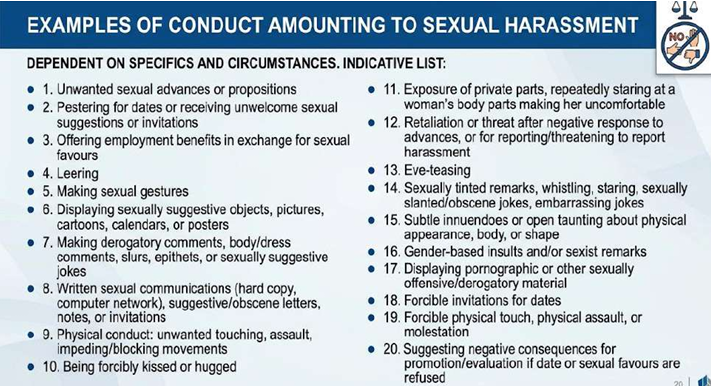
The following list is indicative and dependent on specific facts and circumstances:
- Unwanted sexual advances or propositions;
- Pestering for dates or receiving unwelcome sexual suggestions or invitations;
- Offering employment benefits in exchange for sexual favors;
- Leering;
- Making sexual gestures;
- Displaying sexually suggestive objects, pictures, cartoons, calendars, or posters;
- Making derogatory comments about body or dress, slurs, epithets, or sexually suggestive jokes;
- Written sexual communications (hard copy or via computer network), suggestive/obscene letters, notes, or invitations;
- Physical conduct—unwanted touching, assault, or impeding/blocking movements;
- Being forcibly kissed or hugged;
- Exposure of private parts, or repeatedly staring at a woman’s body making her uncomfortable;
- Retaliation or threats after a negative response to advances, or for reporting/threatening to report harassment;
- Eve-teasing;
- Sexually tinted remarks, whistling, staring, sexually slanted or obscene jokes, or embarrassing jokes;
- Subtle innuendos or open taunting about physical appearance, body, or shape;
- Gender-based insults and/or sexist remarks;
- Displaying pornographic or other sexually offensive/derogatory material;
- Forcible invitations for dates;
- Forcible physical touch, physical assault, or molestation;
- Suggesting negative consequences for promotion/evaluation if a date or sexual favors are refused.
Rajput Jain & Associates (Chartered Accountants) is a multidisciplinary professional services firm providing audit, assurance, taxation, regulatory compliance, risk management, and corporate advisory services to businesses across India. Office: P-6/90 (2nd Floor), Connaught Circus, Connaught Place, New Delhi – 110001, India Contact: +91-98113 22785, +91-95555 55480 E-mail: info@carajput.com