
New Income Tax Compliance & Reporting
Page Contents
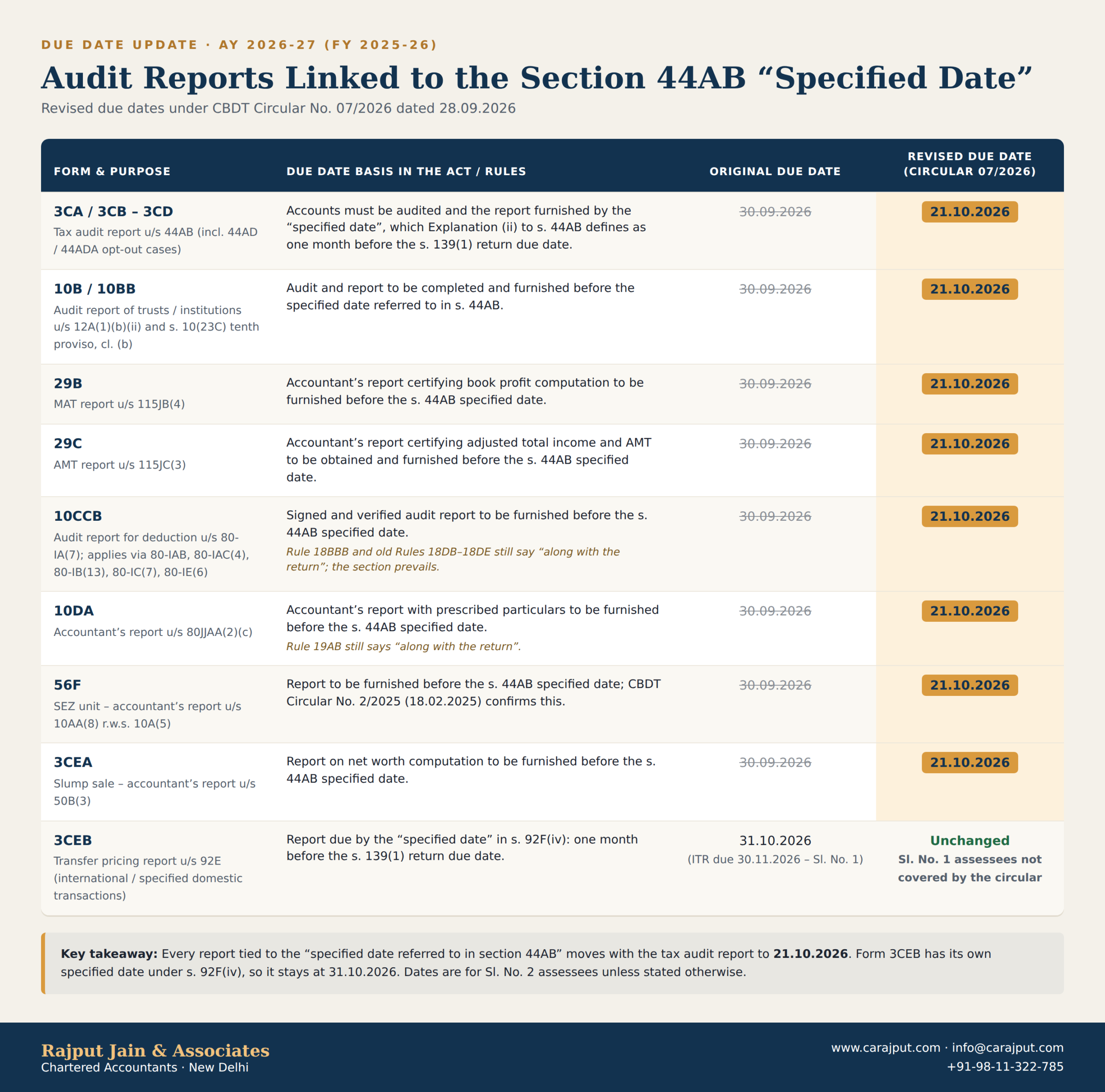
Any audit report whose due date is tied to the Section 44AB “specified date” now stands extended to 21 October 2026, while Form 3CEB continues to be due on 31 October 2026 because it is governed by a separate transfer pricing provision
| Form | Purpose | New Due Date |
|---|---|---|
| 3CA/3CB-3CD | Tax Audit | 21.10.2026 |
| 10B / 10BB | Trust Audit | 21.10.2026 |
| 29B | MAT Report | 21.10.2026 |
| 29C | AMT Report | 21.10.2026 |
| 10CCB | Chapter VI-A Deduction Audit | 21.10.2026 |
| 10DA | Section 80JJAA Report | 21.10.2026 |
| 56F | SEZ Report | 21.10.2026 |
| 3CEA | Slump Sale Report | 21.10.2026 |
| 3CEB | Transfer Pricing Report | 31.10.2026 (No Change) |
New Income Tax Compliance & Reporting
ITR-1 filling expansion if LTCG reporting up to INR 1.25 Lakh : A significant procedural relaxation has been introduced by allowing limited Long-Term Capital Gains (LTCG) reporting in ITR-1. Practical Takeaway for taxpayer Focus is shifting from return filing to return validation, Advisory role is expanding, especially in Presumptive taxation decisions, Data reconciliation (AIS vs books) and Structuring deductions and disclosures.
- Income Tax Compliance is eligible taxpayers can now report LTCG under section 112A (equity shares/equity mutual funds) up to INR 1.25 lakh.
- Implication on Income Tax Compliance & Reporting is Reduces need for migration to ITR-2 for small investors also simplifies compliance for salaried individuals with minor equity transactions.
- Taxpayer must verify no carried-forward capital losses. Taxpayer ensure no other capital gains categories exist (like property). Which Impact that ease of compliance for retail investors, but careful eligibility filtering is critical.
Enhanced New Income Tax Compliance Disclosure Requirements:
The tax dept is clearly moving toward data-driven scrutiny and transparency. Following Areas of tighter reporting:
- Deductions (Chapter VI-A): Granular breakup (80C, 80D, 80G, etc.) and Cross-verification with AIS/TIS and third-party reporting.
- Donations (80G / 80GGC / 80GGB): Mandatory details: PAN of donee, registration number, mode of payment. And also restrictions on cash donations.
- Political Contributions: Increased scrutiny given sensitivity and Mandatory disclosure of recipient entities and payment modes.
- New Income Tax Compliance Shift from “claim-based” to evidence-backed reporting ecosystem.
New Income Tax Compliance Practical Challenge in Presumptive Taxation with Tax Audit
Presumptive Taxation with Tax Audit remains one of the most litigative and misunderstood areas. Taxpayers must movement toward a faceless, data-backed, and AI-driven assessment system. The Income Tax framework is evolving in three clear directions Simplification for small taxpayers (e.g., ITR-1 LTCG inclusion), Increased transparency & disclosures and Technology-driven compliance enforcement.
Key Issues in Presumptive Taxation with Tax Audit
- Following are turnover threshold interaction:
- 44AD: INR 2 crore (INR 3 crore if cash receipts ≤5%)
- 44ADA: INR 50 lakh (INR 75 lakh if cash receipts ≤5%)
- Trigger for Tax Audit: If income declared < presumptive rate & total income exceeds basic exemption.
- Major Practical Dilemmas under new Income Tax Compliance under Opting out of 44AD → 5-year restriction lock-in. Major Practical Dilemmas in Cash vs digital turnover classification disputes. and Professionals incorrectly opting for under section 44AD instead of 44ADA.
- New Income Tax Compliance High-Risk Areas are undervaluing income under presumptive schemes. and simultaneous business + profession income classification errors. This is one of the most advisory-intensive areas for CAs, requiring forward-looking tax planning.
New Compliance Reporting under income tax framework:
- The income tax compliance ecosystem is now fully integrated, and analytics driven. Emerging Compliance Risks under the income tax compliance to taxpayer must Mismatch between books and Annual Information Statement data, Over-reliance on prefilled data without verification and Non-reporting of exempt income (now closely tracked). Income tax compliance core pillars under New Compliance Reporting are mentioned here under :
- Annual Information Statement has to comprehensive financial transaction reporting.
- Taxpayer Information Summary simplified version for return filing.
- Pre-filled ITRs: Salary, interest, dividends, capital gains increasingly automated.
- Real-time Data Matching is to GST with Income Tax, TDS with Reported income and Bank/financial institutions with Annual Information Statement.