
ITR Deadline AY 2026-27: Taxpayers Face Glitches
Page Contents
CBDT Extends Tax Exemption Window for SWFs & Pension Funds
The Central Board of Direct Taxes (CBDT) has officially extended the timeline for income tax exemptions under Section 10(23FE) of the Income Tax Act for Sovereign Wealth Funds (SWFs) and Pension Funds. The new deadline for qualifying investments is now March 31, 2030, up from the earlier March 31, 2025.
- This extension was formalized via Notification No. 113/2025, issued on July 11, 2025, and is effective retrospectively from April 1, 2025.
- The move aims to attract long-term foreign capital into India’s infrastructure, logistics, and power sectors.
- It provides fiscal certainty to global investors and aligns with India’s goal of becoming a $5 trillion economy.
- Retail investors may benefit indirectly through InvITs, REITs, and mutual funds that channel investments into these sectors.
This exemption, provided under Section 10(23FE) of the Income Tax Act, covers income in the form of dividends, Interest, long-term capital gains. Extending the tax exemption window till 2030 cements India’s position as a long-term hub for global infrastructure investments. While sovereign wealth and pension funds directly benefit, retail investors also gain access through mutual funds, InvITs, and REITs. The move is expected to Attract greater foreign capital, Improve transparency, Strengthen India’s infrastructure financing ecosystem
Background of the Scheme
The scheme was first introduced in April 2020 to attract patient global capital into India’s long-term infrastructure projects. Since then, several global funds from Saudi Arabia, Singapore, Kuwait, and Norway have actively participated in the Indian market.
Focus Areas for Investment
The extended policy is expected to channel more foreign capital into priority sectors such as Commercial real estate, logistics parks, data centers, and Urban infrastructure. These inflows lower financing costs for long-gestation projects and ensure steady, predictable capital for India’s infrastructure growth.
Impact on Retail Investors
While large foreign funds are the direct beneficiaries, retail investors stand to gain indirectly through mutual funds, InvITs (Infrastructure Investment Trusts), and REITs (Real Estate Investment Trusts). With higher foreign participation, these instruments become more attractive, giving retail investors access to global-grade infrastructure assets.
ITR Filing Deadline Amid Portal Glitches
ITR Filing Due Dates for AY 2026-27
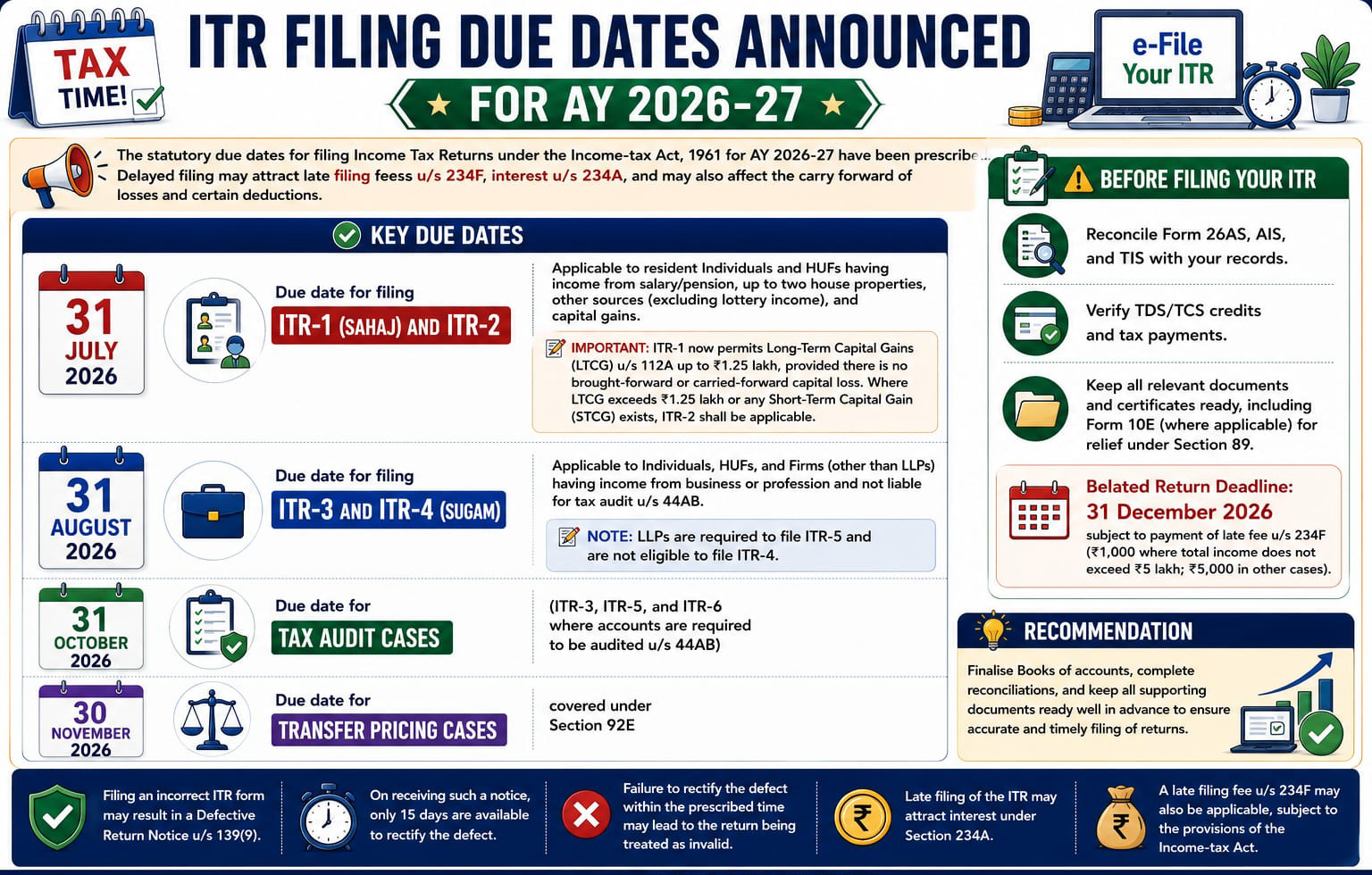
The uploaded infographic highlights the due dates for filing Income Tax Returns (ITRs) for Assessment Year (AY) 2026-27 and certain important compliance points. Key Due Dates are mention here under
| Due Date | Category |
|---|---|
| 31 July 2026 | ITR-1 (Sahaj) and ITR-2 |
| 31 August 2026 | ITR-3 and ITR-4 (Sugam) |
| 31 October 2026 | Tax Audit Cases (ITR-3, ITR-5 & ITR-6 where audit under section 44AB is applicable) |
| 30 November 2026 | Transfer Pricing Cases covered under Section 92E |
ITR Filing Applicability
ITR-1 (Sahaj) & ITR-2
- Applicable to resident individuals and HUFs having income from salary/pension, up to two house properties, other sources (excluding lottery income), and capital gains.
- The infographic notes that ITR-1 can now be used where long-term capital gains under section 112A do not exceed INR 1.25 lakh and there is no brought-forward or carried-forward capital loss.
ITR-3 & ITR-4 (Sugam)
- Applicable to Individuals, HUFs and Firms (other than LLPs) having business or professional income and not liable to tax audit under section 44AB.
- LLPs are required to file ITR-5 and are not eligible to file ITR-4.
Before Filing Your ITR
The infographic recommends:
- Reconciling Form 26AS, AIS and TIS with books and records.
- Verifying TDS/TCS credits and tax payments.
- Keeping all supporting documents ready, including Form 10E wherever applicable
ITR Deadline: Taxpayers Face Glitches, I-T Dept. Issues Filing Advisory
With just days left before the September 15, 2025 deadline for filing income tax returns (ITRs) for FY 2024-25, taxpayers are facing mounting challenges due to portal glitches, delayed utility releases, and a compressed filing window. With the deadline for filing ITRs fast approaching, taxpayers are facing significant technical issues across multiple platforms:
Portal Slowdowns & Technical Issues
Taxpayers have reported difficulties accessing key e-filing platforms: the Annual Information Statement, Form 26AS, and the Taxpayer Information Summary. These platforms have been intermittently down because of heavy traffic. The TRACES portal, vital for Form 26AS, TDS certificates, and tax credit verification, has been unavailable, adding to the stress of last-minute compliance.
I-T Department’s Tech Advisory
To minimize disruptions, the department has advised using the following:
-
Browsers: Microsoft Edge (v88+), Chrome (v88+), Firefox/Mozilla (v86+), Opera (v66+)
-
Operating Systems: Windows 7.x or above, Linux, or Mac OS
-
Other Requirements: Enable CSS & JavaScript, allow cookies, and use a valid Class 2/3 Digital Signature Certificate (DSC) where applicable.
Penalties for Missing Deadlines—Important Reminder
- Belated Return Due Date: 31 December 2026.
- Late filing may attract:
- Late fee under section 234F.
- Interest under section 234A.
- Possible impact on carry forward of losses and certain deductions.
Tax professionals urge taxpayers to check system/browser compatibility in advance and gather all necessary documents and file ITRs at the earliest possible time, avoiding the final-day rush. Missing the deadline can be costly:
-
Late fee: Up to INR 5,000 (capped at INR 1,000 if total income < INR 5 lakh).
-
Interest: 1% per month (or part thereof) on unpaid tax.
What are mandatory ITR filing scenarios for Indian taxpayers?
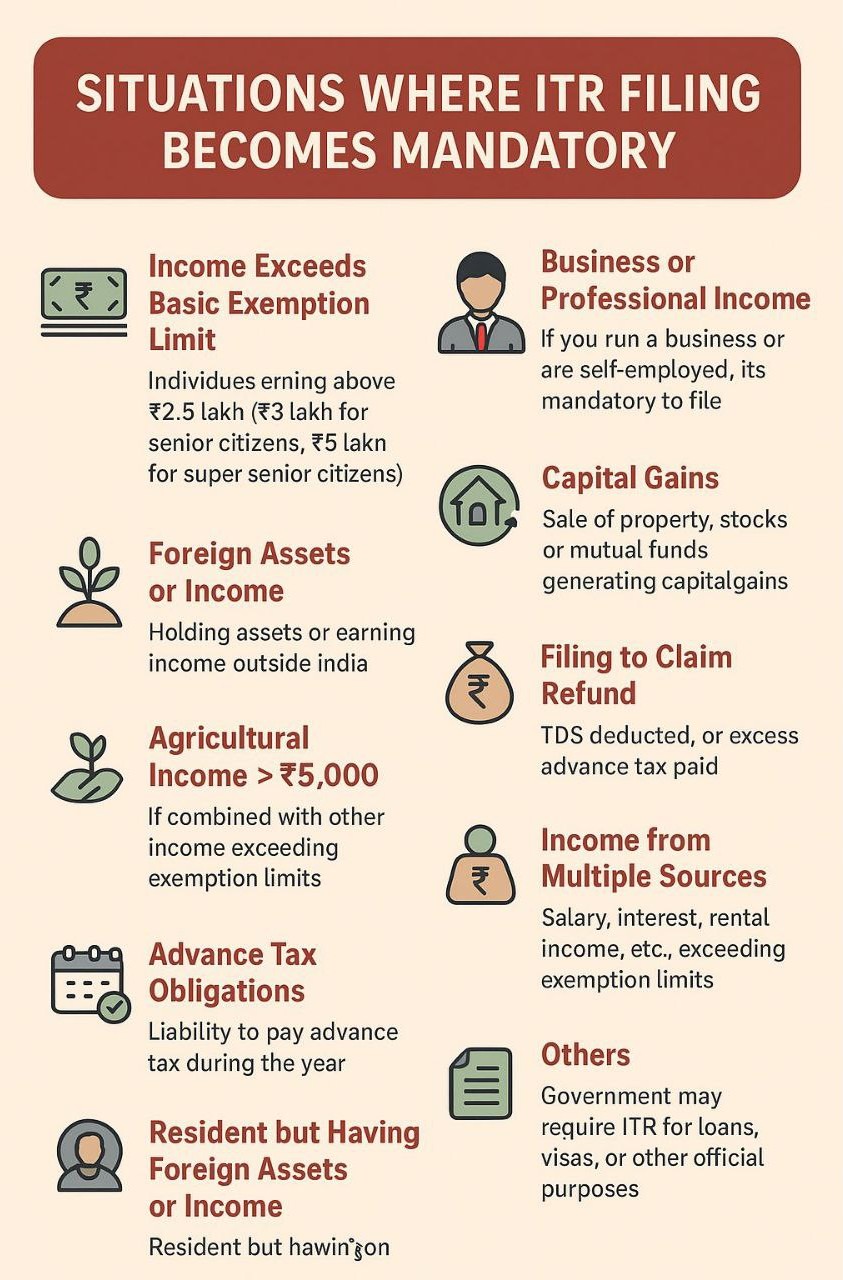
Situations Where Filing of Income Tax Return (ITR) is Mandatory : Even if your income is below the basic exemption limit, in certain cases filing of ITR is compulsory.
- Income exceeds basic exemption limit: INR 2.5 lakh for individuals, INR 3 lakh for senior citizens, INR 5 lakh for super senior citizens.
- Business or professional income: If you’re self-employed or running a business.
- Foreign assets or income: Holding assets or earning income outside India.
- Capital gains: From sale of property, stocks, mutual funds, etc.
- Agricultural income ≥ INR 5,000: If combined with other income exceeding exemption limits.
- To claim a refund: If TDS is deducted or excess advance tax is paid.
- Advance tax obligations: If liable to pay advance tax during the year.
- Income from multiple sources: Salary, interest, rental income, etc., exceeding exemption limits.
- Resident with foreign assets/income: Even if income is below exemption limit.
- Other official requirements: For loans, visa applications, or government mandates.
Even if your taxable income is below the threshold, you must file ITR in the above cases.
In Summary,
- AIS, Form 26AS, TIS, and TRACES portals have experienced intermittent outages due to high traffic.
- Several professional bodies, including BCAS, FKCCI, and tax bar associations, have requested an extension of the deadline. Key concerns include:
- Delayed release of ITR forms and utilities (e.g., ITR-2 and ITR-3 released in July, ITR-5 and ITR-6 in August).
- Mismatch in AIS and Form 26AS data, complicating reconciliations.
- Portal performance issues, including login failures and slow response times.
- Overlap with festive season, reducing staff availability and client coordination.
Despite mounting pressure, CBDT has not yet announced any extension. Tax experts advise filing as early as possible to avoid penalties and last-minute issues.