
Income Tax Savings through House Property
Page Contents

INCOME TAX SAVINGS THROUGH HOUSE PROPERTY
Does your home, saveour income tax? Buying a house for self-occupation can be biggest tax saving instrument. It saves your income tax in two ways. You can save maximum Rs 75750 per year on your home.
Introduction:
There are two main benefits which are available under Income Tax Act, 1961 in relation to Purchase or Construction of House Property which are described as under:
- Deduction of Interest on Capital borrowed for purchase or construction of House Property under Section 24 (b) of the Income Tax Act, 1961. (Interest paid by house owner on housing loan)
- Principle amount paid towards Housing loan for purchase or construction of House Property under Section 80 C of the Income Tax Act, 1961.
- The amount stamp duty/ Registration charges paid while acquiring a property will be allowed deduction U/s 80C.
Interest Paid towards housing loan:-
The house property has been acquired, constructed, repaired, renewed or reconstructed with borrowed capital, the amount payable towards interest on borrowed capital is allowed as deduction under u/s 24(b) of the Income-tax act.
- We have to note here Interest payable on borrowed capital is allowed (Interest paid is irreverent here).
- In case of under-construction property, Interest will aggregate from the date of borrowing till the end of the previous year prior to the previous year in which the house is completed and allowed in five successive financial years starting from the year in which the acquisition or construction was completed.
- In case Assesses is the owner of more than one residential property, he may exercise an option to treat any one of the houses to be self-occupied and the other houses will be deemed to be let out and the annual value of such house will be determined as per Section 23(1)(a) of the Income Tax Act, 1961.
How much Interest Deduction allowed U/s 24(b) :-
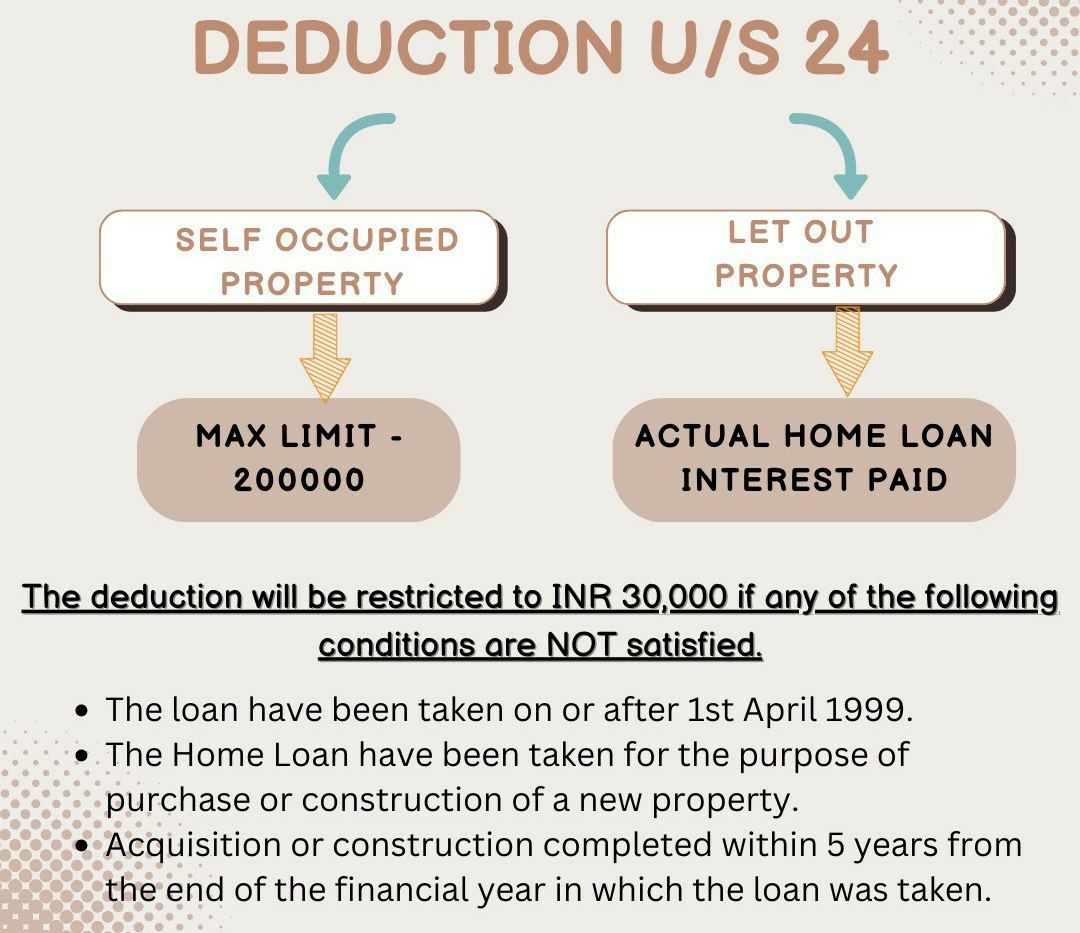
In case of self occupied house:-
(a) In case property is acquired or constructed with capital borrowed on or after 01-04-1999 and such acquisition or construction is completed within 3 years of the end of the financial year in which the capital was borrowed:
Minimum of Actual Interest payable or Rs 1, 50,000/- .
(b) In case property is acquired or constructed with capital borrowed
Minimum of Actual Interest payable or Rs 30,000/- .
In case of Rental / Deemed to be let out House Property.
Interest payable on barrowed capital for the previous year is allowed as deduction under U/s 24(b).
Principle Amount paid towards Housing Loan:-
Any payment made for purchase or construction of a residential house property which is chargeable to tax under the head “Income from House Property” towards any installment or part payment due to any Bank, Financial Institution, Company or Co-Operative Society towards the cost of the house property allotted to him is allowed as deduction U/s 80 C of the Income Tax Act, 1961 to the extent of Rs. 1,00,000 along with other Specified Investments mentioned under Section 80 C of the Income Tax Act, 1961.
Stamp Duty and Registration Charges for a home:-
The amount you pay as stamp duty or registration fee when you buy a house can be claimed as deduction under section 80C in the year of purchase of the house.

Fresh Home Loan for Additional Floor: Can You Claim Interest Deduction Again Under Section 24(b)?
Many homeowners expand their existing homes as family needs grow. A common question that arises is whether a taxpayer can claim an additional deduction u/s 24(b) of the Income-tax Act when a fresh loan is taken for constructing an extra floor on a self-occupied house. Let us understand the tax implications in detail. The Practical Scenario Consider the following situation:
- A taxpayer owns a self-occupied residential house.
- housing loan was originally taken for the construction of the house.
- construction was completed within the prescribed period.
- The taxpayer has been claiming an interest deduction under Section 24(b).
- After five years, the taxpayer decides to construct an additional floor on the same property.
- A fresh loan is obtained specifically for financing the construction of the new floor.
Question: Can the taxpayer claim a deduction for interest on the fresh loan u/s 24(b)?
Answer: Yes. The taxpayer can claim a deduction for interest on the fresh loan taken for the construction of an additional floor, subject to fulfillment of prescribed conditions and the overall limits under Section 24(b).
Understanding Section 24(b)
Section 24(b) of the Income Tax Act allows deductions for interest payable on borrowed capital utilized for the purchase of a house property, construction of a house property, reconstruction of a house property, and repair, renewal, or improvement of a house property. Since construction of an additional floor amounts to further construction, reconstruction, or improvement of the existing residential property, the interest on a loan taken specifically for such construction qualifies for deduction u/s 24(b).
Why Additional Floor Construction Qualifies
The law does not restrict the deduction only to the original construction of a house. Where a taxpayer borrows funds for the extension of an existing house, the addition of new residential space, and the construction of another floor, the borrowing continues to be linked with the house property and therefore falls within the scope of Section 24(b). Accordingly, a fresh loan taken for constructing an additional floor is eligible for interest deduction.
Conditions for Claiming the Deduction
1. Loan Must Be Used for Construction
The taxpayer should be able to demonstrate that the borrowed funds were actually utilized for construction of the new floor. The following documents should be preserved: Loan sanction letter, loan account statements, Construction agreements, contractor bills, material purchase invoices and Bank statements evidencing utilization of funds. Proper documentation becomes crucial in case of scrutiny by the Income Tax Department.
2. Deduction is Linked to Completion of Construction
Interest relating to the construction period is treated as pre-construction interest. The deduction generally becomes available after completion of the construction of the new floor and subject to the provisions governing pre-construction interest.
Maximum Deduction Available for Self-Occupied House
The most important aspect to understand is that the law provides a limit for self-occupied property.
| Particulars | Amount |
|---|---|
| Maximum deduction under Section 24(b) for self-occupied property | INR 2,00,000 per year |
This limit applies to the total interest payable on all eligible housing loans relating to the same self-occupied property. Therefore, interest on the original housing loan and the new loan for additional floor construction must be aggregated while computing the deduction.
No Separate INR 2 Lakh Limit for the New Loan
Many taxpayers assume that since a fresh housing loan has been taken, another deduction of INR 200,000 becomes available. This understanding is incorrect. The law does not grant a separate ceiling for every housing loan. Instead, the aggregate interest deduction for a self-occupied house remains restricted to INR 200,000 annually.
Illustration
Suppose the following interest is payable during a financial year:
| Particulars | Amount |
|---|---|
| Interest on original housing loan | INR 1,20,000 |
| Interest on additional floor loan | INR 1,50,000 |
| Total interest | INR 2,70,000 |
Deduction Available
Although actual interest paid is INR 270,000, the deduction u/s 24(b) will be restricted to INR 200,000 only. Balance interest cannot be claimed due to the statutory cap applicable to self-occupied property.
Treatment of Pre-Construction Interest
If interest is paid on the fresh loan during the construction phase of the additional floor:
- Such interest is accumulated as pre-construction interest.
- It can be claimed in five equal annual installments.
- The claim starts from the financial year in which construction is completed.
However, these installments are also subject to the overall deduction limit applicable to self-occupied property.
Impact of Tax Regime
Old Tax Regime
| Particulars | Position |
|---|---|
| Deduction under Section 24(b) for self-occupied property | Available up to INR 2,00,000 |
New Tax Regime
| Particulars | Position |
|---|---|
| Deduction under Section 24(b) for self-occupied property | Generally not available |
Therefore, the benefit of interest deduction on the fresh loan is primarily relevant to taxpayers opting for the old tax regime. following are key takeaways:
- A fresh loan taken for construction of an additional floor qualifies for deduction under Section 24(b).
- Construction of an additional floor is treated as construction/reconstruction/improvement of house property.
- Proper evidence of utilization of borrowed funds should be maintained.
- Pre-construction interest can be claimed in five equal installments after completion.
- Interest on the original loan and the fresh loan must be aggregated.
- The overall deduction for a self-occupied property remains restricted to INR 2,00,000 per year under the old tax regime.
- No separate deduction limit is available merely because a second housing loan has been taken.
Conclusion
A taxpayer who constructs an additional floor on an existing self-occupied house and finances the construction through a fresh housing loan can claim a deduction of the interest paid on such a loan u/s 24(b) of the Income Tax Act. However, the benefit is not unlimited. For a self-occupied property, the interest on both the original loan and the fresh construction loan is combined, and the deduction remains subject to the overall ceiling of INR 2,00,000 per annum under the old tax regime. Therefore, while a fresh deduction is permissible, it operates within the existing statutory framework and does not create a separate deduction limit for the new loan.