
CSR Policy: Schedule VII & CSR Implementation Activities
Page Contents
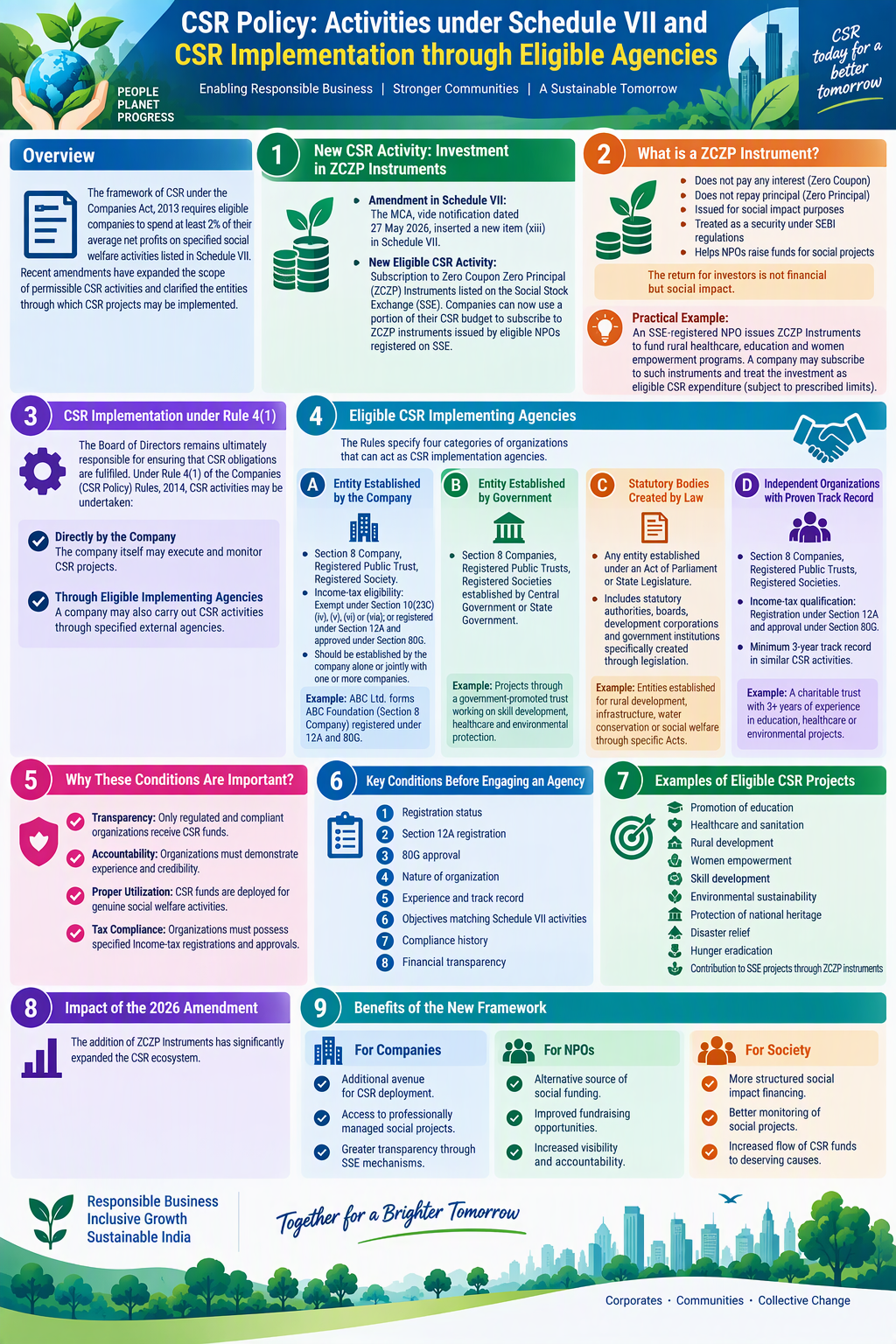
CSR Policy: Activities under Schedule VII and CSR Implementation through Eligible Agencies
The framework of Corporate Social Responsibility (CSR) under the Companies Act, 2013 requires eligible companies to spend at least 2% of their average net profits on specified social welfare activities listed in Schedule VII. Recent amendments have expanded the scope of permissible CSR activities and clarified the entities through which CSR projects may be implemented.
-
-
New CSR Activity: Investment in ZCZP Instruments
-
- Amendment in Schedule VII : The Ministry of Corporate Affairs (MCA), vide notification dated 27 May 2026, inserted a new item (xiii) in Schedule VII.
- New Eligible CSR Activity : Subscription to Zero Coupon Zero Principal (ZCZP) Instruments listed on the Social Stock Exchange (SSE). This means companies can now use a portion of their CSR budget to subscribe to ZCZP instruments issued by eligible Not-for-Profit Organizations (NPOs) registered on a Social Stock Exchange.
What is a ZCZP Instrument?
A Zero Coupon Zero Principal Instrument Does not pay any interest, Does not repay principal, Is issued for social impact purposes, Is treated as a security under SEBI regulations and Helps NPOs raise funds for social projects. The return for investors is not financial but social impact.
Practical Example : Suppose an SSE-registered NPO issues ZCZP Instruments to fund Rural healthcare projects, Education initiatives and Women empowerment programs. A company may subscribe to such instruments and treat the investment as eligible CSR expenditure (subject to prescribed limits).
-
CSR Implementation under Rule 4(1)
The Board of Directors remains ultimately responsible for ensuring that CSR obligations are fulfilled. Under Rule 4(1) of the Companies (CSR Policy) Rules, 2014, CSR activities may be undertaken:
-
- Directly by the Company : The company itself may execute and monitor CSR projects.
- Through Eligible Implementing Agencies : A company may also carry out CSR activities through specified external agencies.
-
Eligible CSR Implementing Agencies
The Rules specify four categories of organizations that can act as CSR implementation agencies.
Category (A): Entity Established by the Company
CSR projects can be undertaken through Section 8 Company, Registered Public Trust, Registered Society, provided such entities:
Income Tax Eligibility Must be Exempt under Section 10(23C)(iv), (v), (vi) or (via); or Registered under Section 12A; and Approved under Section 80G.
Ownership Condition : The entity should be established By the company alone; or Jointly with one or more companies. Example ABC Ltd. forms: ABC Foundation (Section 8 Company) Registered under 12A and 80G. and CSR spending through ABC Foundation will be permissible.
Category (B): Entity Established by Government
CSR activities may also be carried out through Section 8 Companies, Registered Public Trusts, Registered Societies established by Central Government; or State Government. Example Projects implemented through a government-promoted trust working on Skill development, Healthcare and Environmental protection may qualify.
Category (C): Statutory Bodies Created by Law
CSR projects may be implemented through: Any entity established under an Act of Parliament or State Legislature. Explanation The term “entity” refers to Statutory authorities Boards, Development corporations, Government institutions specifically created through legislation. Example : Entities established for Rural development, Infrastructure development, Water conservation, Social welfare through specific Acts can receive CSR funding.
Category (D): Independent Organizations with Proven Track Record
CSR activities may be undertaken through Section 8 Companies, Registered Public Trusts and Registered Societies having: Income Tax Qualification Registration under Section 12A and Approval under Section 80G and Experience Requirement Minimum 3-year track record in similar CSR activities. Example A charitable trust successfully conducting Education programs, Healthcare camps, Environmental projects for more than 3 years can act as an implementation agency.
Why These Conditions Are Important?
The Government intends to ensure:
Transparency : Only regulated and compliant organizations receive CSR funds.
Accountability : Organizations must demonstrate experience and credibility.
Proper Utilization : CSR funds are deployed for genuine social welfare activities.
Tax Compliance : Organizations must possess specified Income-tax registrations and approvals.
Key Conditions Before Engaging an Implementing Agency
The Board should verify Registration status, Section 12A registration, 80G approval, Nature of organization, Experience and track record, Objectives matching Schedule VII activities, Compliance history and Financial transparency.
Examples of Eligible CSR Projects :
Through eligible agencies, companies may undertake Promotion of education, Healthcare and sanitation, Rural development, Women empowerment, Skill development, Environmental sustainability and Protection of national heritage, Disaster relief, Hunger eradication, Contribution to Social Stock Exchange projects through ZCZP instruments
Impact of the 2026 Amendment :
The addition of ZCZP Instruments has significantly expanded the CSR ecosystem.
Benefits for Companies
- Additional avenue for CSR deployment.
- Access to professionally managed social projects.
- Greater transparency through Social Stock Exchange mechanisms.
Benefits for NPOs
- Alternative source of social funding.
- Improved fundraising opportunities.
- Increased visibility and accountability.
Benefits for Society
- More structured social impact financing.
- Better monitoring of social projects.
- Increased flow of CSR funds to deserving causes.
Key Takeaways
- Schedule VII now includes subscription to ZCZP Instruments on the Social Stock Exchange as an eligible CSR activity.
- CSR projects may be undertaken directly by the company or through eligible implementation agencies.
- Implementing agencies may be Company-established Section 8 companies, trusts, or societies; Government-established entities; Statutory bodies created by law, Independent organizations with a minimum 3-year track record.
- Most implementing agencies must possess valid 12A registration and 80G approval.
- Companies must conduct due diligence before routing CSR funds through any implementing agency.
- The 2026 amendment strengthens the integration of CSR funding with India’s rapidly evolving social finance ecosystem.