
New GST Registration Guidelines from 1 November 2026
Page Contents

New GST Registration Guidelines from 1 November 2026
As per New GST Registration Guidelines from 1st Nov 2026 – As per Circular-No-257-03-2026 (2) and central-tax-05-gst-27102026
The CBIC has issued comprehensive GST Registration Guidelines through Circular-No-257-03-2026 (2) and amended GST Rules through central-tax-05-gst-27102026 to standardize documentation, reduce unnecessary notices, prevent fake registrations, and introduce a new registration mechanism for e-commerce sellers.These changes are effective from 1 November 2026.
Major Changes Applicable from 1 November 2026
| Particulars | Earlier Position | New Position from 1 Nov 2026 |
| GST Registration Documentation | Different practices followed by officers | Standardized list of acceptable documents prescribed |
| PPOB Documents | Frequent disputes and additional notices | Detailed prescribed list for each category of premises |
| Co-working Space Registration | No uniform guidelines | Specifically permitted with membership agreement |
| Consent-Based Premises | Frequent objections | Standard consent format prescribed |
| Registration Processing | Many avoidable queries | Officers restricted from seeking unnecessary documents |
| Rule 14B Registration | Not available | New registration mechanism for E-commerce sellers |
| Address Verification | General address accepted | Specific and complete address mandatory |
| Registration Application | Limited guidance | Detailed FAQs and document checklist issued |
New Rule 14B Registration for E-Commerce Sellers
The most significant change from 1 November 2026 is the introduction of Rule 14B. Under this scheme, a seller can obtain GST registration in another state even without having a physical office there, by using the warehouse of an e-commerce operator (ECO) as the Principal Place of Business. following are Eligibility Conditions for New Rule 14B registration for e-commerce sellers:
| Condition | Requirement |
| Existing GST Registration | Must already have GST registration in a home State |
| Business Model | Supply of goods through E-Commerce Operators |
| Physical Presence | Not required in destination State |
| Monthly B2B Tax Liability | Not more than ₹2.50 lakh per month |
| ECO Consent | Mandatory |
| Aadhaar Verification | Mandatory |
| Warehouse Usage | ECO warehouse can be declared as PPoB |
Example: A seller registered in Uttar Pradesh can obtain GST registration in Maharashtra using an Amazon or Flipkart warehouse without opening an office in Maharashtra.
Detailed Principal Place of Business (PPOB) Requirement
CBIC has clarified acceptable documents for every type of premises.
PPOB Document Checklist
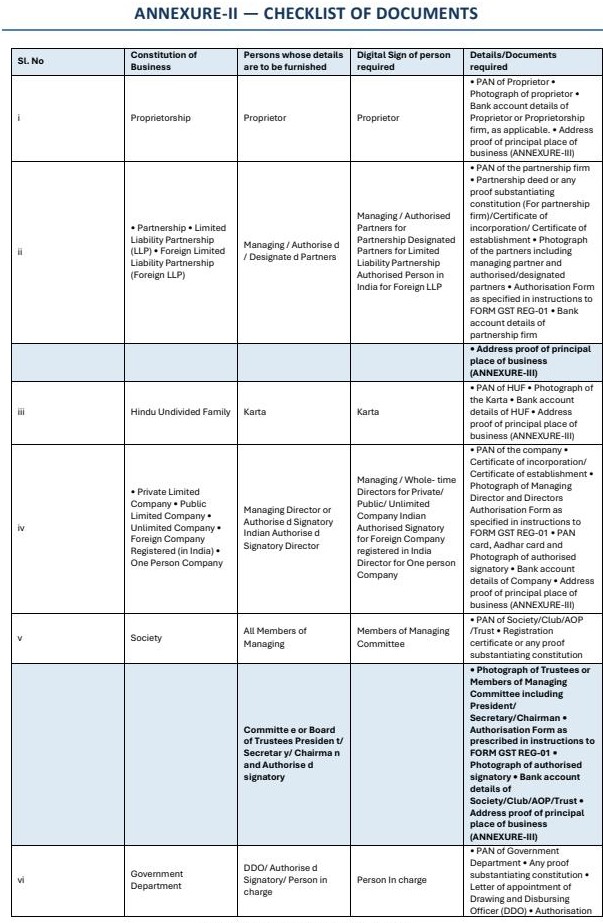
| Nature of Premises | Documents Required |
| Owned Property | Property Tax Receipt, Municipal Khata, Property Identification Document, Electricity Bill or Water Bill |
| Property of Deceased Ancestor | Death Certificate + Affidavit + Ownership Proof |
| Rented Property | Rent/Lease Agreement + Ownership Proof |
| No Rent Agreement | Undertaking + Utility Bill |
| Consent-Based Property | Consent Letter + Ownership Proof |
| Co-working Space | Membership Agreement + Supporting Ownership/Rent Documents |
| SEZ Unit | LOA/LOP from Development Commissioner |
Family Property Cannot Be Treated as Owned Property
CBIC has specifically clarified that if the property belongs to Father, Mother, Spouse, Brother/Sister, Director and Partner. then it cannot be selected as“Owned Premises”.The taxpayer must choose Consent-Based Premises and upload a consent letter along with ownership proof.
Co-Working Space Registration Clarified
GST registration can now be taken from co-working spaces provided A specified desk/cabin/workstation is allotted, Membership agreement is available, Ownership or lease documents of the co-working provider are uploaded. This will benefit startups, freelancers and professionals.
Aadhaar Authentication Strongly Recommended
| Scenario | Registration Timeline |
| Aadhaar Authentication Completed | Within 7 Working Days |
| No Aadhaar Authentication | Up to 30 Days with Physical Verification |
| Rule 14A Registration | Within 3 Working Days |
| Rule 14B Registration | Electronic grant after verification |
Mandatory Business Constitution Documents
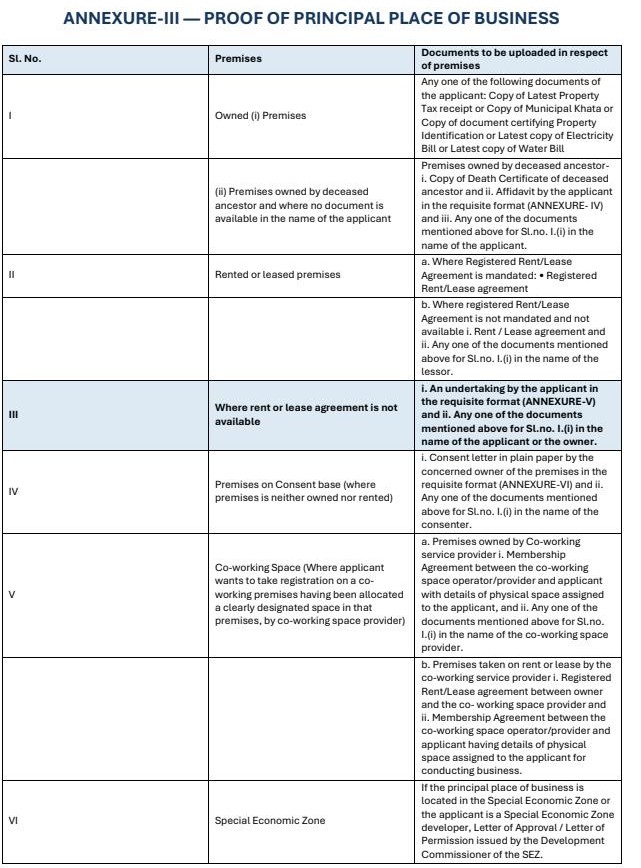
GST applicants must now upload prescribed constitutional documents.
| Entity Type | Documents Required |
| Proprietorship | PAN, Photo, Bank Details |
| Partnership | Partnership Deed |
| LLP | Incorporation Certificate, LLP Details |
| Company | COI, Director Details, Resolution |
| Trust | Registration Certificate |
| Society | Registration Certificate |
| Government Department | Constitution Proof |
Bank Account Requirements Clarified
CBIC has stated Bank account details are not mandatory at the time of registration. However, they must be furnished within 30 days of registration or before filing GSTR-1, whichever is earlier. Account must be linked to the PAN of the applicant.
Officers Cannot Ask for Unnecessary Documents
CBIC has specifically instructed officers not to seek unrelated documents, such as Udyam Registration Certificate, Residential address in same city, Proof that premises is commercial, Photographs of business activity, Additional ownership documents beyond prescribed list, Personal assumptions regarding business operations, only prescribed documents can be requested.
Complete Address Becomes Critical
Applicants must provide Building No./Flat No,Street Name, Locality, District, PIN Code, Landmark, Latitude & Longitude (where possible). Vague addresses can result in GST registration notices or rejection.
Simplified Registration (Rule 14A) Continues
Small taxpayers may continue to opt for Rule 14A where B2B GST liability does not exceed INR 2.50 lakh per month.Aadhaar authentication is completed. And Registration is granted automatically within 3 working days.
Practical Impact for Taxpayers
| Category | Impact |
| Startups | Easier registration through co-working spaces |
| LLPs & Companies | Clear document list reduces notices |
| Online Sellers | Can register in multiple states through Rule 14B |
| Proprietors | Simplified ownership and consent documentation |
| Consultants & Professionals | Less litigation on address proof |
| GST Practitioners | Standardized registration documentation |
Key Takeaway – New GST Registration Guidelines from 1 November 2026
The biggest reform from 1 November 2026 is the introduction of Rule 14B, permitting e-commerce sellers to obtain GST registration in states where they have no physical office by using an approved e-commerce warehouse. Simultaneously, CBIC has standardized the entire GST registration process by prescribing exact documentation requirements for owned premises, rented premises, consent-based properties, co-working spaces, LLPs, companies, and other business entities, while restricting officers from demanding documents beyond the prescribed checklist