
GST Credit vs Debit Note: Meaning, Accounting, ITC Impact
Page Contents
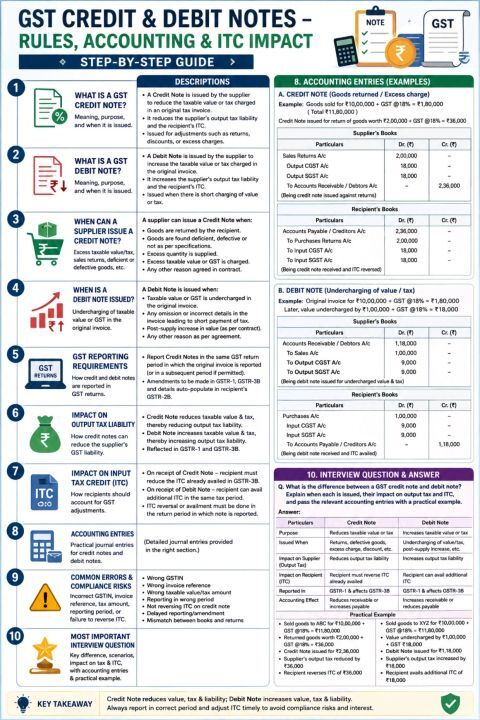
GST Credit Note vs Debit Note: Complete Guide to Meaning, Accounting Entries, ITC Impact & GST Compliance
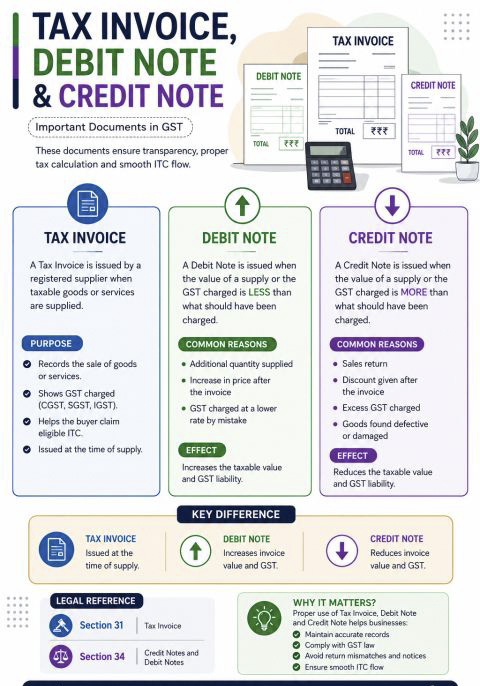
🔹 Credit Note
- Issued when the taxable value or goods and services tax charged earlier needs to be reduced (subject to GST law conditions).
- May arise due to sales return, post-sale discount, deficiency in goods/services, etc.
- Results in a reduction of the supplier’s output tax liability, where legally permissible.
- The recipient must reverse/reduce the corresponding input tax credit to the extent attributable to the credit note.
🔹 Debit Note
- Issued when the taxable value or goods and services tax charged earlier needs to be increased.
- May arise due to underbilling, price revision upward, short recovery of tax, etc.
- Results in an increase in the supplier’s output tax liability.
- The recipient may claim additional input tax credit, subject to eligibility and other provisions of the GST law.
Difference between a GST credit note and debit note:
GST Credit Notes and Debit Notes, their accounting treatment, goods and services tax implications, ITC impact, return reporting, and compliance requirements. Here’s a simplified explanation:
| Particulars | Credit Note | Debit Note |
|---|---|---|
| Meaning | Issued to reduce the taxable value or GST charged in the original invoice | Issued to increase the taxable value or GST charged in the original invoice |
| Issued By | Supplier | Supplier |
| Effect on Invoice Value | Reduces invoice value | Increases invoice value |
| GST Impact | May reduce supplier’s output tax liability (subject to legal conditions) | Increases supplier’s output tax liability |
| Recipient’s ITC | Recipient must reverse/reduce input tax credit proportionately | Recipient may claim additional input tax credit, if eligible |
| Common Reasons | Sales return, post-sale discount, short supply, defective goods/services | Price revision upward, under-billing, short tax charged |
| Accounting Impact | Reduces revenue and goods and services tax liability | Increases revenue and goods and services tax liability |
1. When is a GST Credit Note Issued?
A supplier issues a credit note when goods are returned by the customer, goods are found defective, there is a deficiency in services, a post-sale discount is provided, and the taxable value or goods and services tax originally charged exceeds the correct amount. Example
Original Invoice:
- Taxable Value = ₹100,000
- GST @18% = ₹18,000
Later, goods worth ₹20,000 are returned.
Credit Note:
- Value Reduction = ₹20,000
- GST Reduction = ₹3,600
Supplier’s Entry
Sales Return A/c Dr.       ₹20,000
Output CGST A/c Dr.         ₹1,800
Output SGST A/c Dr.         ₹1,800
      To Customer A/c              ₹23,600
Recipient’s Entry
Supplier A/c Dr.           ₹23,600
      To Purchase Return A/c     ₹20,000
      To Input CGST A/c           ₹1,800
      To Input SGST A/c           ₹1,800
The recipient reverses ITC of ₹3,600.
2. When is a GST Debit Note Issued?
A supplier issues a debit note when the invoice value was understated, an additional quantity was supplied, the price escalated after invoicing, and GST was short-charged originally. Example
Original Invoice:
- Taxable Value = ₹1,00,000
- GST @18% = ₹18,000
Later, value revised to:
- ₹1,10,000
Increase:
- Value = ₹10,000
- GST = ₹1,800
Debit Note issued for ₹11,800.
Supplier’s Entry
Customer A/c Dr.           ₹11,800
      To Sales A/c                ₹10,000
      To Output GST A/c            ₹1,800
Recipient’s Entry
Purchase A/c Dr.           ₹10,000
Input GST A/c Dr.           ₹1,800
      To Supplier A/c             ₹11,800
The recipient can claim additional ITC of ₹1,800, subject to eligibility.
3. GST Return Reporting
- Credit Note: Reported in GSTR-1 of the supplier and reflected in the recipient’s GSTR-2B. Tax liability reduction is permitted only if conditions under goods and services tax law are satisfied.
- Debit Note : Reported in GSTR-1 of the supplier and reflected in the recipient’s GSTR-2B. Additional tax liability becomes payable in the reporting period.
4. Impact on Input Tax Credit (ITC)
- Credit Note: Recipient must reduce eligible input tax credit and reverse the input tax credit where required. Because the tax component itself has been reduced.
- Debit Note: The recipient may Claim additional input tax credit, Subject to Section 16 conditions and time limits
5. Key Compliance Risks
- Wrong GSTIN, wrong invoice reference, improper tax adjustment, non-reversal of ITC on credit note, delay in reporting documents, and mismatch between books and GST returns. These issues can lead to interest, penalty, ITC disallowance, and GST notices.
What is the difference between a GST credit note and debit note?
| Basis | Credit Note | Debit Note |
|---|---|---|
| Purpose | Reduce taxable value/tax | Increase taxable value/tax |
| Supplier’s Output Tax | Decreases | Increases |
| Recipient ITC | Reversed/Reduced | Additional ITC available |
| Revenue Impact | Reduces revenue | Increases revenue |
| Typical Cases | Sales return, discount, defects | Price escalation, short billing |
| GST Liability | Reduced (subject to conditions) | Increased immediately |
Ultimate Takeaway- Golden Rule:
- Credit Note = Reduction in Tax Liability: Credit Note = Reduction in value, tax and (subject to law) supplier’s GST liability
- Debit Note = Increase in Tax Liability. Debit Note = Increase in value, tax and supplier’s GST liability
- The recipient must appropriately adjust input tax credit whenever a GST Credit Note results in a reduction of eligible input tax credit. So the recipient must adjust ITC accordingly: reverse input tax credit for credit notes and claim additional eligible input tax credit for debit notes.
At a Glance: goods and services tax Credit Note vs Debit Note
| Particulars | Credit Note | Debit Note |
|---|---|---|
| Purpose | Reduce taxable value/tax | Increase taxable value/tax |
| Supplier’s Output Tax Liability | Decreases (subject to conditions) | Increases |
| Recipient’s input tax credit | Reduced/Reversed, as applicable | Additional input tax credit may be claimed, if eligible |
| Common Reasons | Sales return, discount, deficiency in supply | Underbilling, price escalation, short tax charged |