
Differences Ind AS (India), IFRS (Global), & US GAAP (USA)
Page Contents
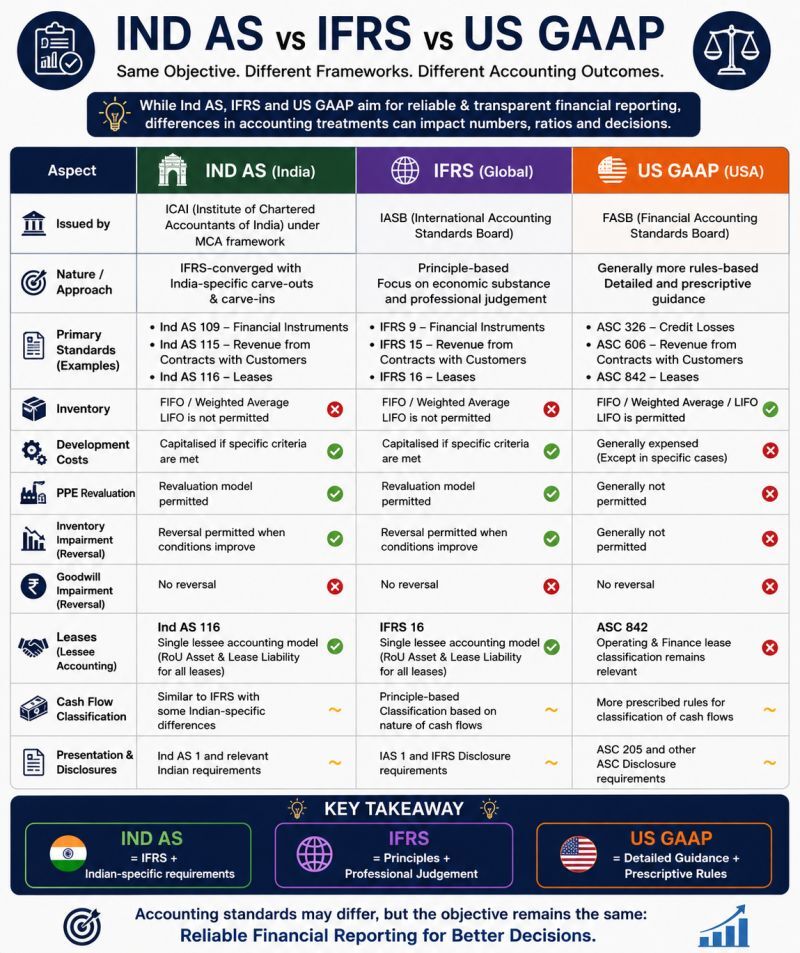
IFRS vs Ind AS vs US GAAP: A Simple Comparison Every Finance Professional Should Know
Financial reporting standards may appear similar at first glance, but the philosophy behind them and their practical application can lead to significantly different accounting outcomes.
IFRS (International Financial Reporting Standards)
- Issued by the International Accounting Standards Board (IASB)
- Adopted in 140+ jurisdictions globally
- Based on a principle-driven approach
- Emphasizes economic substance over legal form
- Allows greater professional judgment in applying accounting standards
- Enhances global comparability of financial statements
Ind AS (Indian Accounting Standards)
- India’s accounting framework converged with IFRS
- Notified by the Ministry of Corporate Affairs (MCA)
- Mandatory for specified classes of Indian companies
- Largely aligned with IFRS, but includes India-specific carve-outs and carve-ins
- Balances international best practices with local regulatory, legal, and economic requirements
- Improves comparability of Indian companies with global peers
US GAAP (Generally Accepted Accounting Principles)
- Issued by the Financial Accounting Standards Board (FASB)
- Predominantly followed in the United States
- Based on a rules-driven framework
- Contains detailed guidance for a wide range of accounting scenarios
- Focuses on consistency and compliance through prescriptive requirements
- Reduces ambiguity but offers less flexibility than IFRS
Key Differences: Ind AS (India), IFRS (Global), and US GAAP (USA)
- Compares Ind AS (India), IFRS (Global), and US GAAP (USA). Here’s a simplified tabular comparison:
| Aspect | Ind AS (India) | IFRS (Global) | US GAAP (USA) |
|---|---|---|---|
| Issued By | ICAI under MCA framework | IASB (International Accounting Standards Board) | FASB (Financial Accounting Standards Board) |
| Approach | IFRS-converged with Indian carve-outs and modifications | Principles-based | More rules-based and detailed |
| Financial Instruments | Ind AS 109 | IFRS 9 | ASC 326 |
| Revenue Recognition | Ind AS 115 | IFRS 15 | ASC 606 |
| Leases | Ind AS 116 | IFRS 16 | ASC 842 |
| Inventory Valuation | FIFO, Weighted Average; LIFO not allowed | FIFO, Weighted Average; LIFO not allowed | FIFO, Weighted Average, LIFO allowed |
| Development Costs | Capitalized if specified criteria are met | Capitalized if specified criteria are met | Generally expensed as incurred |
| PPE Revaluation | Revaluation model permitted | Revaluation model permitted | Generally not permitted |
| Inventory Impairment Reversal | Allowed if conditions improve | Allowed if conditions improve | Not allowed |
| Goodwill Impairment Reversal | Not allowed | Not allowed | Not allowed |
| Lessee Accounting | Single lease accounting model (ROU Asset + Lease Liability) | Single lease accounting model (ROU Asset + Lease Liability) | Operating and Finance lease distinction retained |
| Cash Flow Classification | Similar to IFRS with some India-specific differences | Principle-based classification | More prescriptive guidance |
| Presentation & Disclosures | Ind AS 1 and Indian regulatory requirements | IAS 1 and IFRS disclosure requirements | ASC disclosure requirements |
Key Differences at a Glance: Ind AS vs IFRS and IFRS vs US GAAP
| Area | Ind AS vs IFRS | IFRS vs US GAAP |
|---|---|---|
| Framework | Ind AS is based on IFRS but includes Indian carve-outs | IFRS is principles-based; US GAAP is rules-based |
| Inventory | Same as IFRS (LIFO prohibited) | US GAAP allows LIFO |
| Development Costs | Capitalization allowed | US GAAP usually requires expensing |
| Asset Revaluation | Allowed | US GAAP generally prohibits revaluation |
| Impairment Reversal | Allowed for inventory | US GAAP does not allow reversal |
| Lease Accounting | Similar to IFRS | US GAAP maintains two lease classifications |
| Standard | Essence |
|---|---|
| Ind AS | IFRS + Indian regulatory modifications |
| IFRS | Principle-based, globally accepted framework |
| US GAAP | Detailed rule-based framework mainly used in the United States |
Quick Comparison
| Particulars | IFRS | Ind AS | US GAAP |
|---|---|---|---|
| Issued By | IASB | MCA/ICAI | FASB |
| Approach | Principle-based | IFRS-converged | Rule-based |
| Professional Judgment | High | Moderate to High | Limited |
| Global Adoption | 140+ Countries | India | USA |
| Flexibility | Higher | Moderate | Lower |
| Revaluation of PPE | Allowed | Allowed | Generally Not Allowed |
| Development Costs | Capitalized (subject to conditions) | Capitalized (subject to conditions) | Generally Expensed |
| LIFO Inventory Method | Not Allowed | Not Allowed | Allowed |
Key Takeaway
- IFRS = Principles + Professional Judgment
- Ind AS = IFRS + Indian Regulatory Realities
- US GAAP = Detailed Rules + Compliance Precision
Understanding these frameworks is essential for:
- Cross-border listings
- Group consolidations
- Mergers & Acquisitions (M&A)
- Global audits
- Multinational financial reporting
- Foreign investments and fund raising
For a CA or finance professional, the most exam- and practice-relevant differences are LIFO treatment, capitalization of development costs, asset revaluation, impairment reversals, and lease accounting.