
Guide for Taxpayers on Form 16, Form 16A & Form 26AS
Page Contents
Understanding Form 16, Form 16A & Form 26AS: A Complete Guide for Taxpayers
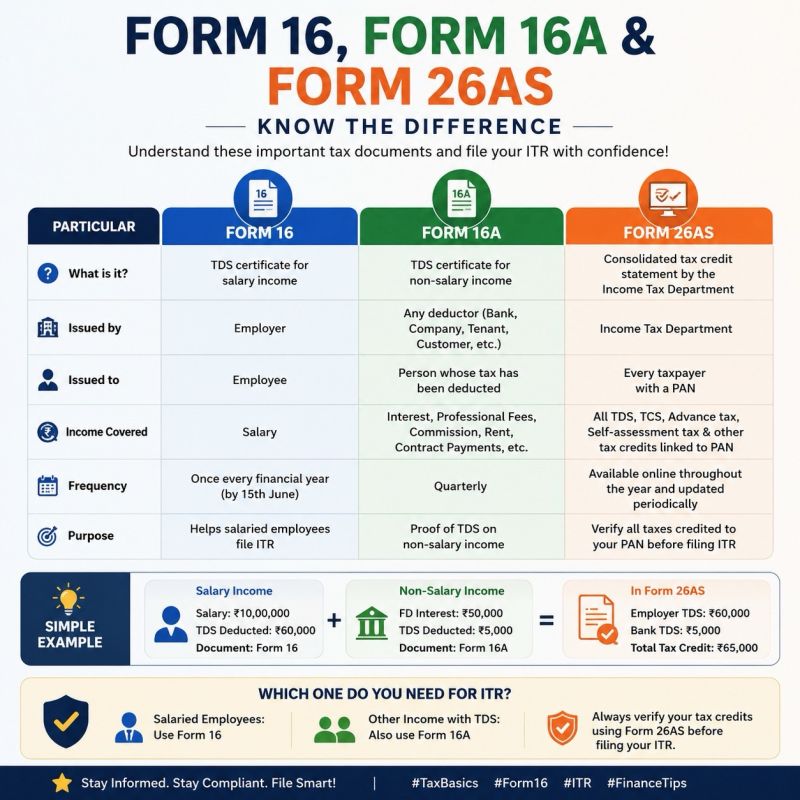
When filing your Income Tax Return (ITR), three important documents often come into the picture: Form 16, Form 16A, and Form 26AS. While all three are related to taxes and tax deductions at Source, they serve different purposes. Let’s simplify them.
1. Form 16 – TDS Certificate for Salary Income
What is Form 16?
Form 16 is a certificate issued by an employer to an employee showing:
- Total salary paid during the financial year
- Tax deducted from salary
- Details of deductions claimed under Chapter VI-A
- Exemptions and taxable income computation
Who Issues It? : Employer
WhoReceives It? : Salaried Employee
Why Is It Important?
- Acts as proof of tax deducted from salary.
- Helps in preparing and filing ITR.
- Provides a detailed breakup of salary and deductions.
Example : If your annual salary is INR 10,00,000 and your employer has deducted TDS of INR 60,000, these details will appear in Form 16.
2. Form 16A – Tax Deducted at Source Certificate for Non-Salary Income
What is Form 16A? : Form 16A is a tax deduction from salary certificate issued for income other than salary.
- Common Sources Covered: Bank FD Interest, Professional Fees, Commission Income, Rent Payments, Contractual Payments and Brokerage
- Who Issues It? : Deductor (Bank, Company, Tenant, Customer, etc.)
- WhoReceives It? : Person whose tax has been deducted
- Frequency : Issued quarterly
Why Is It Important?
It provides proof that tax has been deducted on non-salary income and deposited with the government. Example: Suppose FD Interest = INR 50,000 and Tax Deducted at Source Deducted = INR 5,000, then The bank will issue Form 16A reflecting these details.
3. Form 26AS – Your Tax Passbook
What is Form 26AS? : Form 26AS is a consolidated tax statement maintained against your PAN. Think of it as your tax passbook. It shows all taxes credited against your PAN during the financial year. Contains Details Of
- Tax Deducted at Source deducted by employers
- TCS (Tax Collected at Source)
- Tax Deducted at Source deducted by banks and other deductors
- Advance Tax paid
- Self-Assessment Tax paid
- Refunds received
- High-value financial transactions
Who Issues It? : Income Tax Department
WhoCan Access It? : Every PAN holder through the Income Tax Portal
Why Is It Important? : Before filing your return, you should verify whether all taxes deducted from your income are actually reflected in Form 26AS.
Quick Comparison—Form 16, Form 16A, and Form 26AS
| Particulars | Form 16 | Form 16A | Form 26AS |
|---|---|---|---|
| Purpose | Salary TDS Certificate | Non-Salary Tax Deducted at Source Certificate | Consolidated Tax Statement |
| Issued By | Employer | Deductor (Bank, Tenant, Company, etc.) | Income Tax Department |
| Income Covered | Salary | Interest, Rent, Professional Fees, Commission, etc. | All Tax Credits |
| Frequency | Yearly | Quarterly | Continuous Updates |
| Used For | Salary ITR Filing | Reporting Other Income | Verification of Tax Credits |
Simple Illustration
- Salary Income: Salary: INR 1,000,000, TDS by Employer: INR 60,000, and Document: Form 16
- FD Interest: Interest Income: INR 50,000, TDS by Bank: INR 5,000 and Document: Form 16A
- Form 26AS Will Show: Employer Tax Deducted at Source: INR 60,000 and Bank Tax Deducted at Source: INR 5,000
Total Tax Credit Available = INR is 65,000
Why Cross-Verification Is Important
Many taxpayers make the mistake of relying only on Form 16 or Form 16A while filing returns.
Before filing your ITR:
- Match Tax Deducted at Source in Form 16 with Form 26AS
- Verify that all tax credits are appearing correctly
- Match Tax Deducted at Source in Form 16A with Form 26AS
- Report all income, including interest income
Failure to do so may result in:
- Tax notices
- Lower refunds
- Tax credit mismatch
- Additional tax demand
Form 16 and Form 16A are supporting documents, but Form 26AS is the final tax credit record maintained by the Income Tax Department. If Tax Deducted at Source appears in Form 16 or Form 16A but is not reflected in Form 26AS, contact the deductor immediately and get the correction made before filing your return. Key Takeaway
Form 16 = Salary Income + Tax Deducted at Source Proof
Income tax Form 16A = Non-Salary Income + Tax Deducted at Source Proof
Form 26AS = Master Tax Statement Showing All Tax Credits Linked to Your PAN
Always check Form 26AS before submitting your ITR to ensure that every rupee of Tax Deducted at Source deducted from your income is correctly credited to your PAN.
Preparing for the Transition from Form 16 & Form 16A to Form 130 & Form 131
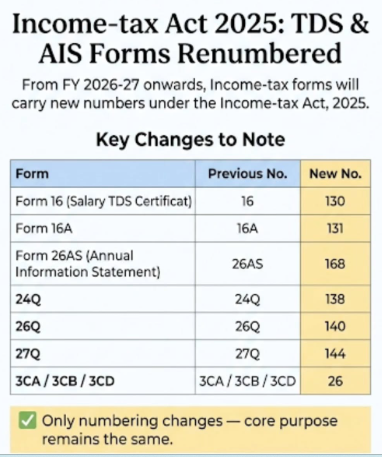
- While Form 16 and Form 16A will continue to be applicable for FY 2025-26, taxpayers, employers, and businesses should start preparing for a significant change in the Tax Deducted at Source reporting framework under the Income Tax Act, 2025.
- The new tax law introduces Form 130 and Form 131, which will replace the existing Tax Deducted at Source certificates and become the standard documents for reporting tax deducted at source from Tax Year (TY) 2026-27 onwards.
What Changes Under the New Income Tax Act, 2025?
Under the new regime:
- Form 130 will replace Form 16 for salary income.
- Form 131 will replace Form 16A for non-salary income.
These new forms are intended to streamline Tax Deducted at Source reporting while maintaining the same objective of providing taxpayers with proof of tax deducted and deposited against their PAN.
Form 130: Replacement for Form 16
Form 130 will become the primary salary tax deduction at source certificate under the Income Tax Act, 2025. Similar to Form 16, it will contain details such as:
- Salary income earned during the year
- Tax deducted at source
- Exemptions claimed
- Deductions claimed under eligible provisions
- Total tax liability
- Taxes paid and deposited
For salaried employees, Form 130 will continue to be a key document for filing income tax returns and reconciling tax credits.
Form 131: Replacement for Form 16A
Form 131 will replace Form 16A and will be issued for non-salary income where Tax Deducted at Source has been deducted.
This may include:
- Interest income
- Professional fees
- Commission income
- Rent payments
- Contract payments
- Other specified payments subject to Tax Deducted at Source
Like Form 16A, Form 131 will serve as proof that tax has been deducted and deposited with the government.
Key Compliance Deadlines
| Description | Period | Applicable Form | Due Date |
|---|---|---|---|
| Salary Tax Deducted at Source Certificate | FY 2025-26 | Form 16 | 15 June 2026 |
| Non-Salary Tax Deducted at Source Certificate | January-March 2026 Quarter | Form 16A | 15 June 2026 |
| Salary Tax Deducted at Source Certificate | TY 2026-27 | Form 130 | 15 June 2027 |
| Non-Salary Tax Deducted at Source Certificate | TY 2026-27 Onwards | Form 131 | As prescribed under the new law |
What Should Businesses and Taxpayers Do?
To ensure a smooth transition:
- Review existing payroll and Tax Deducted at Source compliance processes.
- Update accounting and tax software to accommodate the new forms.
- Train finance and HR teams on the revised reporting requirements.
- Monitor notifications and implementation guidelines issued by the Income Tax Department.
- Continue complying with existing Form 16 and Form 16A requirements until the new framework becomes effective.
The shift from Form 16 and Form 16A to Form 130 and Form 131 marks an important step in the modernization of India’s tax administration system. While the purpose of the certificates remains largely unchanged, businesses should proactively prepare for the transition to avoid compliance challenges.
For FY 2025-26, continue using Form 16 and Form 16A. Beginning with TY 2026-27, taxpayers and deductors should be ready to adopt Form 130 and Form 131 under the Income Tax Act, 2025.