
Income Tax Changes Salaried Employees Coming from April 2026
Page Contents
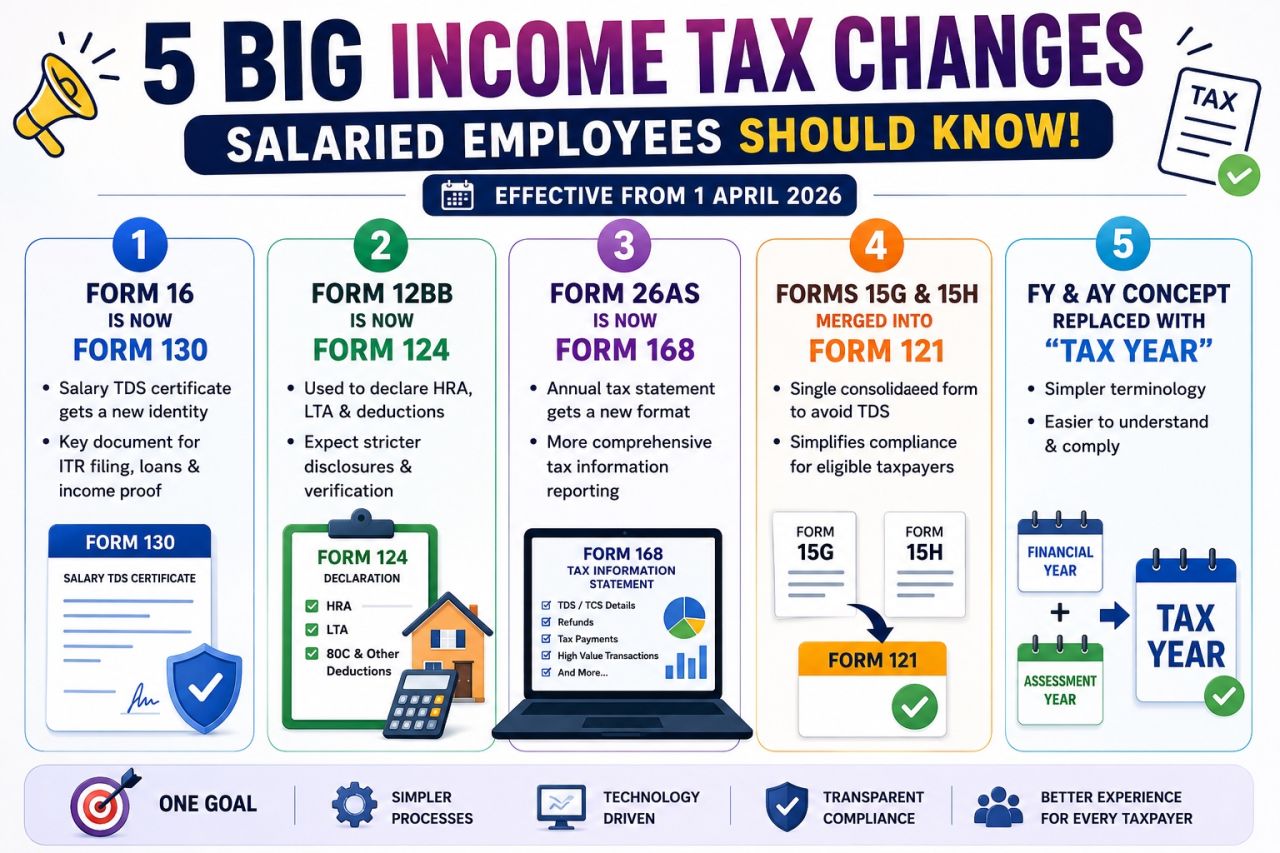
Salaried Employees: Big Income Tax Changes Coming from April 2026!
India’s upcoming I. Tax Act, 2025, is set to bring a major overhaul in tax forms and compliance processes (with effect from 1 April 2026) While the underlying tax rules may remain largely similar, the framework is being restructured to create a simpler, more technology‑driven, and transparent tax system. The new income tax system is moving from “form-based compliance” to “data-driven compliance” (with effect from 1 April 2026)
For salaried employees, the biggest impact will be visible in salary documentation formats (Form 16 and declarations being renumbered). Tax Deducted at Source reporting systems and employer compliance workflows and tax filing terminology and structure (introduction of “Tax Year”). These changes are not just cosmetic; they mark a shift toward standardized and logically numbered forms, increased data integration through the Annual Information Statement and Taxpayer Information Summary, reduced manual errors, and higher cross-verification.
CLARIFICATIONS RELATED TO SALARIED EMPLOYEES’ CHANGES ON THE NEW INCOME TAX ACT CHANGES
-
Form Renumbering Is Primarily Structural
The proposed legislation reorganizes provisions, schedules, and forms into a new numbering framework. Therefore
- Form 16 : likely renumbered as Income tax Form 130
- Income tax Form 12BB : likely renumbered as Form 124
- Form 26AS : proposed as Income tax Form 168
- Income tax Form 15G/15H : proposed consolidated Income tax Form 121
These changes are largely administrative and structural in nature. The underlying compliance purpose of these forms remains substantially similar unless notified otherwise through detailed rules. (with effect from 1 April 2026)
“Primarily a structural renumbering with limited functional change, subject to detailed rules.”
Major Impact Areas for Salaried Employees
Salary Documentation & Employer Compliance:
- Employers may need to update payroll software and human resource management system systems, revise employee declaration formats, reconfigure tax-deducted-at-source reporting workflows, and integrate stronger digital verification mechanisms.
- Employees should expect more data-linked validations, a reduced scope for manual mismatches, and increased cross-verification of deductions/exemptions.
- Salary Documentation & Employer Compliance changes reduced manual mismatches & increased cross-verification. This is exactly the direction of Annual Information Statement and Taxpayer Information Summary
House Rent Allowance & Deduction Verification Could Become Stricter
- The proposed replacement of Form 12BB with Form 124 may indicate Permanent Account Number linked landlord validation, Better Annual Information Statement and Taxpayer Information Summary integration, Automated mismatch detection , Digital documentation requirements.
- This may especially affect House Rent Allowance claims, home loan interest claims, Section 80C investments, Leave Travel Allowance exemptions, Likely integration with Annual Information Statement and Taxpayer Information Summary reconciliation engines for automated mismatch detection
Form 26AS Expansion Is Significant
- The proposed Form 168 is expected to function more like a consolidated taxpayer information statement rather than merely a tax deducted at Source Potential inclusions may cover salary tax deducted at source, high-value financial transactions, foreign remittances, securities transactions, Property transactions, goods and services tax-linked reporting, and interest/dividend income reconciliation.
- This aligns with the government’s broader move toward pre-filled and analytics-driven compliance. A shift from a tax-deducted-at-source statement is full financial information layer”
The Tax Year concept will reduce confusion:
- Replacing “Previous Year” with “Assessment Year” with a single “Tax Year” concept is one of the most taxpayer-friendly proposals. Currently, many taxpayers confuse FY 2025-26 and AY 2026-27 . Under the new framework, a single unified “tax year” terminology may simplify return filing, notices, and compliance communication.