
ICAI New Policy on Extremely Low Fee Quotation in CA Tender
Page Contents
ICAI’s Policy on Extremely Low Fee Quotations in Tenders: Disciplinary Ethical Implications & Practical Guidance
Very Important Decision by ICAI to Curb Unethical Fee Undercutting
A welcome and much-needed step by the Institute of Chartered Accountants of India to protect the dignity, quality, and sustainability of the profession.
What has ICAI decided?
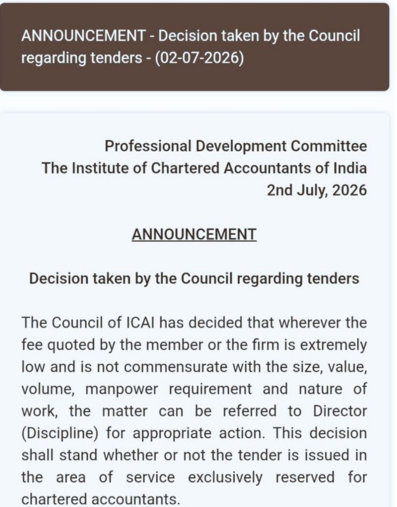
As per the ICAI Professional Development Committee Announcement Council decision dated 02 July 2026, if a chartered accountant or a CA firm quotes an extremely low fee in a tender that is not commensurate with the size, value, volume, manpower requirement, and nature of work, the matter may be referred to the Director (Discipline) for appropriate disciplinary action.
The Institute of Chartered Accountants of India Council’s announcement, but a few statements should be moderated because the announcement itself is relatively brief and does not prescribe detailed disciplinary criteria or define what constitutes an “extremely low” fee. It is better to distinguish between what The Institute of Chartered Accountants of India has officially stated and your professional analysis.
The decision applies to tenders for services exclusively reserved for chartered accountants and tenders for services not exclusively reserved for chartered accountants.
What is inferred (not expressly stated by ICAI)
The following points are reasonable professional interpretations, but they should be presented as analysis rather than official The Institute of Chartered Accountants of India policy: protection of audit quality, discouraging destructive fee undercutting, promoting ethical competition, maintaining the dignity of the profession, ensuring adequate deployment of manpower and professional resources, and protecting the public interest.
Similarly, statements such as “Professional services started being treated as a commodity.” “Threat to public interest.” And “Quality of professional work was compromised” are analytical observations and should not be attributed directly to ICAI unless specifically stated in the announcement.
Points requiring caution
The following statements in your write-up go beyond the official announcement: “ICAI now views such conduct more seriously.” Better wording: The Council has indicated that quoting an extremely low fee in such circumstances may warrant disciplinary scrutiny.
“Step 2: The Institute of Chartered Accountants of India will ask how many professionals were proposed, whether the fee was commercially viable, etc.” The announcement does not prescribe any investigation procedure. A safer wording is During disciplinary proceedings, the facts and circumstances of each case may be examined.
“The Institute of Chartered Accountants of India will likely examine each case based on turnover, audit hours, staffing requirements, and industry practices.” This is logical but speculative. Better wording As no quantitative benchmark has been prescribed, each case is expected to be assessed on its own facts and circumstances.
Important Clarifications: What ICAI Has Not Stated
Certain conclusions should be avoided because they are not expressly mentioned in the official announcement.
ICAI Has Not Declared Every Low Fee as Misconduct
A more accurate interpretation is that the Council has indicated that quoting an extremely low fee, where it is not commensurate with the assignment, may warrant disciplinary scrutiny.
The Institute of Chartered Accountants of India has Not Prescribed an Investigation Procedure
The announcement does not specify how disciplinary proceedings will be conducted. A balanced interpretation is that, during any disciplinary proceedings, the facts and circumstances of each case may be examined.
No Benchmark Has Been Prescribed for “Extremely Low Fee”
The Institute of Chartered Accountants of India has not specified minimum fee limits, percentage-based thresholds, standard fee schedules, or any mathematical formula. Accordingly, each matter is expected to be assessed on its own facts and circumstances.
Practical implications for practicing CAs
The decision is likely to have a significant impact on bank audits, internal audits, PSU and government tenders, Concurrent audits, stock audits, GST and tax-related assignments, and accounting, assurance, and advisory engagements.
Practicing chartered accountants should therefore quote fees that are commensurate with the scope and complexity of the assignment. Practicing Chartered Accountants must Maintain documentation supporting the basis of fee determination also Consider factors such as manpower, time commitment, travel, technology, reporting responsibilities and professional risk while quoting fees. Practicing CAs avoid fee quotations that could be perceived as commercially unrealistic merely to secure an assignment.
Conclusion
The announcement represents an important policy development by The Institute of Chartered Accountants of India. While it does not prohibit competitive pricing, it signals that quoting an extremely low fee, which is not commensurate with the size, value, volume, manpower requirement, and nature of the work, may attract disciplinary scrutiny.
Since no numerical benchmark has been prescribed, the assessment is likely to be made on a case-by-case basis, considering the specific facts and circumstances of each assignment.
As no numerical benchmark has been prescribed, each case is likely to be evaluated on its own facts and circumstances. A Welcome Move for the Profession. This decision is likely to:
- Promote quality over L1 (lowest fee) bidding.
- Enhance the credibility of audit and assurance services.
- Preserve the dignity and value of the CA profession.
- Strengthen public confidence in professional services rendered by chartered accountants.
- Protect ethical practitioners.
Accordingly, chartered accountants and CA firms should ensure that their fee quotations are commercially justifiable, professionally responsible, and capable of supporting the quality standards expected under the ICAI Code of Ethics and applicable professional standards.