TDS & TCS Changes in Budget 2026
Page Contents
TDS & TCS Changes (Effective from 1 April 2026): Budget 2026
The Indian Financial Budget 2026 introduces a major overhaul of India’s Tax Deducted at Source and Tax Collected at Source framework under the new Income Tax Act, with the central objective of simplifying compliance, reducing litigation, and unblocking working capital tied up due to high withholding and collection rates. The reforms rationalize multiple provisions and bring clarity to long-disputed areas such as manpower taxation, Tax Collected at Source on foreign remittances, and certificates for lower or nil deductions. Below is a detailed breakdown of the updates highlighted in budget 2026, which come to an effective date : All changes apply from 1 April 2026
Property Purchase from Non-Residents
- A major relief for resident property buyers, TAN is no longer required for deducting Tax Deducted at Source on payments to non-residents. Buyers can now use a PAN-based challan to deposit Tax Deducted at Source. This simplifies compliance for individuals, especially those making one-time NRI property purchases.
- Lower/Nil Tax Deducted at Source Certificates – Now Automated: A new rule-based automated system will issue lower/nil TDS certificates under Section 197. Manual approvals and officer discretion are eliminated. Faster processing will greatly benefit MSMEs and exporters facing cash flow stress due to excess TDS.
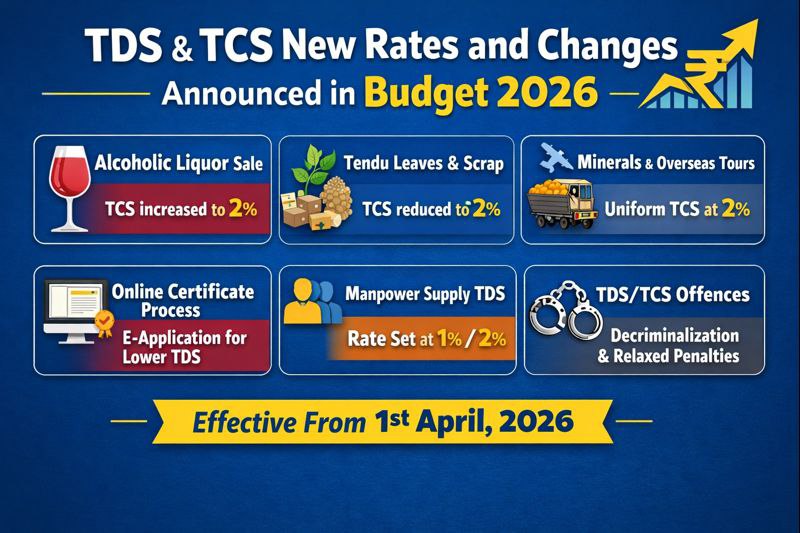
- Tendu Leaves & Scrap : Tax Collected at Source reduced to 2%. Previously applicable Tax Collected at Source rates (often higher for specific categories) have been rationalized. Which impact is beneficial for forest produce traders and scrap dealers?
- Minerals & Overseas Tours : Uniform TCS rate fixed at 2%. Earlier Tax Collected at Source on overseas tour packages could go up to 20%. Which impacts major relief for the travel industry and consumers.
- Motor Accident Claims – No Tax Deducted at Source : Interest awarded by Motor Accident Claims Tribunals (MACT) will not attract Tax Deducted at Source. Taxpayers ensure full compensation reaches victims and their families.
- Manpower Supply Services – Clear Classification: To end the long-standing confusion between Sections 194C and 194J. Manpower services are now explicitly classified under Section 194C (works contract). TDS Rates: 1% for Individuals/HUFs & 2% for Others (Companies, firms, LLPs, etc.). This will significantly reduce disputes during Tax Deducted at Source assessments and audits. Tax Deducted at Source Rate rationalization : Tax Deducted at Source rate set at 1% / 2% clarifies applicable rate brackets, reducing disputes on manpower vs. contract services classification. Which impacts that better predictability for staffing agencies and business directors.
Key TCS Changes (Effective 1 April 2026)
- Liberalized Remittance Scheme : To ease cash outflow burdens on families sending money abroad, Tax Collected at Source reduced it from 5% to 2% for education & medical treatment. This addresses the liquidity challenges caused by earlier higher Tax Collected at Source rates.
- Overseas Tour Packages – Flat Rate Regime : The previous dual structure (5% and 20%) is abolished. A single uniform TCS rate of 2% is introduced, offering significant relief for foreign travelers and travel companies.
- Tax Collected at Source on Alcoholic Liquor Sales: Tax Collected at Source increased to 2%. The earlier rate (generally 1%) has been revised upward. Which impact that higher upfront collection at source for liquor traders. A uniform 2% Tax Collected at Source will apply to alcoholic liquor, scrap, and minerals. This creates consistency across categories and simplifies compliance for traders.
- Tax Deducted at Source and Tax Collected at Source Offenses: Decriminalization & Relaxed Penalties. Minor defaults are likely moved from prosecution to penalty-based handling. And which impact that less litigation and more focus on compliance over punishment.
Administrative & Compliance Reforms in Budget 2026
- Reduced Penalties: Several minor Tax Deducted at Source and Tax Collected at Source defaults are now shifted from prosecution-based provisions to fee-based penalties, reducing litigation.
- Extended ITR Filing Deadline: For non-audited business cases and trusts, the ITR due date is extended to 31st August.
- Online Certificate Process : E‑application for Lower Tax Deducted at Source Certificates streamlines the process under section 197. Which impact faster approvals, reduced manual intervention, and better compliance.
- MSME-Focused Cash Flow Relief: The revamped Lower Tax Deducted at Source Certificate Scheme is expected to significantly help MSMEs suffering from high Tax Deducted at Source blocking their working capital.
These reforms aim to reduce compliance burden, minimize disputes and litigation, improve taxpayer cash flows, streamline foreign remittance processes, and digitize and automate withholding systems. The shift towards rationalized rates and automated processing marks a pro-taxpayer, pro-compliance direction under the new Income Tax Act.