
FAST-DS Foreign Asset Disclosure Scheme: Key Highlights
Page Contents
FAST-DS Foreign Asset Disclosure Scheme: Key Highlights for Taxpayers and Professionals
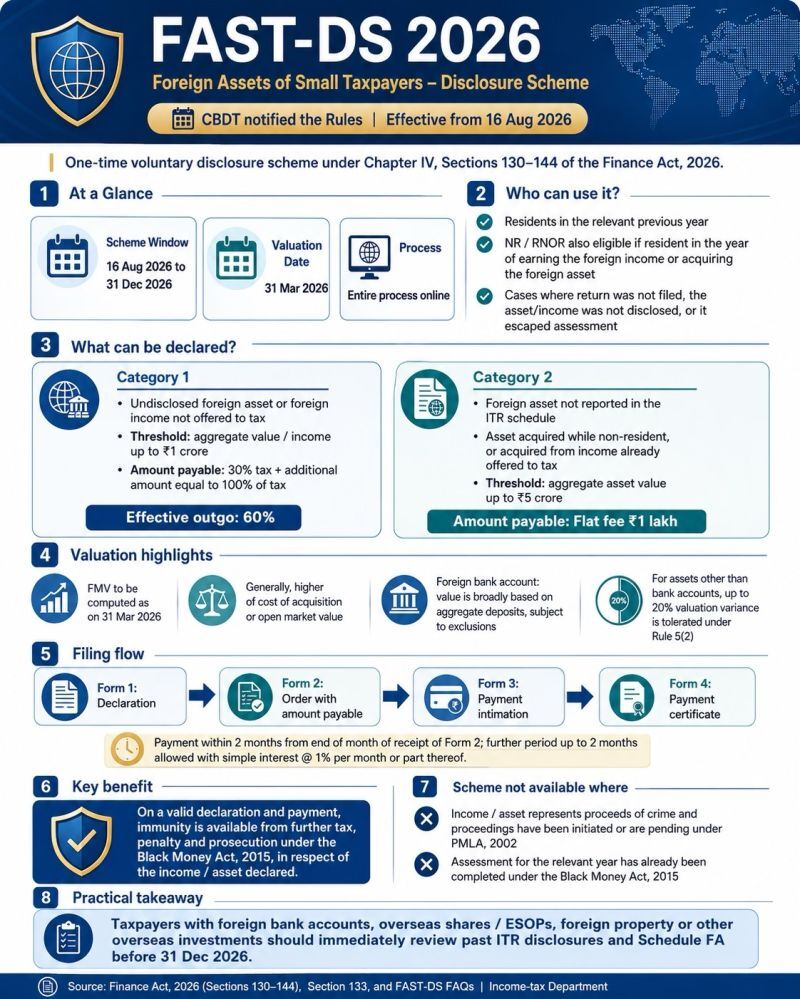
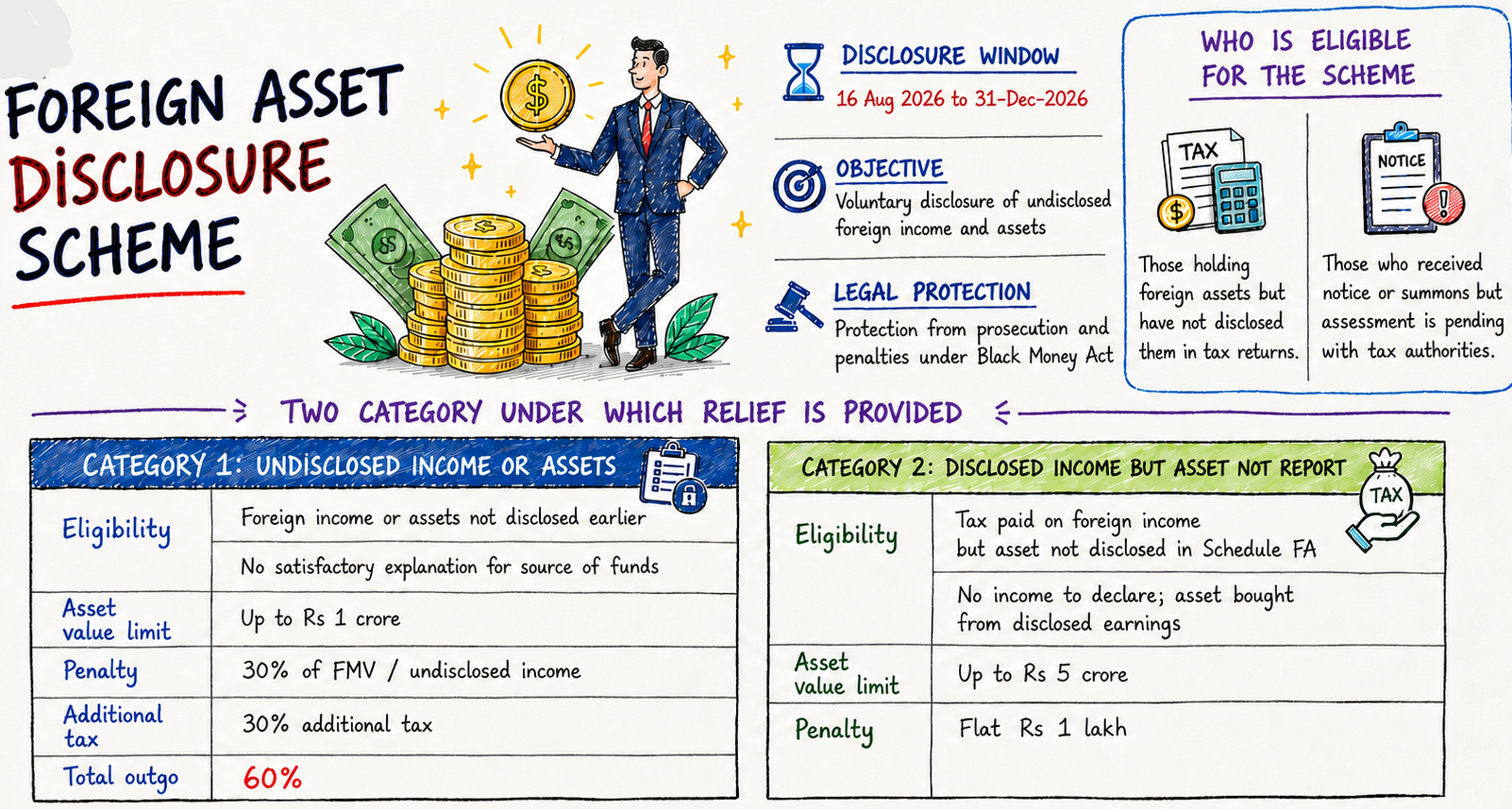
The Govt has proposed a foreign asset disclosure/amnesty framework known as FAST-DS (Foreign Assets and Specified Transactions Disclosure Scheme), aimed at encouraging voluntary compliance by taxpayers holding overseas assets and income. While detailed guidelines are awaited, the announcement suggests that certain low-risk foreign bank account holders may be exempt from making a declaration, whereas persons holding undisclosed foreign assets or foreign income may be provided an opportunity to regularize their tax affairs.
Exemption for Certain Foreign Bank Account Holders :
A taxpayer may not be required to file a declaration under FAST-DS (Foreign Assets and Specified Transactions Disclosure Scheme) where the following conditions are satisfied:
- The aggregate balance of all eligible foreign bank accounts does not exceed INR 20 lakh.
- Funds originate from fully disclosed and tax-paid sources.
- There is no undisclosed income associated with the account.
- The account does not contain unexplained credits, unaccounted cash deposits, or suspicious transactions.
- Illustrative Example : An Indian resident worked in the UAE for several years and maintained a savings account there. Upon returning to India, the account continues to hold approximately INR 12 lakh accumulated from disclosed salary income earned abroad. Assuming the funds are properly documented and no undisclosed income is involved, such an account may qualify for exemption from declaration under the proposed FAST-DS framework.
Cases Where Disclosure May Still Be Required
Undisclosed Foreign Income:
The exemption may not apply where foreign income has not been reported in India, such as:
- Rental income from overseas properties not disclosed in tax returns.
- Interest earned on foreign bank deposits that was not offered to tax.
- Dividends received from foreign investments but omitted from income tax filings.
Unexplained Credits or Deposits :
Disclosure may also become necessary where foreign accounts contain:
- Cash deposits without satisfactory source evidence.
- Transfers received through third-party arrangements.
- Funds arising from unreported business activities or other undisclosed sources.
Foreign Assets Other Than Bank Accounts :
The proposed exemption appears to be limited to qualifying bank account balances. Other foreign assets may continue to require disclosure, including:
- Foreign shares and securities.
- Overseas immovable property.
- Interests in foreign trusts or foundations.
- Crypto assets held outside India.
- Foreign partnership or business interests.
The final scope will depend on the scheme notification and CBDT guidelines.
One-Time Opportunity for Voluntary Disclosure :
The announcement indicates that taxpayers may be permitted to voluntarily disclose Foreign bank, accounts. Foreign financial assets, Previously unreported foreign income and Other overseas investments and holdings.
Proposed deadline: 31 December (subject to final notification). The likely objectives of the scheme are Encouraging voluntary tax compliance, Reducing disputes and litigation, bringing undisclosed overseas wealth into the formal tax system and Providing relief from more stringent consequences under anti-black money legislation.
Significance from a Compliance Perspective:
Foreign asset reporting remains a high-risk compliance area under Indian tax laws. Non-disclosure may attract proceedings under: The Black Money (Undisclosed Foreign Income and Assets) and Imposition of Tax Act, 2015, The Income-tax Act, 1961 and FEMA provisions, where applicable. Potential consequences of non-compliance may include Taxation of undisclosed foreign assets, Significant penalties, Prosecution in serious cases and Scrutiny of foreign remittances and overseas investments. Accordingly, taxpayers should carefully assess:
- Whether all foreign assets and accounts have been disclosed.
- WhetherSchedule FA disclosures were made wherever applicable.
- Whether foreign income has been appropriately offered to tax in India.
Rule 3 of FAST-DS Rules, 2026: Valuation of Foreign Assets for Disclosure
Rule 3 of the Foreign Assets of Small Taxpayers – Disclosure Scheme Rules, 2026 (FAST-DS Rules, 2026) prescribes the methodology for determining the Fair Market Value of foreign assets for the purposes of declaration under the Scheme. The valuation is required to be carried out as on the valuation date, i.e., 31 March 2026. Key Valuation Principles under Rule 3 of FAST-DS Rules, 2026
- General Rule for Fair Market Value (FMV)
For most foreign assets, the FMV shall generally be determined as the higher of:
-
- The actual cost of acquisition or amount invested; or
- Open market value of the asset as on 31 March 2026.
Where a reliable market valuation is not available, the value may be determined based on the prescribed indexed cost methodology under the Rules.
- Foreign Immovable Property and Tangible Assets
In the case of foreign immovable property, bullion, jewellery, precious stones, works of art, antiques, archaeological collections, or similar tangible assets, the value shall ordinarily be the higher of Cost of acquisition; or Open market value as on 31 March 2026, supported by an appropriate valuation report where required.
Where market valuation cannot be established, indexed cost may be considered in accordance with the Rules.
- Foreign Shares and Securities
The valuation mechanism differs depending on whether the securities are quoted or unquoted:
-
- Quoted Shares / Securities : FMV shall generally be the higher of Acquisition cost; or The average of the highest and lowest quoted price on a recognized stock exchange on the valuation date or the immediately preceding trading day.
- Unquoted Shares / Securities : Valuation shall be undertaken using the specific formula prescribed under Rule 3. Depending on the nature of the instrument, the Rules may require determination based on net asset value, open market value, or indexed cost principles.
- Foreign Bank Accounts
A significant feature of Rule 3 relates to the valuation of foreign bank accounts. For disclosure purposes, the value of a foreign bank account is generally calculated as:
-
- The aggregate of all deposits made into the account from the date of opening up to 31 March 2026; and
- Not merely the closing balance available on that date.
However, the following are generally excluded while computing the value:
-
- Amounts re-deposited out of withdrawals previously made from the same account; and
- Amounts already subjected to taxation and penalty under the relevant provisions of the Black Money (Undisclosed Foreign Income and Assets) and Imposition of Tax Act, 2015.
- Foreign Partnership, LLP and AOP Interests
Where a taxpayer holds an interest in a foreign Partnership Firm, Limited Liability Partnership, or Association of Persons. the value is generally determined with reference to:
-
- Net asset value of the entity as on 31 March 2026; and
- The taxpayer’s entitlement based on capital contribution, profit-sharing ratio, or dissolution rights.
- Other Foreign Assets (Residual Category)
For foreign assets not specifically covered elsewhere under Rule 3, the valuation shall generally be the higher of Cost or amount invested; or Arm’s length open market value on the valuation date. Where market ascertainment is impracticable, indexed cost principles may apply.
- Reinvestment Adjustments and Currency Conversion
The Rules also contain provisions for:
-
- Avoiding duplication where disclosed funds have been reinvested into other foreign assets;
- Adjustments for tracing movement of funds between different foreign assets; and
- Conversion of foreign currency values into Indian Rupees.
For currency conversion:
-
- Assets denominated in major foreign currencies are generally converted using the Reserve Bank of India Reference Rate as on 31 March 2026.
- Where the currency is not directly notified by Reserve Bank of India, conversion may first be made into USD and thereafter into INR.
Practical Illustration : Suppose a taxpayer acquired a foreign apartment in Dubai for INR 80 lakh and its open market value on 31 March 2026 is INR 1.20 crore. Under Rule 3, the value for disclosure purposes would generally be: Fair Market Value = INR 1.20 crore (higher of cost and market value).
Similarly, if a foreign bank account has a closing balance of only INR 10 lakh, but total eligible deposits since opening amount to INR 45 lakh, the value considered for disclosure may be INR 45 lakh, subject to permissible exclusions under the Rules.
Practical Checklist for Chartered Accountants
| Area for Review | Action Required |
| Foreign bank accounts | Verify whether aggregate balance exceeds INR 20 lakh |
| Source of funds | Obtain salary records, foreign tax returns, remittance proofs, bank statements |
| Foreign income | Review interest, dividends, rental income, capital gains and other earnings |
| Schedule FA compliance | Examine disclosures in prior income tax returns |
| Other overseas assets | Identify foreign property, securities, crypto holdings, trusts, etc. |
| Undisclosed items | Evaluate whether voluntary disclosure under FAST-DS (Foreign Assets and Specified Transactions Disclosure Scheme) should be considered before the prescribed deadline |
Example : A taxpayer holds
- Singapore bank account: INR 8 lakh
- UK bank account: INR 6 lakh
- US bank account: INR 4 lakh
- Total balance: INR 18 lakh
If all balances arise from disclosed salary income and there are no unexplained deposits or undisclosed earnings, the proposed exemption may be available. However, if the taxpayer earned INR 3 lakh of interest income that was never reported in Indian tax returns, disclosure under FAST-DS (Foreign Assets and Specified Transactions Disclosure Scheme) may still become necessary, since the exemption appears to be contingent upon the absence of any undisclosed income.
Conclusion
The above position is based solely on the announcement and currently available information. Taxpayers and professionals should rely on the final scheme notification, CBDT guidelines, FAQs, and circulars once officially released. Key issues such as the definition of “disclosed sources,” valuation methodology, eligibility criteria, declaration procedures, and immunity provisions can only be confirmed after formal notification.
Rule 3 serves as the cornerstone for determining the reportable value of overseas assets under the FAST-DS framework. Taxpayers and Chartered Accountants should carefully evaluate the nature of each foreign asset, maintain supporting documentation, obtain valuation reports where necessary, and ensure proper currency conversion before filing any declaration under the Scheme. Given that the valuation methodology may directly impact tax, penalty, and disclosure obligations, a detailed review of foreign assets well before the compliance deadline is advisable.
For clients with foreign assets or overseas income, a comprehensive review of Schedule FA disclosures, foreign income reporting, and offshore asset holdings for prior years is advisable before concluding whether the proposed FAST-DS (Foreign Assets and Specified Transactions Disclosure Scheme) exemption applies.