
ETF Taxation in India – Simplified Overview
Page Contents
ETF Taxation in India – Simplified Overview
- ETFs are taxable in India. Any profit earned from the sale of ETF units and any income received through IDCW (Income Distribution cum Capital Withdrawal) is subject to tax.
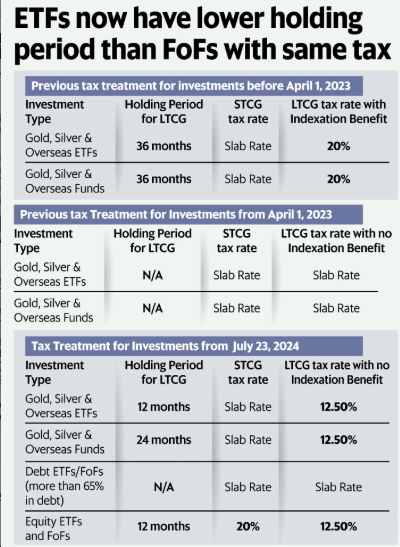
- Equity ETFs enjoy equity taxation benefits, provided they satisfy the prescribed domestic equity exposure conditions. Short-Term Capital Gains (holding period up to 12 months) are taxed at 20%, while Long-Term Capital Gains (holding period exceeding 12 months) are taxed at 12.5% on gains exceeding INR 1.25 lakh in a financial year. Payment of STT on sale is a prerequisite for concessional taxation.
- Gold ETFs and silver ETFs are treated as listed non-equity securities. Gains arising from units held for up to 12 months are taxed at the investor’s applicable slab rate as STCG. Gains from units held for more than 12 months are taxed as LTCG at 12.5% without indexation benefit. The INR 1.25 lakh LTCG exemption available under Section 112A does not apply to Gold and Silver ETFs. Further, STT is generally not applicable on Gold and Silver ETF transactions.
- Debt ETF taxation depends on the composition of the fund. From FY 2025-26 onwards, the provisions of Section 50AA apply primarily to funds investing more than 65% of their assets in debt and money market instruments. Accordingly, tax treatment must be evaluated based on the underlying portfolio of the ETF.
- No GST is levied on the purchase or sale of ETF units, including Gold ETFs, Silver ETFs, and Gold/Silver Mutual Funds. However, purchases of physical gold and physical silver continue to attract GST at 3%.
- IDCW income, wherever distributed by an ETF, is added to the investor’s total income and taxed according to the applicable income-tax slab rate, irrespective of the category of ETF.
- Exchange listing alone does not determine taxation. The tax treatment of an ETF is governed by its underlying assets, applicable provisions of the Income-tax Act, and the nature of the investment exposure.
Differences Between Gold ETFs and Silver ETFs
| Particulars | Gold ETFs | Silver ETFs |
|---|---|---|
| Nature of Asset | Tracks the price of gold bullion | Tracks the price of silver bullion |
| Volatility | Comparatively less volatile and more stable | More volatile with larger price fluctuations |
| Primary Demand Driver | Investment, central bank reserves, jewellery demand, safe-haven buying | Industrial demand (electronics, solar panels, EVs) along with investment demand |
| Safe-Haven Status | Considered a traditional safe-haven asset during economic uncertainty | Less of a safe-haven asset and more influenced by economic cycles |
| Risk Level | Lower risk | Higher risk |
| Liquidity | Generally higher trading volumes and liquidity | Comparatively lower liquidity |
| Price Movement | Relatively stable and gradual | Can witness sharp upward or downward movements |
| Inflation Hedge | Strong inflation hedge | Inflation hedge, but more dependent on industrial demand trends |
| Return Potential | Moderate and steady long-term returns | Higher return potential, but with higher risk |
| Economic Sensitivity | Less dependent on industrial growth | Highly sensitive to industrial growth and manufacturing activity |
| Portfolio Role | Wealth preservation and risk diversification | Growth-oriented exposure to precious metals |
| Suitable For | Conservative investors seeking stability | Aggressive investors willing to accept higher volatility |
| Market Behaviour During Crisis | Usually performs well during market uncertainty | May decline if industrial demand weakens |
| Taxation | STCG: Slab Rate (<12 months); LTCG: 12.5% (>12 months) | STCG: Slab Rate (<12 months); LTCG: 12.5% (>12 months) |
| Investment Objective | Capital protection and portfolio hedge | Growth and participation in industrial metal demand |
Practical questions and responses from professionals:
Question: Regularly trading of gold & silver ETFs during FY 2025-26, 559 buys & 559 sells, all bought & sold executed within a week, max 111 days, having some closing stock in is eligible under which code in Business & Profession in ITR3?
Answer: Business Code 21011 – Buying and Selling of Shares (Delivery-Based Trading as Business Income)
For a person who has regularly traded gold ETFs and silver ETFs during FY 2025-26 with 559 purchase transactions and 559 sale transactions, most holdings were sold within a week (maximum holding period 111 days), with frequent and systematic trading activity and Some units remaining as closing stock at year-end.
the activity is more likely to be treated as business income rather than capital gains, based on the volume, frequency, and intention of trading. CBDT Circular No. 6/2016 also recognizes that frequent trading may be treated as business income.
Nature of Business Code in ITR-3
- Since ETF units are securities and the activity involves regular purchase and sale as a business, the appropriate code would generally be 21011 – Buying and Selling of Shares (delivery-based trading treated as business income).
Why not 21009 or 21010?
- 21009: Speculative Trading (Intraday) applies where no delivery is made.
- 21010: Futures & Options Trading applies only to derivatives.
- Gold ETF / Silver ETF purchased and sold with delivery through a demat account is closest to 21011.
Reporting in ITR-3
If offered as business income:
- Opening Stock: Nil (if first year)
- Purchases: ETF purchases during the year
- Sales/Turnover: ETF sales during the year
- Closing Stock: Value of unsold ETF units as on 31.03.2026
- Business Code: 21011
Practical responses from professionals:
For 559 buy and 559 sell transactions, I would generally recommend filing ITR-3, Offer income under Profits and Gains of Business or Profession, and selecting Nature of Business Code 21011 and maintaining a record of turnover and profit/loss from ETF trading, so we have to check the applicability of tax audit u/s 44AB based on turnover and other conditions. In this case we have to use Business Code 21011 – Buying and Selling of Shares (Delivery-Based Trading as Business Income)
Quick Tax Summary on ETF taxation
| ETF Type | STCG Tax | LTCG Tax | Holding Period for LTCG |
|---|---|---|---|
| Equity ETFs | 20% | 12.5% on gains exceeding INR 1.25 lakh | More than 12 months |
| Gold ETFs | Slab Rate | 12.5% (No Indexation) | More than 12 months |
| Silver ETFs | Slab Rate | 12.5% (No Indexation) | More than 12 months |
| Debt ETFs* | Slab Rate | Depends on applicable provisions | Depends on fund structure |
While Equity ETFs receive concessional equity taxation, Gold and Silver ETFs are taxed as listed non-equity securities, and Debt ETFs require a closer examination of their underlying investment composition before determining the applicable tax treatment.