
SSE Eligibility, Registration, Fund Raising & Compliance
Page Contents
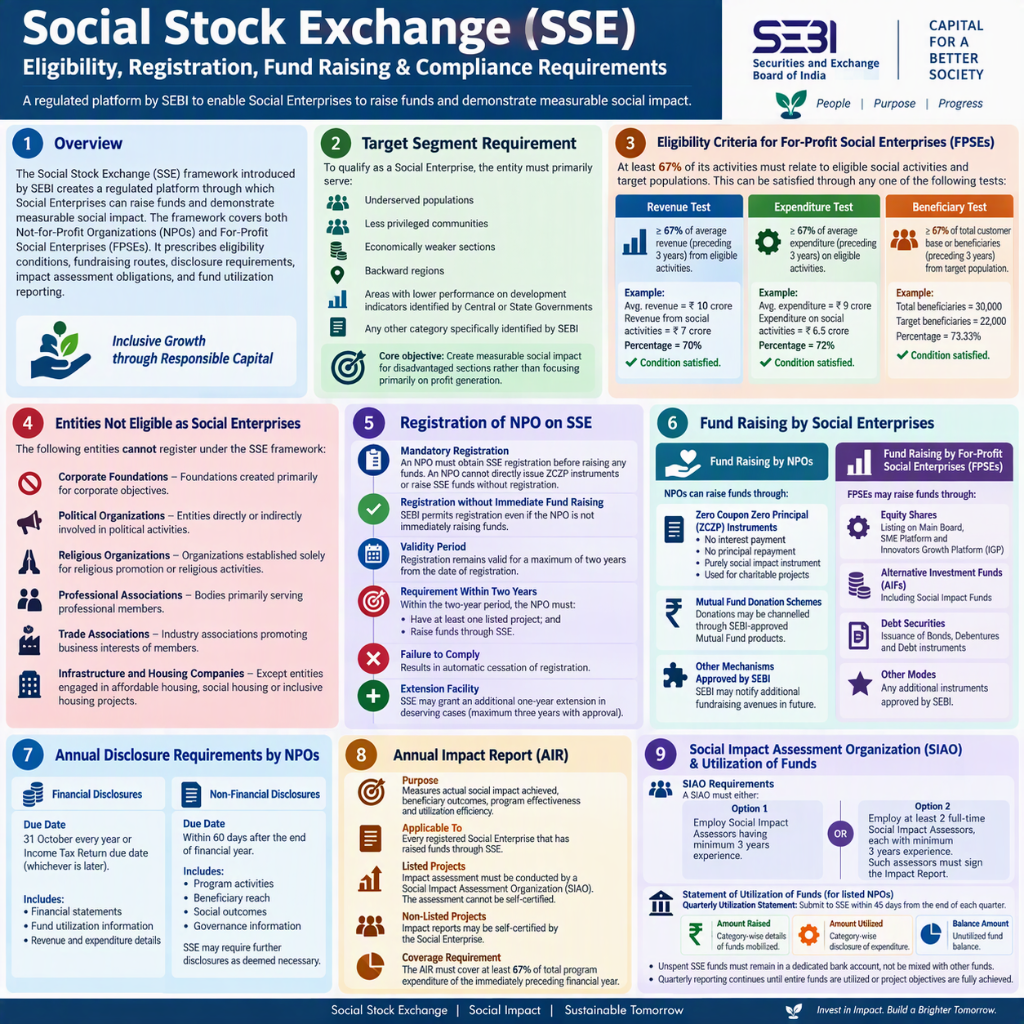
Social Stock Exchange (SSE): Eligibility, Registration, Fund Raising & Compliance Requirements
The Social Stock Exchange (SSE) framework introduced by SEBI creates a regulated platform through which Social Enterprises can raise funds and demonstrate measurable social impact. The framework covers both Not-for-Profit Organizations (NPOs) and For-Profit Social Enterprises (FPSEs). It also prescribes eligibility conditions, fundraising routes, disclosure requirements, impact assessment obligations, and fund utilization reporting.
-
Target Segment Requirement
- To qualify as a Social Enterprise, the entity must primarily serve Underserved populations; Less privileged communities; Economically weaker sections; Backward regions; Areas with lower performance on development indicators identified by Central or State Governments; or Any other category specifically identified by SEBI.
- The core objective is that the enterprise should create measurable social impact for disadvantaged sections rather than focusing primarily on profit generation.
-
Eligibility Criteria for For-Profit Social Enterprises
A For-Profit Social Enterprise (FPSE) must demonstrate that a substantial part of its activities is directed toward eligible social objectives. At least 67% of its activities must relate to eligible social activities and target populations. This condition can be satisfied through any one of the following tests:
Revenue Test
At least 67% of average revenue during the preceding three years must arise from eligible activities serving target beneficiaries. Example Average revenue for last three years = INR 10 crore . Revenue from eligible social activities = INR 7 crore and Percentage: INR 7 crore ÷ INR 10 crore = 70% Condition satisfied.
Expenditure Test
At least 67% of average expenditure during the preceding three years must be spent on eligible social activities. Example Average annual expenditure = INR 9 crore
Expenditure on social activities = INR 6.5 crore
Percentage: INR 6.5 crore ÷ INR 9 crore = 72% Condition satisfied.
Beneficiary Test
At least 67% of total customer base or beneficiaries over the preceding three years must belong to the target population. Example Total beneficiaries = 30,000
Target beneficiaries = 22,000
Percentage: 22,000 ÷ 30,000 = 73.33% Condition satisfied.
-
Entities Not Eligible as Social Enterprises
The following entities cannot register as Social Enterprises under the SSE framework:
- Corporate Foundations ; Foundations created primarily for corporate objectives.
- Political Organizations : Entities directly or indirectly involved in political activities.
- Religious Organizations : Organizations established solely for religious promotion or religious activities.
- Professional Associations : Bodies primarily serving professional members.
- Trade Associations : Industry associations promoting business interests of members.
- Infrastructure and Housing Companies : Except entities engaged in Affordable housing; Social housing; Inclusive housing projects. Therefore, not every non-profit or company qualifies for SSE participation.
Registration of NPO on Social Stock Exchange
Mandatory Registration : Before raising any funds through SSE, an NPO must obtain registration with the Social Stock Exchange. An NPO cannot directly issue ZCZP instruments or raise SSE funds without registration.
Registration without Immediate Fund Raising
- SEBI permits registration even where the NPO is not immediately raising funds. Time Limit : The registration remains valid for Maximum two years from the date of registration.
- Requirement Within Two Years : Within the two-year period, the NPO must Have at least one listed project; and Raise funds through SSE. Failure to do so results in Automatic Cessation of Registration The NPO loses its SSE registration status.
- Extension Facility : SSE may grant Additional one-year extension in deserving cases. Thus, maximum period can become Three years with SSE approval.
-
Fund Raising by Social Enterprises
Fund Raising by NPOs
NPOs can raise funds through:
- Zero Coupon Zero Principal (ZCZP) Instruments : These are non-return-bearing social securities. Features No interest payment, No principal repayment, Purely social impact instrument. And Used for charitable projects.
- Mutual Fund Donation Schemes : Donations may be channelled through SEBI-approved Mutual Fund products.
- Other Mechanisms Approved by SEBI : SEBI may notify additional fundraising avenues in future.
Fund Raising by For-Profit Social Enterprises
For-Profit Social Enterprises have wider options. They may raise funds through:
- Equity Shares : Listing on Main Board, SME Platform and Innovators Growth Platform (IGP)
- Alternative Investment Funds (AIFs) : Including Social Impact Funds
- Debt Securities : Issuance of Bonds, Debentures and Debt instruments
- Other Modes : Any additional instruments approved by SEBI.
- Annual Disclosure Requirements by NPOs
Every NPO registered on SSE must submit annual disclosures. Financial Disclosures : Due Date 31 October every year or Income Tax Return due date (whichever is later). These disclosures include Financial statements, Fund utilization information and Revenue and expenditure details
Non-Financial Disclosures : Must be submitted Within 60 days after the end of financial year : These disclosures include Program activities, Beneficiary reach, Social outcomes, Governance information. SSE may require further disclosures as deemed necessary.
- Annual Impact Report (AIR) :
One of the most important requirements under SSE is the Annual Impact Report (AIR).Every registered Social Enterprise that has raised funds through SSE must submit an AIR.
- Purpose : AIR measures Actual social impact achieved, Beneficiary outcomes, Program effectiveness and Utilization efficiency
- Listed Projects : Where funds have been raised through listed SSE projects: Impact assessment must be conducted by: Social Impact Assessment Organization (SIAO). The assessment cannot be self-certified.
- Non-Listed Projects : Impact reports may be Self-Certified : by the Social Enterprise.
- Coverage Requirement : The AIR must cover At least 67% of total program expenditure of the immediately preceding financial year.
-
Social Impact Assessment Organization (SIAO)
A Social Impact Assessment Organization must either:
-
- Option 1 : Employ Social Impact Assessors having: Minimum 3 years experience Or
- Option 2 : Employ At least 2 full-time Social Impact Assessors; and Each assessor must possess minimum 3 years experience. Such assessors must sign the Impact Report.
Statement of Utilization of Funds
A listed NPO must submit a Quarterly Utilization Statement : to SSE.Due Date : Within 45 days from the end of each quarter.
Information Required : The statement should specify:
- Amount Raised: Category-wise details of funds mobilized.
- Amount Utilized: Category-wise disclosure of expenditure.
- Balance Amount : Unutilized fund balance.
Separate Bank Account Requirement : Unspent SSE funds must Remain in a dedicated bank account, Not be mixed with other funds and Be separately monitored
Duration of Reporting : Quarterly reporting continues until Entire funds are utilized; or Project objectives are fully achieved.
Key Takeaways
- Social Enterprises must focus on underserved and disadvantaged communities.
- A For-Profit Social Enterprise must satisfy the 67% revenue, expenditure, or beneficiary test.
- Corporate foundations, political entities, religious organizations, and most infrastructure companies are excluded.
- NPO registration on SSE is mandatory before fundraising.
- NPOs can raise money through Zero Coupon Zero Principal (ZCZP) Instruments.
- For-Profit Social Enterprises can raise equity, debt, and AIF funding.
- Annual Financial and Non-Financial disclosures are mandatory.
- Annual Impact Reports must be submitted and independently assessed for listed projects.
- Quarterly fund utilization reporting is compulsory.
- Unutilized funds must remain segregated in a separate bank account.
The SSE framework is designed to bring the same level of transparency, governance, reporting, and accountability to the social sector that exists in traditional capital markets, thereby increasing investor and donor confidence in social impact projects