
Disclosure Zero O/S Audit fee for CA before signing Audit Report
Page Contents
Unpaid Audit Fees and Auditor Independence: What the ICAI Code of Ethics Really Says
No, an auditor is not barred from signing this year’s audit report just because earlier fees are unpaid. But long-overdue fees are a real independence threat, and the ICAI Code of Ethics expects you to act on them.
A message has circulated widely among practitioners claiming that auditors must ensure “zero outstanding” audit fees before signing any audit report. It mixes a genuine ethical requirement with an overstatement. This article separates the two, explains the relevant provisions of the Code of Ethics, 2019 (Volume I, effective 1 July 2020), and sets out what audit firms should actually do.
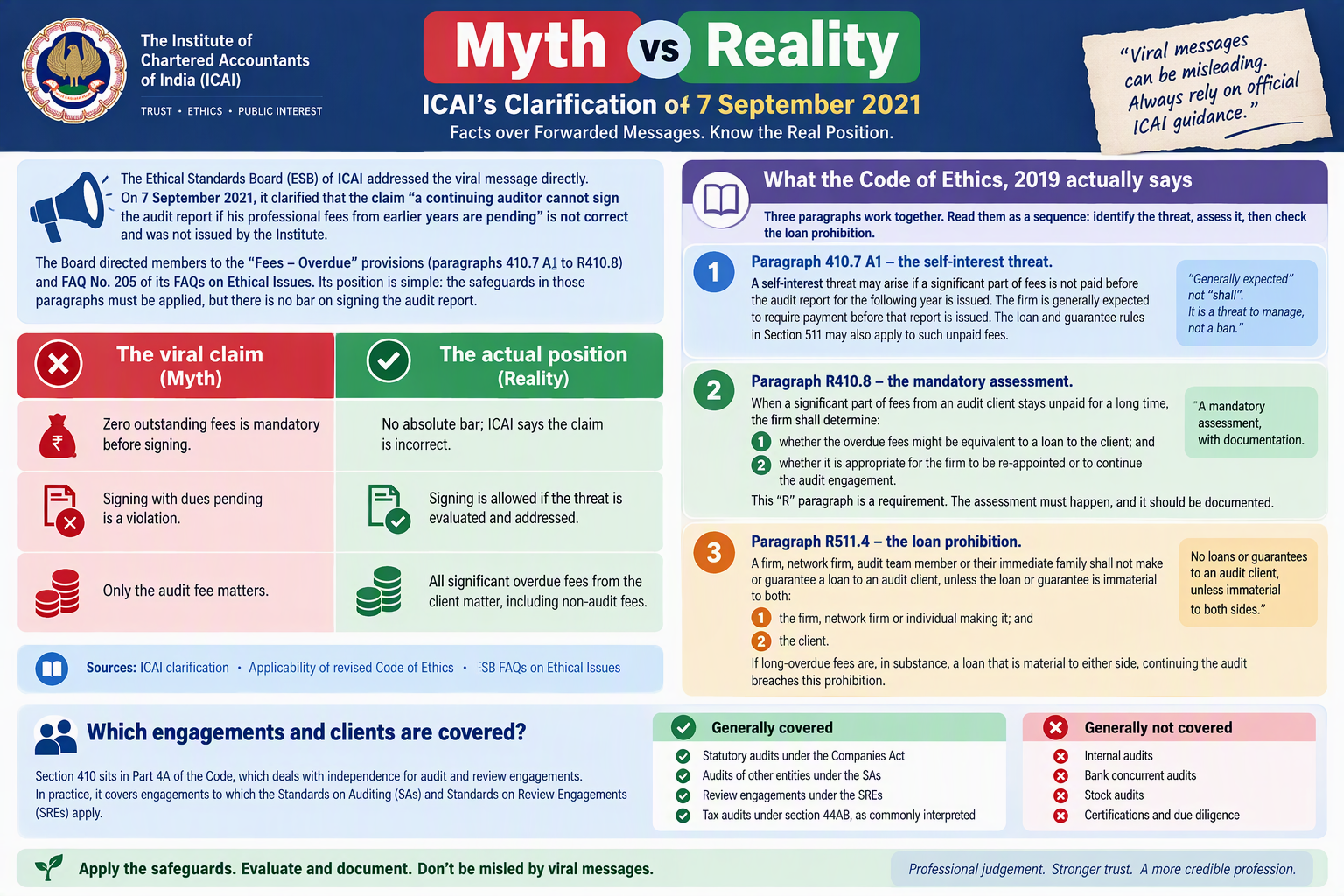
Myth vs reality: ICAI’s clarification of 7 September 2021
The Ethical Standards Board of ICAI addressed the viral message directly. On 7 September 2021, it clarified that the claim “a continuing auditor cannot sign the audit report if his professional fees from earlier years are pending” is not correct and was not issued by the Institute.
The Board directed members to the “Fees – Overdue” provisions (paragraphs 410.7 A1 to R410.8) and FAQ No. 205 of its FAQs on Ethical Issues. Its position is simple: the safeguards in those paragraphs must be applied, but there is no bar on signing the audit report.
| The viral claim | The actual position |
|---|---|
| Zero outstanding fees is mandatory before signing | No absolute bar; ICAI says the claim is incorrect |
| Signing with dues pending is a violation | Signing is allowed if the threat is evaluated and addressed |
| Only the audit fee matters | All significant overdue fees from the client matter, including non-audit fees |
Sources: ICAI clarification · Applicability of revised Code of Ethics · ESB FAQs on Ethical Issues
What the Code of Ethics, 2019 actually says
Three paragraphs work together. Read them as a sequence: identify the threat, assess it, then check the loan prohibition.
Paragraph 410.7 A1 – the self-interest threat. A self-interest threat may arise if a significant part of fees is not paid before the audit report for the following year is issued. The firm is generally expected to require payment before that report is issued. The loan and guarantee rules in Section 511 may also apply to such unpaid fees.
Note the wording. It targets last year’s fees still unpaid when next year’s report is signed. It says “generally expected”, not “shall”. That is why it is a threat to manage, not a ban.
Paragraph R410.8 – the mandatory assessment. When a significant part of fees from an audit client stays unpaid for a long time, the firm shall determine:
- whether the overdue fees might be equivalent to a loan to the client; and
- whether it is appropriate for the firm to be re-appointed or to continue the audit engagement.
This “R” paragraph is a requirement. The assessment must happen, and it should be documented.
Paragraph R511.4 – the loan prohibition. A firm, network firm, audit team member or their immediate family shall not make or guarantee a loan to an audit client, unless the loan or guarantee is immaterial to both:
- the firm, network firm or individual making it; and
- the client.
If long-overdue fees are, in substance, a loan that is material to either side, continuing the audit breaches this prohibition.
Which engagements and clients are covered?
Section 410 sits in Part 4A of the Code, which deals with independence for audit and review engagements. In practice, it covers engagements to which the Standards on Auditing (SAs) and Standards on Review Engagements (SREs) apply.
| Generally covered | Generally not covered |
|---|---|
| Statutory audits under the Companies Act | Internal audits |
| Audits of other entities under the SAs | Bank concurrent audits |
| Review engagements under the SREs | Stock audits |
| Tax audits under section 44AB, as commonly interpreted | Certifications and due diligence |
The tax audit position reflects the common professional reading. Where an engagement is borderline, treat it as covered and apply the safeguards.
Who counts as the “audit client”?
It is the entity on which the firm performs an audit or review. For a listed entity, the audit client always includes its related entities. For an unlisted entity, it includes related entities over which the client has direct or indirect control. So overdue fees from a group company can count too.
What if only the audit fee is paid and other fees are pending?
Collecting just the previous year’s audit fee may address paragraph 410.7 A1, but it does not close the matter. The Code speaks of “fees” due from the audit client, not only the audit fee.
If significant fees for tax, advisory or other services remain unpaid for a long time, R410.8 still requires the loan-equivalence and continuation assessment. R511.4 then applies if those dues amount to a material loan to the client.
Safeguards the Code prescribes
The Code gives two examples of actions that may address the self-interest threat from overdue fees:
- Obtain partial payment of the overdue fees before issuing the next report.
- Independent review: have an appropriate reviewer who did not take part in the audit engagement review the work performed.
If neither reduces the threat to an acceptable level, the firm should consider declining reappointment or withdrawing from the engagement. Whatever you decide, record the assessment, the amounts, the aging, and the safeguard applied in the audit file.
Why this matters in practice
This is not a theoretical concern. In a professional misconduct matter arising from an SFIO investigation, the SFIO objected that the auditor kept accepting the audit year after year despite long-outstanding audit and non-audit fees. It treated the auditor’s independence as already compromised and held the auditor to be a party to the fraud committed by the client.
The lesson: unpaid fees can be read as a financial stake in the client. If something later goes wrong, regulators may ask why you stayed on.
Practical steps for audit firms
- Set payment terms in the engagement letter. State the fee, the billing milestones and the due dates upfront.
- Collect an advance. Take a retainer or part-payment before fieldwork begins.
- Bill by milestone. Tie invoices to stages such as planning, fieldwork and draft report, rather than one bill at the end.
- Review fee ageing before acceptance. Check all dues from the client and its related entities before accepting re-appointment each year.
- Agree a written payment plan for older balances, and follow up in writing.
- Document the R410.8 assessment. Record whether the dues resemble a loan, their materiality to both sides, the safeguard applied and the conclusion on continuing.
- Escalate early. Raise persistent non-payment with those charged with governance, and consider whether to continue.
Summary
Pending fees from earlier years do not stop you from signing the audit report. Ignoring them can still cost you your independence, and possibly your reputation. Assess significant overdue fees every year, apply a safeguard, document your conclusion, and walk away when the dues start to look like a loan.
Need help with audit independence or engagement acceptance? The team at Rajput Jain & Associates advises audit firms and businesses on Code of Ethics compliance, engagement terms and audit quality reviews. [Contact us] to discuss your situation. This article is for general information only and is based on the ICAI Code of Ethics, 2019 and ICAI’s clarification of 7 September 2021. Check the latest ICAI announcements and seek professional advice before acting on a specific case.