
Moving to UAE: What Actually Decides Your Indian Tax Residence
Page Contents
Moving to the UAE: What Actually Decides Your Indian Tax Residence
Documents show where you live, not your tax status
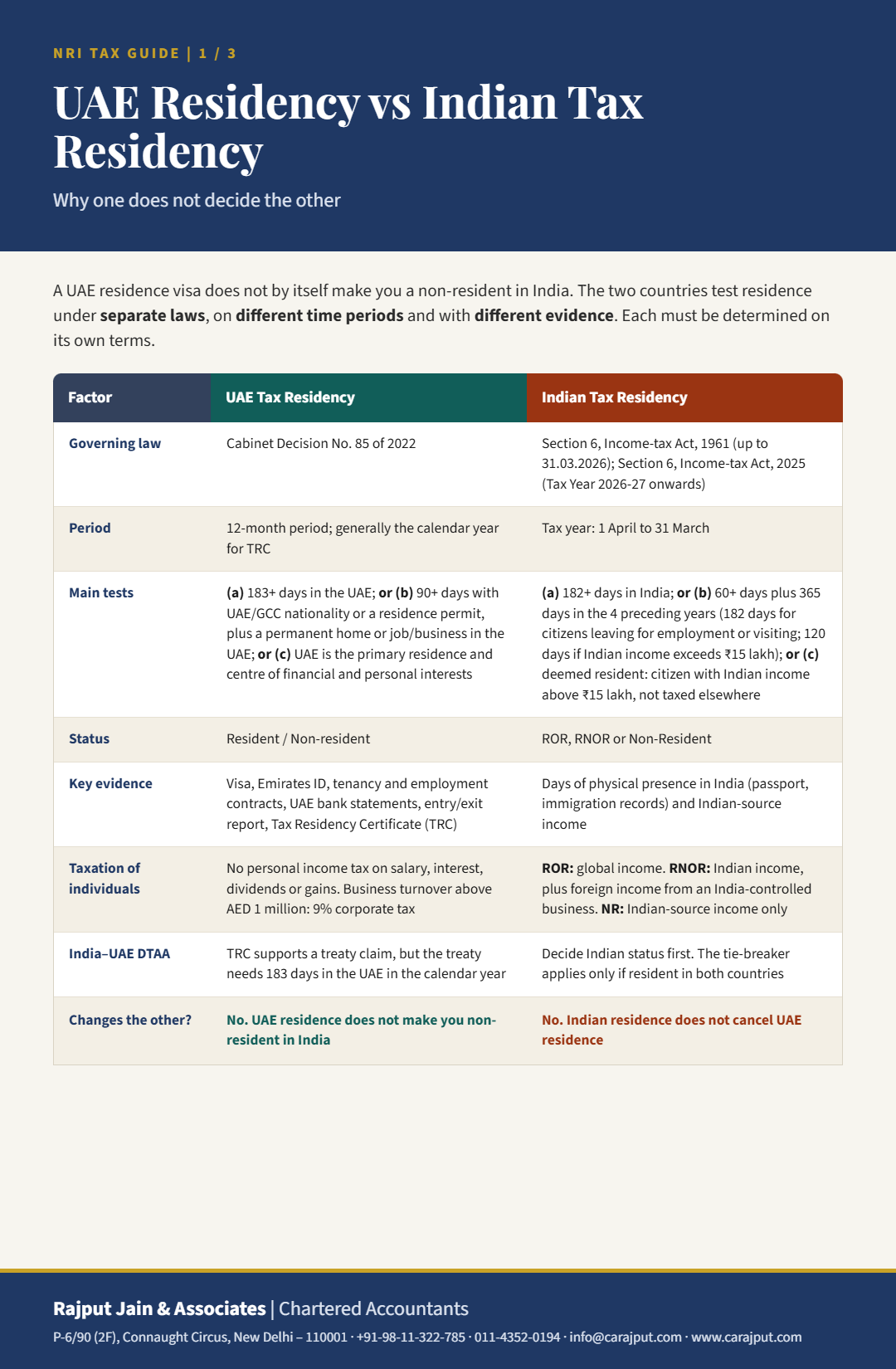
A UAE residence visa, Emirates ID, tenancy contract and Dubai bank account are good evidence of where a person lives. None of them decides residential status under Indian income tax law.
Indian residence is decided by the number of days you are physically present in India. The count is applied afresh for each tax year. A person can be a non-resident one year and a resident the next, whatever documents they hold.
The basic residence tests
Residential status is governed by Section 6 of the Income-tax Act, 1961 for years up to 31 March 2026, and by Section 6 of the Income-tax Act, 2025 from 1 April 2026. An individual is resident in India for a tax year if either of these applies:
- they are in India for 182 days or more during the year, or
- they are in India for 60 days or more during the year and 365 days or more in total over the four preceding years.
Anyone who meets neither test is a non-resident.
The year you leave: timing is everything.
An Indian citizen who leaves India for employment abroad gets relief in the year of departure. The 60-day test does not apply to them, so they are resident that year only if they spend 182 days or more in India.
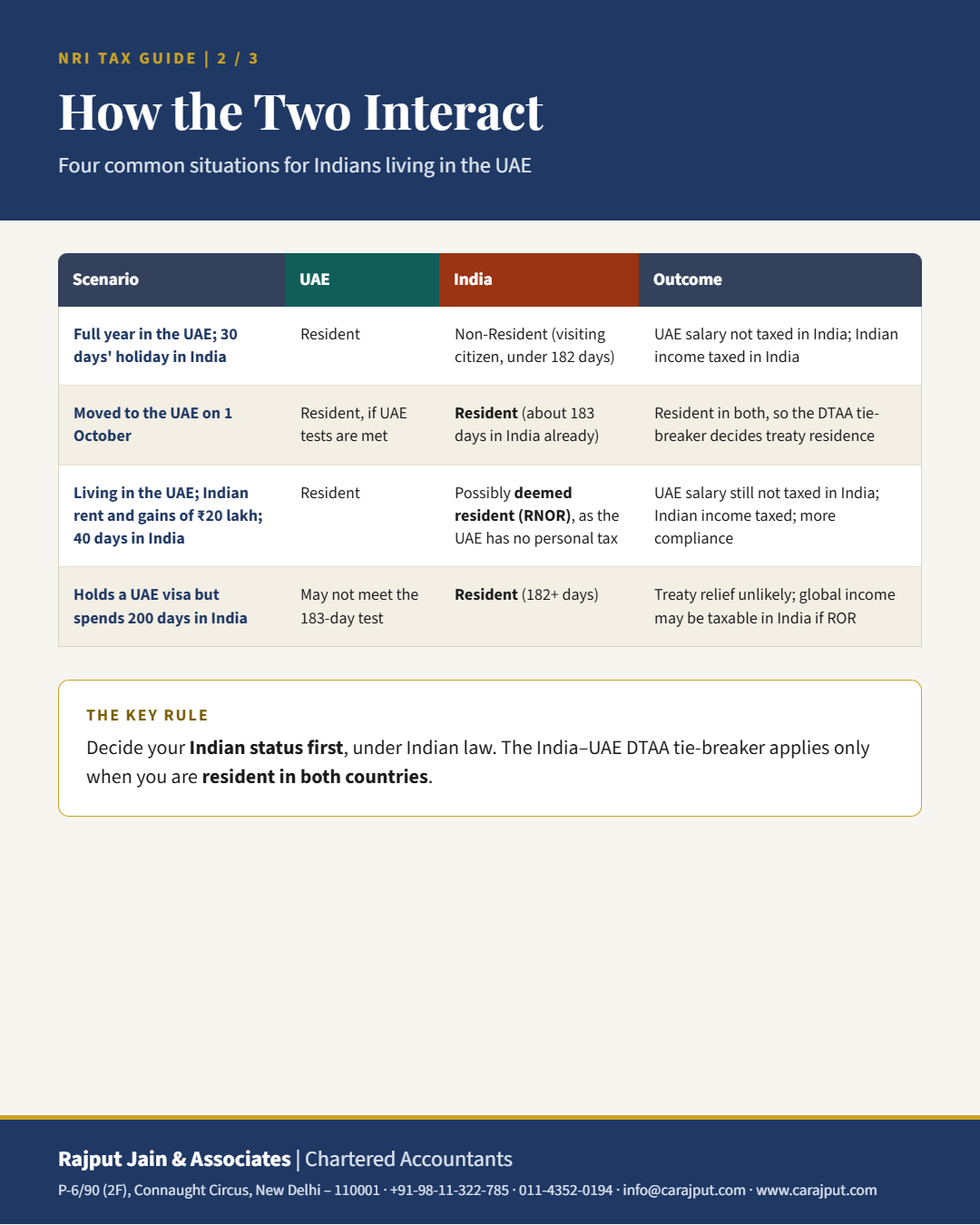
This relief is often lost because of the departure date. The tax year starts on 1 April. Someone who moves to Dubai on 1 October has already spent about 183 days in India and is resident for that year. A genuine UAE job cannot undo days already spent in India.
Practical tip: Plan the departure date carefully, and check your own day count against your passport stamps and the immigration movement record from the Bureau of Immigration. Arrival and departure days generally both count as days in India.
Visiting India after moving
An Indian citizen or Person of Indian Origin (PIO) who lives abroad and comes to India on a visit also gets the 60-day limit raised to 182 days. In practice:
- they become resident only if they spend 182 days or more in India during the year, and
- time spent in India in earlier years cannot, on its own, make them resident.
This relief applies only to someone visiting. A person who comes back to live or work in India is not visiting, and the normal 60-day test applies to them from the year of return.
The INR 15 lakh rules
1. Visiting NRIs with high Indian income: the 120-day test
For a visiting Indian citizen or Person of Indian Origin whose total income, other than income from foreign sources, exceeds ₹15 lakh, the visit limit falls from 182 days to 120 days. This applies where they also have 365 days or more in India over the four preceding years.
A person who becomes resident under this rule is treated as Resident but Not Ordinarily Resident (RNOR), not as an ordinary resident.
2. Deemed residence: a particular concern for the UAE
An Indian citizen whose Indian income (excluding foreign-source income) exceeds ₹15 lakh is deemed resident in India if they are not liable to tax in any other country because of domicile or residence. This applies even if they spend very little time in India.
This matters for people living in the UAE. The UAE does not levy personal income tax, so a UAE-based individual may not be “liable to tax” there as Indian law uses that term. A UAE-based Indian citizen with more than ₹15 lakh of Indian income, such as rent, interest, dividends or capital gains, should therefore specifically assess the deemed-residence risk.
The saving grace: A deemed resident is classified as RNOR. Their UAE salary and other foreign income remain outside the Indian tax net, unless that income comes from a business controlled in India or a profession set up in India. Even so, the status affects filing, disclosure and treaty positions, so it should be managed and not ignored.
Where the treaty takes a different view
The India–UAE Double Taxation Avoidance Agreement (DTAA) has its own residence test. Under Article 4, an individual is a UAE resident for treaty purposes only if present in the UAE for at least 183 days in the calendar year.
UAE domestic law is more generous. Under Cabinet Decision No. 85 of 2022, an individual can be a UAE tax resident with 90 days of presence, if combined with UAE or GCC nationality or a valid residence permit, and a permanent place of residence or employment or business in the UAE.
Why this matters:
- A UAE Tax Residency Certificate issued on the 90-day test may not be enough to claim treaty benefits in India. For treaty purposes, the 183-day calendar-year test must be met.
- The treaty uses the calendar year (January–December), while Indian residence uses the tax year (April–March). A mid-year move can fall differently under each, so both periods should be checked separately.
- The treaty’s tie-breaker rules (permanent home, centre of vital interests, habitual abode, nationality) come into play only if a person is resident in both countries under their domestic laws.
What remains taxable in India after you become a non-resident?
Becoming a non-resident does not end your Indian tax obligations. Income earned or arising in India remains taxable, including:
- rent from Indian property,
- interest on NRO deposits, bonds and loans,
- dividends from Indian companies, and
- capital gains on Indian shares, mutual funds and property.
TDS on payments to non-residents is generally deducted at higher rates. A return is usually required where Indian income exceeds the basic exemption limit or where you want to claim a refund.
UAE salary sent to India:
Salary for work done in the UAE and first received in the UAE is not taxable in India for a non-resident. It does not become taxable just because it is later transferred to an Indian bank account. However, the place of first receipt must be supported by evidence, such as a UAE payroll account and salary slips. Salary for work performed in India remains taxable wherever it is paid.
UAE companies controlled from India:
A company incorporated in the UAE can still be an Indian tax resident if its Place of Effective Management (POEM) is in India. This is the case where the key management and commercial decisions are, in substance, made in India. The provision is Section 6(3) of the Income-tax Act, 1961, and the corresponding provision of the Income-tax Act, 2025. Founders who move to Dubai but continue to run the company from India should take particular care.
Common Mistakes to Avoid
-
Applying the 60-day test without the 365-day condition, or to the wrong person
The 60-day test makes a person resident only if they also spent 365 days or more in India over the four preceding years. Many NRIs also don’t realise that the 60-day test does not apply to an Indian citizen or Person of Indian Origin visiting India. For them, the limit is 182 days, or 120 days if their Indian income exceeds ₹15 lakh. For an Indian citizen leaving India for employment, only the 182-day test applies in the year of departure. Applying the wrong test gives the wrong status.
-
Confusing the 120-day rule with deemed residence
These are two separate provisions, and both involve Indian income above ₹15 lakh (excluding foreign-source income):
-
- The 120-day rule: A visiting Indian citizen or PIO with Indian income above ₹15 lakh becomes resident if in India for 120 days or more in the year and 365 days or more in the four preceding years.
- Deemed residence: An Indian citizen with Indian income above ₹15 lakh who is not liable to tax in any other country by reason of domicile or residence is deemed resident. This applies regardless of the number of days spent in India.
Both result in RNOR status. Deemed residence matters especially in the UAE, which has no personal income tax, so UAE residents with substantial Indian income should assess it specifically.
- Misunderstanding when the DTAA tie-breaker applies
The tie-breaker rules in Article 4 of the India–UAE DTAA come into play only when a person is resident in both countries under their domestic laws. The rules look at permanent home, centre of vital interests, habitual abode and nationality. A common example is the year of departure, where someone crosses 182 days in India and is also a UAE resident.
Two errors are common:
-
- assuming that living in the UAE automatically makes a person non-resident in India, without first applying Indian law, and
- claiming treaty benefits without meeting the treaty’s own test of 183 days’ presence in the UAE in the calendar year. Where the tie-breaker applies, substantial family, home or economic ties in India can still lead to India being treated as the country of residence.
-
Miscounting days in India
Every day of physical presence counts, including short visits and the days of arrival and departure, which are generally both counted as days in India. Estimates from memory are unreliable. Reconcile the count with passport stamps and the immigration movement record from the Bureau of Immigration, and remember that the count runs from 1 April to 31 March.
- Getting the reporting obligations wrong
What must be reported depends on residential status:
| Status | Foreign income | Foreign assets (Schedule FA) |
| Resident and Ordinarily Resident (ROR) | Taxable in India; must be reported in full | Mandatory |
| Resident but Not Ordinarily Resident (RNOR) | Generally not taxable; not included in total income (unless from a business controlled in, or profession set up in, India) | Not required |
| Non-Resident (NR) | Not taxable; not reported | Not required |
The most costly mistake is by returning NRIs. They move from RNOR to ROR status and fail to report their global income and foreign assets. That can attract penalties under the Black Money Act.
Practical Example: Assessing Residential Status after Moving to the UAE
Facts: Mr. Ahmed is an Indian citizen who lived and worked in India throughout his career. He moved to Dubai on 1 April 2023 to take up employment and intends to live there permanently. Because he was in India full-time in FY 2019-20 to FY 2022-23, he has about 1,460 days in India in the four years before he left. His Indian income, from rent and FD interest, is about ₹6 lakh a year.
| Year | Days in India | Test that applies | Status |
| FY 2023-24 (year of departure) | 11 (1 April departure day + 10 days in January) | Left India for employment, so only the 182-day test applies | Non-Resident |
| FY 2024-25 | 20 | Indian citizen visiting India: 182-day test (Indian income below ₹15 lakh) | Non-Resident |
| FY 2025-26 | 30 | Same as above | Non-Resident |
Key observations:
- The 60-day test never applied to him. Mr. Ahmed was not non-resident because he stayed under 60 days. As a visiting Indian citizen, his limit was 182 days. He could have spent up to 181 days in India each year and remained non-resident, as long as his Indian income stayed below ₹15 lakh.
- Deemed residence did not apply, because his Indian income was below ₹15 lakh.
- Tax consequences: For each of these years, his UAE salary is not taxable in India. His Indian rent and interest remain taxable in India, and he should file an Indian return if that income exceeds the basic exemption limit.

What if the facts change? Tax Year 2026-27
Suppose Mr. Ahmed sells a property in India, taking his Indian income to ₹18 lakh, and spends 130 days in India looking after family.
| Check | Result |
| Indian income (excluding foreign income) above ₹15 lakh? | Yes, ₹18 lakh |
| Days in India during the year ≥ 120? | Yes, 130 days |
| Days in India in the four preceding years ≥ 365? | Yes: 365 (FY 2022-23) + 11 + 20 + 30 = 426 days |
| Result | Resident, but Not Ordinarily Resident (RNOR) |
Separately, because the UAE does not tax his income, he is at risk of being deemed resident even if he had spent far fewer days in India. That too would result in RNOR status.
As an RNOR, his UAE salary would still not be taxed in India. However, the change of status affects his TDS position, his return filing and any treaty claims. The lesson: a one-time spike in Indian income, such as from a property sale, can change residential status even when the pattern of visits stays the same.
The practical point: build the file now
Residential status depends on the facts and must be worked out again every year. The strongest position comes from records kept at the time, not reconstructed after a notice. Keep:
- passport copies, travel itineraries and the immigration movement record,
- UAE employment contract, salary slips and payroll bank statements,
- The UAE tenancy contract and utility bills,
- UAE bank statements, the Emirates ID and the residence visa, and
- The UAE Tax Residency Certificate, where available.
A well-kept, contemporaneous file is far easier to defend than a residence claim pieced together after scrutiny begins.
Relocated to the UAE or planning a move? We can work out your residential status year by year, plan your visits and handle your Indian tax compliance. Moving to the UAE or already living there? We help NRIs determine residential status year by year, claim treaty benefits and stay compliant in India.
IFCCL – P-6/90 (2F), Connaught Circus, New Delhi – 110001 | +91-98-11-322-785 | ☎️ 9555 555 480 Email info@carajput.com | www.carajput.com
This article is for general information only and does not constitute tax advice. Residential status depends on individual facts and should be assessed with professional advice.