
Running a Crypto Corporate over-the-counter Desk in India
Page Contents
Running a Crypto OTC Desk in India: A Complete Guide to Accounting, Tax, GST and Regulatory Compliance for USDT Transactions
Corporate over-the-counter (OTC) trading in stablecoins such as USDT (Tether) has grown rapidly in India. Businesses buy USDT for cross-border settlements, treasury management and trading, and many prefer a KYC-driven OTC desk over a public order book. For the companies running these desks, however, the tax and regulatory framework is layered and strict. A flat 30% tax applies on VDA income, 1% TDS applies on every transfer, the GST position remains unsettled, and FIU-IND registration is mandatory under anti-money laundering law.
In this article, we walk through a typical corporate USDT over-the-counter transaction flow and explain how it should be treated for accounting, revenue recognition, inventory costing, income tax, TDS, GST and compliance reporting. The analysis reflects the law as it stands after the Income-tax Act, 2025, which came into force on 1 April 2026.
A Typical Corporate USDT OTC Transaction Flow
Consider a private limited company engaged in corporate over-the-counter transactions in USDT. Its operating model looks like this:
- Customer onboarding: Customers are onboarded through KYC/CDD procedures and place USDT purchase orders with the company.
- INR receipt: The customer transfers INR to the company’s corporate bank account (say, Bank A).
- Internal fund movement: After reconciling the customer payment, the company moves its own funds from Bank A to its second corporate current account (Bank B).
- Purchase of USDT: From Bank B, INR is transferred to the company’s verified corporate/Enterprise account on an Indian VDA exchange, where USDT is purchased under an approved OTC arrangement.
- Transfer to corporate wallet: The USDT may then move from the exchange account to the company’s own corporate wallet on an offshore platform.
- Delivery to customer: From that corporate wallet, USDT is transferred to the customer’s KYC-verified wallet against the OTC order.
Reverse settlement:
In some deals the sequence is reversed. The company delivers USDT first and the customer pays INR afterwards. These are reconciled through the order, bank credit, wallet address and blockchain transaction ID (TxID).
The company keeps records linking KYC, order, bank transaction, exchange trade, USDT quantity, wallet addresses and TxIDs. Each deal can therefore be traced end to end: customer → bank → exchange → corporate wallet → customer wallet.
This structure is fundamentally sound. There is a single legal entity across all accounts, counterparties are KYC-verified, and reconciliation happens at TxID level. The real compliance challenges lie in VDA income-tax computation, TDS on sales to customers, an unresolved GST position, and PMLA registration.
Change in Law: The Income Tax Act, 2025
From 1 April 2026, the Income-tax Act, 2025 has replaced the Income-tax Act, 1961. For VDA transactions, the key changes are in section numbering, not substance:
| Provision | Income Tax Act, 1961 | Income Tax Act, 2025 |
|---|---|---|
| 30% flat tax on VDA income | Section 115BBH | Section 194(1) |
| 1% TDS on transfer of VDA | Section 194S | Section 393(1), Table Sl. No. 8(vi) |
The 30% rate, the bar on deductions other than cost of acquisition, the restriction on set-off of losses, and the 1% TDS with its thresholds all continue unchanged.
1. Nature of the Business: Principal Dealer, Not Broker
The first question is whether the company acts as a principal or as an agent. In this model, the company:
- buys USDT in its own name,
- holds it in its own accounts and wallets, and
- resells it to customers at a spread.
It carries price and inventory risk, especially in reverse-settlement deals where it delivers USDT before receiving payment. The company is therefore a principal dealer, not a broker or facilitator. This conclusion drives the accounting, revenue and tax treatment that follows.
Internal transfers are not turnover
Movements between the company’s own accounts are not sales and do not give rise to income, TDS or GST:
- Bank A → Bank B transfers (both in the company’s name)
- Bank → INR balance with the exchange
- USDT moving from the exchange account to the company’s own offshore wallet
None of these is a “transfer” of a VDA to another person. They should be recorded as contra or inter-ledger entries, each tagged with the related order reference, so the audit trail stays intact.
2. Accounting Treatment of USDT
Classification as inventory
USDT held for resale in the ordinary course of business should be classified as inventory, not as an investment, intangible asset or cash equivalent.
- Ind AS entities: This follows the IFRIC agenda decision of June 2019, which applied IAS 2 (Ind AS 2) to crypto held for sale in the ordinary course of business. Measurement is at the lower of cost and net realisable value. An entity qualifying as a commodity broker-trader may instead measure at fair value less costs to sell.
- AS (Indian GAAP) entities: The same substance-based approach applies, with measurement at the lower of cost and NRV.
Cost formula
The company should adopt FIFO or weighted average cost, applied lot-wise for each platform and followed consistently from year to year. Because the income-tax computation matches cost to each individual transfer, the inventory ledger should capture the following for every lot:
- quantity of USDT,
- purchase rate,
- INR cost, and
- blockchain TxID or exchange trade ID.
What goes into cost
- Include: the purchase price paid on the exchange and directly attributable trading fees.
- Exclude: GST on exchange fees where input tax credit (ITC) is available.
- Expense: network or withdrawal fees for moving USDT between the company’s own wallets are best treated as period costs.
Other balance sheet items
| Situation | Accounting treatment |
|---|---|
| INR lying with the exchange | “Balance with VDA exchange” under other current assets, not cash and bank |
| INR received from customer before USDT delivery | Customer advance (liability) |
| USDT delivered before INR received (reverse settlement) | Trade receivable, subject to expected credit loss or provisioning review |
Schedule III disclosures
Under the amended Schedule III to the Companies Act, 2013, companies must disclose:
- profit or loss on transactions in crypto or virtual currency,
- the amount of such currency held at the reporting date, and
- deposits or advances received from any person for trading or investing in crypto or virtual currency.
The notes to accounts should also identify the platforms and wallets where the inventory is held.
3. Revenue and Margin Recognition
Gross, not net
As a principal, the company should recognise revenue gross. Revenue is the INR sale value of USDT delivered, and the cost of USDT sold is shown as purchases or changes in inventory. The spread appears as gross margin.
Netting purchases against sales would understate turnover. This matters for tax audit applicability, GST reporting and FIU reporting.
When to recognise
Revenue is recognised on transfer of control, which is the moment USDT is credited to the customer’s verified wallet, evidenced by the on-chain TxID. The date of receiving INR does not decide it.
| Settlement type | Step 1 | Step 2 |
|---|---|---|
| Normal flow | INR received → customer advance | USDT delivered → revenue recognised |
| Reverse flow | USDT delivered → revenue plus receivable | INR received → receivable settled |
Every sale should be backed by a sale note or invoice showing the customer name, order ID, USDT quantity, rate, INR value, wallet address and TxID.
4. Income Tax on VDA Income: The 30% Regime
Income from the transfer of a VDA is taxed at a flat 30%, plus surcharge and cess in the case of a company, even when it is earned as business income. Two restrictions make this regime unusually harsh:
- No deduction other than cost of acquisition is allowed.
- Losses cannot be set off against any other income, including other VDA income, and cannot be carried forward.
Practical consequences for an OTC desk
- Business expenses are not deductible against VDA income. Salaries, rent, bank charges, network fees, technology costs and compliance expenses cannot reduce taxable VDA income. In effect, the gross spread is taxed, computed transfer by transfer.
- Loss-making transfers are ignored. If USDT is sold below cost, for example after a sharp move in the INR/USD rate, the loss is disregarded and is not netted against profitable transfers.
- NRV write-downs are not deductible. A year-end write-down of unsold USDT reduces book profit but must be added back in the tax computation.
- Treatment of exchange fees is debatable. The conservative approach treats only the purchase consideration as cost of acquisition. If trading fees are included, the reasoning should be documented.
- Computation should run from the lot-level ledger. It should reconcile with AIS and Form 26AS, TDS credits and the VDA schedule in the income tax return.
Any non-VDA income, such as interest or advisory fees, is taxed separately at the rate normally applicable to the company.
5. TDS on VDA Transfers: Section 393(1) (Earlier Section 194S)
A person paying consideration to a resident for the transfer of a VDA must deduct 1% TDS at the time of credit or payment, whichever is earlier. For an OTC desk, this applies in several ways.
(a) Purchases from an Indian exchange
For trades executed on or through an exchange, the exchange mechanism under CBDT Circular No. 13/2022 governs, and the exchange handles deduction. The company should still obtain written confirmation from the exchange on how TDS is handled on its OTC and Enterprise trades, and reconcile the position with AIS.
(b) Sales to customers: the key exposure
Each customer paying the company for USDT must deduct 1% TDS and deposit it with the government. The thresholds are low:
- INR 50,000 per year for “specified persons” (certain individuals and HUFs), and
- INR 10,000 per year for all others.
Corporate customers are not specified persons, so in practice every corporate customer must deduct TDS. In the reverse-settlement flow, the customer’s TDS obligation arises when it credits the company’s account, which is typically on receiving the USDT.
Recommended controls:
- The customer agreement and each order confirmation should state that the customer will remit 99% of the consideration and deposit 1% as TDS against the company’s PAN.
- TDS certificates should be tracked and matched with AIS every month.
- Short credits should be followed up promptly. Without matched TDS credit, the company must pay the full 30% tax from its own funds.
(c) Purchases outside an exchange
If the company buys USDT directly from another over-the-counter desk or a peer-to-peer seller, the company itself becomes the deductor. It must deduct 1% and file the relevant TDS statement.
(d) Interaction with other provisions
Buyer-side TDS on purchase of goods (the earlier Section 194Q) does not apply where VDA TDS applies. The company should also confirm that all its customers are Indian residents, since transfers to non-residents raise separate tax and FEMA issues.
6. GST on Crypto Over-the-Counter Transactions
GST is the least settled area of crypto taxation in India, and it calls for a considered, documented position.
What is clear
Since July 2025, service fees charged by cryptocurrency exchanges and platforms to Indian users attract GST at 18%. This covers trading fees, withdrawal charges and similar platform services. For an over the counter desk, GST charged by the Indian exchange on its fees should be available as input tax credit, since the fees are used in the course of business.
What remains unsettled
There is no CBIC notification or circular on how to classify a principal’s supply of a crypto asset itself. The widely followed industry practice is to charge 18% GST on service fees charged by exchanges, custodians and OTC desks, while treating the underlying crypto transfer as outside the GST net pending clarification.
An OTC desk differs from an exchange because it earns a spread, not a visible fee. Three positions are realistically available:
| Position | Approach | Assessment |
|---|---|---|
| A: Conservative | Treat the supply of USDT as taxable (as goods or a residual service) at 18% on the full transaction value | Lowest demand risk, but commercially heavy; customers’ ITC depends on their own business use |
| B: Middle path | Price each deal as USDT at a disclosed reference rate plus a separately stated OTC/conversion service charge; charge 18% GST on the service charge; treat the underlying VDA transfer as outside GST | Most common among OTC desks; defensible with proper documentation |
| C: Aggressive | Charge no GST at all on the spread | Not advisable without an advance ruling |
Our view: Position B, supported by a written legal opinion, is the most balanced approach. Where volumes are significant, the company should consider seeking an advance ruling from the Authority for Advance Ruling in its state.
Whichever position is adopted:
- Contracts, pricing and invoices must reflect that position consistently.
- Turnover must be reported consistently in GSTR-1 and GSTR-9, including exempt or non-GST turnover where relevant.
- Fees charged by an offshore platform to an Indian GST-registered business may attract reverse charge (RCM) as an import of services. Check whether the offshore platform charges Indian GST on its invoices before deciding between RCM and ITC.
7. PMLA and FIU-IND Registration
Mandatory registration
Since the March 2023 notification under the Prevention of Money Laundering Act, 2002 (PMLA), entities engaged in specified VDA activities, including exchanging VDAs for fiat currency, are reporting entities. An OTC desk exchanging USDT for INR falls squarely within this definition and must register with FIU-IND.
This is the most significant non-tax compliance point for any crypto OTC business. Registration should come before the business is scaled up. Key obligations after registration
- Appointment of a Designated Director and a Principal Officer
- A documented KYC/CDD and AML/CFT policy
- Filing of Suspicious Transaction Reports (STRs) within 7 days
- Reporting of VDA-specific data such as wallet addresses, transaction hashes, IP addresses and device identifiers where required
- Record retention for five years
The registration process involves an in-person meeting with FIU. Documents submitted include incorporation records, GST returns, income tax returns and TDS returns on VDA transactions. A desk that already reconciles at TxID level is well placed to meet these requirements.
Counterparty due diligence
The company should deal only with FIU-registered exchanges and platforms. Several offshore exchanges were blocked in India in late 2023 and early 2024 for operating without registration, and some later registered after paying penalties. Registration status should be checked periodically on the FIU-IND website, with evidence kept on file.
Payment-source controls
These controls matter most for reverse-settlement deals:
- Accept INR only from a bank account in the customer’s own name, as verified during KYC. Third-party payments are the most common route by which fraud proceeds reach OTC desks, and they often lead to bank account freezes by cyber-crime authorities.
- Screen customer wallet addresses using on-chain analytics before delivering USDT.
- Set credit limits for customers who are allowed reverse settlement.
Banking relationships
The company’s bankers should be informed that the accounts are used for a VDA OTC business. The reason for routing funds through a second bank (for instance, the exchange’s supported banking channel) should be documented, so that the multi-account movement is not mistaken for layering.
Offshore holdings and FEMA
USDT held on an offshore platform is held outside India. There is no settled FEMA position on this, so the company should consider disclosing it in the foreign-assets schedule of its income tax return. It should also avoid dealing with non-resident customers without specific FEMA advice.
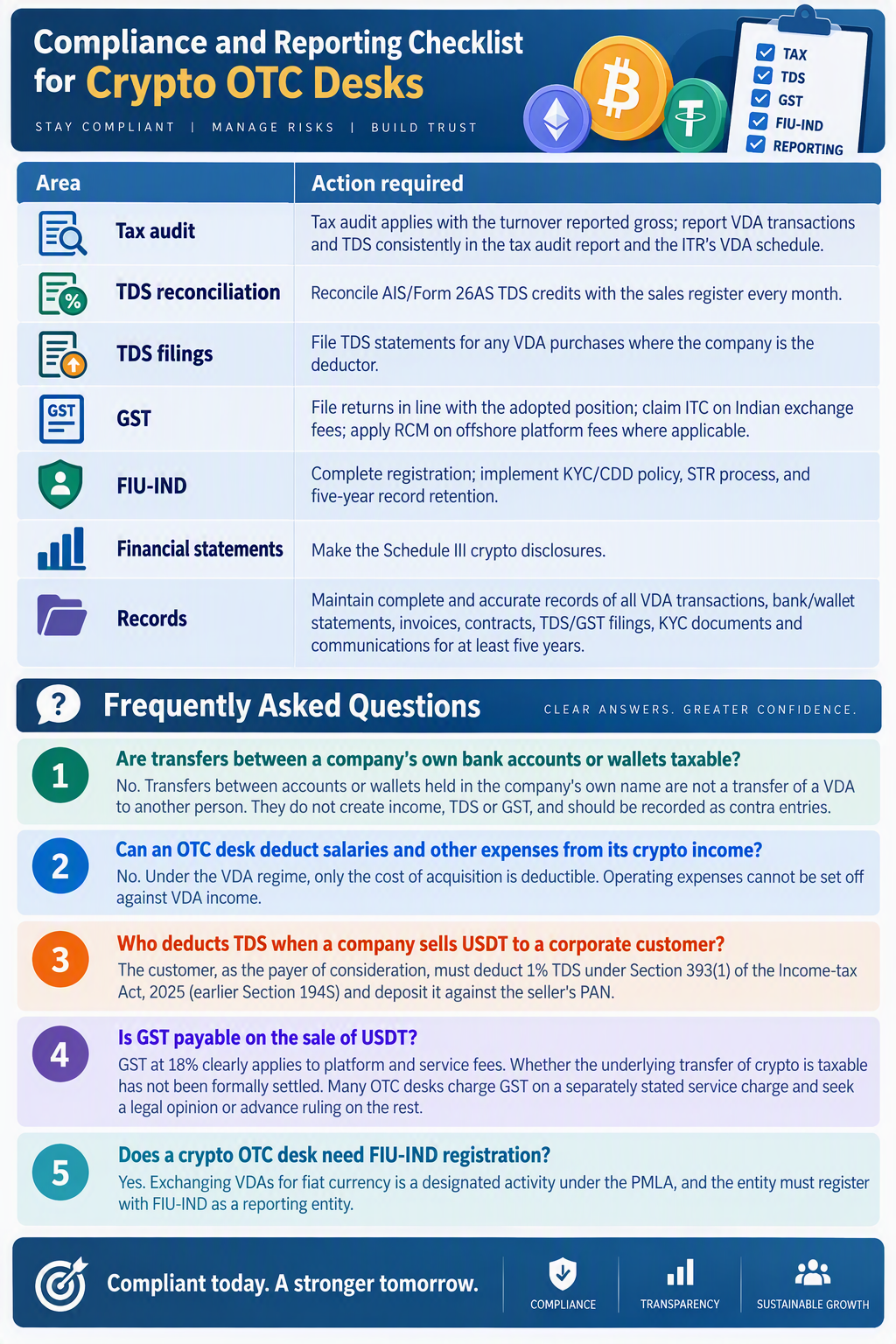
8. Compliance and Reporting Checklist for Crypto OTC Desks
| Area | Action required |
|---|---|
| Tax audit | Tax audit applies with the turnover reported gross; report VDA transactions and TDS consistently in the tax audit report and the ITR’s VDA schedule. |
| TDS reconciliation | Reconcile AIS/Form 26AS TDS credits with the sales register every month. |
| TDS filings | File TDS statements for any VDA purchases where the company is the deductor. |
| GST | File returns in line with the adopted position; claim ITC on Indian exchange fees; apply RCM on offshore platform fees where applicable. |
| FIU-IND | Complete registration; implement KYC/CDD policy, STR process, and five-year record retention |
| Financial statements | Make the Schedule III crypto disclosures. |
| Records | Maintain order-level records linking KYC, order, bank credit, exchange trade, wallet addresses and TxIDs |
Increased visibility for the tax department: Since April 2026, Indian VDA platforms report user transaction data directly to the tax department, and cross-border data sharing on crypto assets begins from April 2027. OTC desks should assume that their transactions are visible to the department and keep their records ready.
Frequently Asked Questions
Are transfers between a company’s own bank accounts or wallets taxable?
No. Transfers between accounts or wallets held in the company’s own name are not a transfer of a VDA to another person. They do not create income, TDS or GST, and should be recorded as contra entries.
Can an OTC desk deduct salaries and other expenses from its crypto income?
No. Under the VDA regime, only the cost of acquisition is deductible. Operating expenses cannot be set off against VDA income.
Who deducts TDS when a company sells USDT to a corporate customer?
The customer, as the payer of consideration, must deduct 1% TDS under Section 393(1) of the Income-tax Act, 2025 (earlier Section 194S) and deposit it against the seller’s PAN.
Is GST payable on the sale of USDT?
GST at 18% clearly applies to platform and service fees. Whether the underlying transfer of crypto is taxable has not been formally settled. Many OTC desks charge GST on a separately stated service charge and seek a legal opinion or advance ruling on the rest.
Does a crypto OTC desk need FIU-IND registration?
Yes. Exchanging VDAs for fiat currency is a designated activity under the PMLA, and the entity must register with FIU-IND as a reporting entity.
Conclusion
A well-structured crypto OTC desk, with KYC-verified customers, accounts held in a single legal name and TxID-level reconciliation, already has the foundation for good compliance. The areas that need careful attention are:
- the 30% VDA tax computed transfer by transfer without deduction of expenses,
- 1% TDS on every sale to customers, and tracking of that credit,
- a documented GST position in the absence of formal clarification, and
- mandatory FIU-IND registration with a working AML framework.
Getting these right at the outset avoids tax demands, blocked TDS credits, frozen bank accounts and regulatory action later.
The views in this article are based on the law as it stands at the time of writing. The GST position in particular may change with a CBIC clarification. Readers should seek professional advice on their specific facts before acting.
Need help with crypto and VDA compliance?
M/s Rajput Jain & Associates, Chartered Accountants, advises businesses on VDA taxation, TDS compliance, GST positions, FIU-IND registration, and crypto accounting. P-6/90 (2F), Connaught Circus, Connaught Place, New Delhi – 110001 +011-43-52-0194 | +91-9555 555 480 or 98-11-322-785 info@carajput.com | www.carajput.com