
Decoding Form 10B & Form 10BB for AY 2026-27
Page Contents
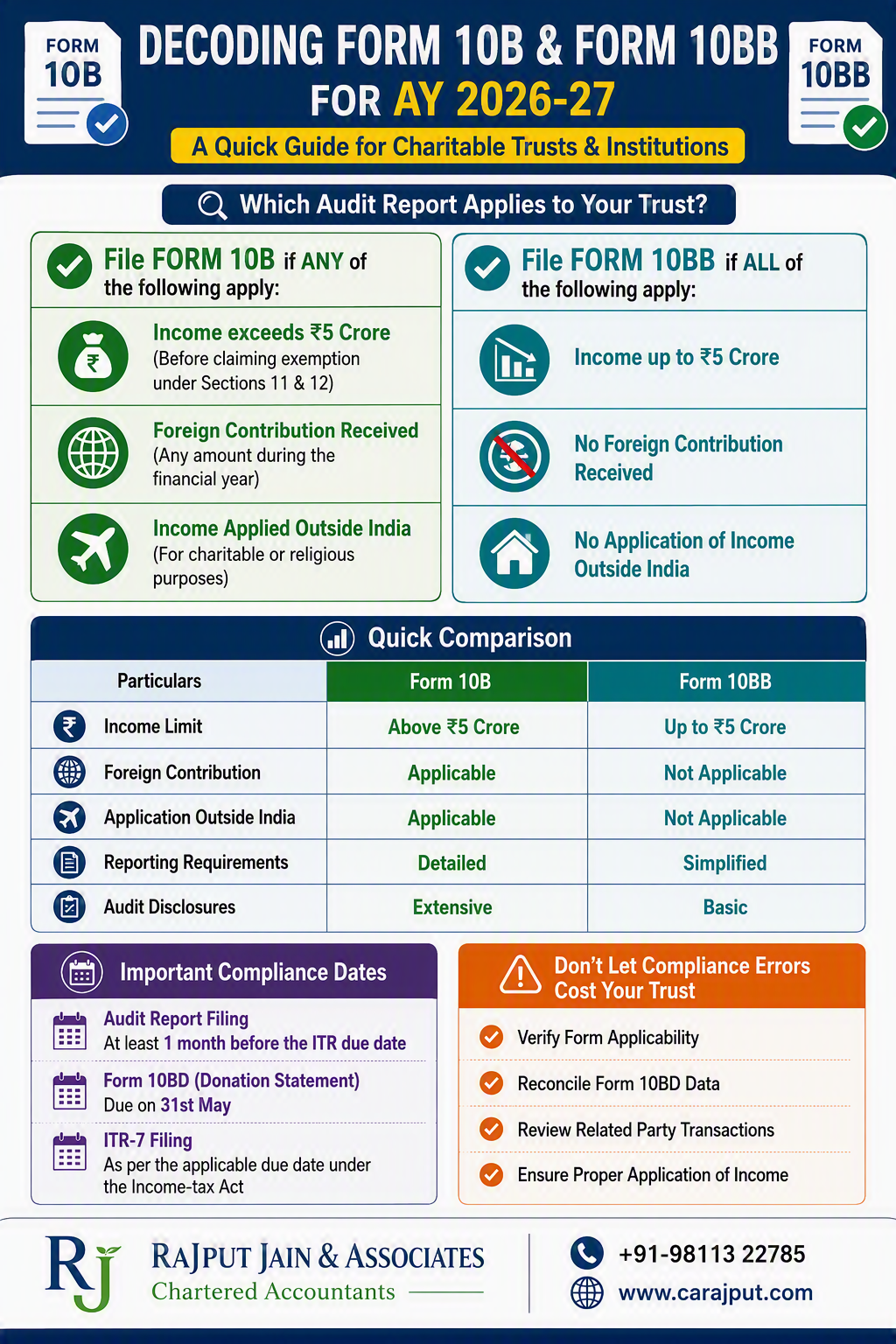
Decoding Form 10B & Form 10BB for AY 2026-27: for Charitable Trust
Introduction
The audit reporting landscape for charitable trusts and institutions has become increasingly detailed and compliance-driven. With the introduction of revised reporting requirements and significant amendments under the Finance Act (No. 2), 2024, trustees, NGOs, charitable institutions, and tax professionals must clearly understand the applicability and disclosure requirements of Form 10B and Form 10BB. This article provides a practical overview of the applicability, recent amendments, reporting schedules, and compliance checkpoints relevant for Assessment Year (AY) 2026-27.
Major Changes Introduced by Finance Act (No. 2), 2024
Merger of Registration Regimes
The Finance Act (No. 2), 2024 has effectively merged the approval regime under Section 10(23C) with the registration framework under Sections 11 to 13 for future applications. Applications under Section 10(23C) filed on or after 1 October 2024 are no longer considered, while existing approvals remain valid until expiry and subsequent renewal is available only under the second regime.
Condonation of Delay in Registration Applications
Trusts failing to apply for registration within prescribed timelines can seek condonation from the jurisdictional Commissioner. However, failure to obtain condonation may trigger taxation on accreted income under Chapter XII-EB.
Additionally, condonation requests relating to Forms 9A, 10, 10B, and 10BB cannot be entertained beyond three years from the relevant assessment year. The prescribed authority must dispose of such applications within six months.
Applicability of Form 10B and Form 10BB
When is Form 10B Required?
A charitable trust or institution must furnish Form 10B if during the previous year:
- Total income before claiming exemption under Sections 11 and 12 exceeds ₹5 crore.
- Income of institutions approved under Section 10(23C) exceeds ₹5 crore.
- Foreign contributions are received.
- Any part of income is applied outside India.
When is Form 10BB Required?
Form 10BB applies in cases where:
- Total income before exemption under Sections 11 and 12 does not exceed ₹5 crore.
- Income of Section 10(23C) institutions remains below ₹5 crore.
- None of the triggering conditions applicable to Form 10B are present.
Expanded Disclosure Requirements
The revised audit report requires significantly enhanced disclosures covering operational, financial, governance, and regulatory aspects of trusts. Key disclosure areas include:
- Registration and Legal Details
Auditors are required to verify and report:
-
- PAN and legal constitution of the trust.
- Registration details under Sections 12AB, 80G, 10(23C), and other applicable provisions.
- Effective date of registration.
- Unique Registration Number (URN).
- Registration authority details.
- Management and Related Persons
Detailed reporting is required regarding:
-
- Authors, founders, trustees, directors, office bearers and significant shareholders.
- Beneficial ownership disclosures.
- PAN, Aadhaar and identification details.
- Changes in governance structure during the year.
- Trust Objects and Modifications
Trusts must disclose:
-
-
- Primary charitable purpose such as education, medical relief, relief of poor, yoga, preservation of environment, preservation of monuments, or advancement of general public utility.
- Any modification to trust deeds and the corresponding application made to tax authorities.
-
Reporting on Books of Account
The revised reporting framework requires auditors to examine compliance with Rule 17AA. Trusts must maintain adequate books and supporting documentation including:
-
-
- Cash books and ledgers.
- Bills and vouchers.
- Records of donations.
- Details of loans, borrowings and investments.
- Project-wise records and application of income details.
-
Enhanced Reporting on Donations and Voluntary Contributions
A significant portion of Form 10B focuses on donations and donor reporting. Trusts are required to reconcile:
-
- Donations reported in Form 10BD.
- Corpus donations.
- Anonymous donations under Section 115BBC.
- Foreign contributions.
- Donations not reported due to incomplete information.
The total voluntary contributions reported in Form 10B must match the income and expenditure accounts, ensuring consistency between statutory filings and financial statements.
Application of Income: A Key Compliance Area
The concept of “application of income” remains critical for charitable institutions. The audit report requires reporting of:
- Amount spent on charitable activities in India.
- Donations made to other institutions.
- Revenue and capital expenditure.
- Repayment of loans used for charitable purposes.
- Corpus fund utilisation and replenishment.
- Amounts accumulated under Sections 11(1) and 11(2).
The auditor must also identify expenditures that are not allowable, including:
- Non-compliance with TDS provisions.
- Cash payments exceeding prescribed limits under Section 40A(3).
- Unapproved overseas application of income.
- Diversion of funds inconsistent with charitable objects.
Transactions with Specified Persons
Transactions involving persons specified under Section 13(3) have come under increased scrutiny. Trusts must disclose transactions relating to:
- Loans and advances.
- Rent of trust properties.
- Salary and remuneration.
- Purchase and sale of assets.
- Diversion of trust income or property.
- Investments in concerns where interested persons hold substantial interest.
These disclosures help determine whether any benefit has been conferred on specified persons, potentially jeopardising tax exemptions.
Other Critical Compliance Checks
Form 10B also seeks disclosures regarding:
- Violations under Section 12AB.
- Acceptance and repayment of loans under Sections 269SS and 269T.
- Cash receipt restrictions under Section 269ST.
- TDS/TCS compliance and related interest liabilities.
- Foreign contribution utilisation.
- Accumulation and deemed application of income under Forms 9A and 10.
Practical Takeaways for Trusts
To ensure smooth filing of Form 10B or Form 10BB, trustees should:
- Maintain complete donor and beneficiary records.
- Reconcile Form 10BD data with accounting records.
- Ensure compliance with TDS and cash transaction provisions.
- Review transactions involving trustees and related parties.
- Maintain documentary evidence supporting application of income.
- Verify registration status and URN details.
- Conduct periodic compliance reviews before year-end.
Conclusion
The revised Form 10B and Form 10BB framework reflects the Income Tax Department’s increasing focus on transparency, governance, donor reporting, and utilisation of charitable funds. Charitable institutions can no longer treat these reports as routine compliance obligations. Instead, they should use the reporting process as an opportunity to strengthen governance, improve internal controls, and safeguard tax exemptions. For AY 2026-27, proactive planning and accurate documentation will be the key to successful compliance and risk mitigation