
Revision & Rectification Provision under IT Act 2025 vs 1961
Page Contents
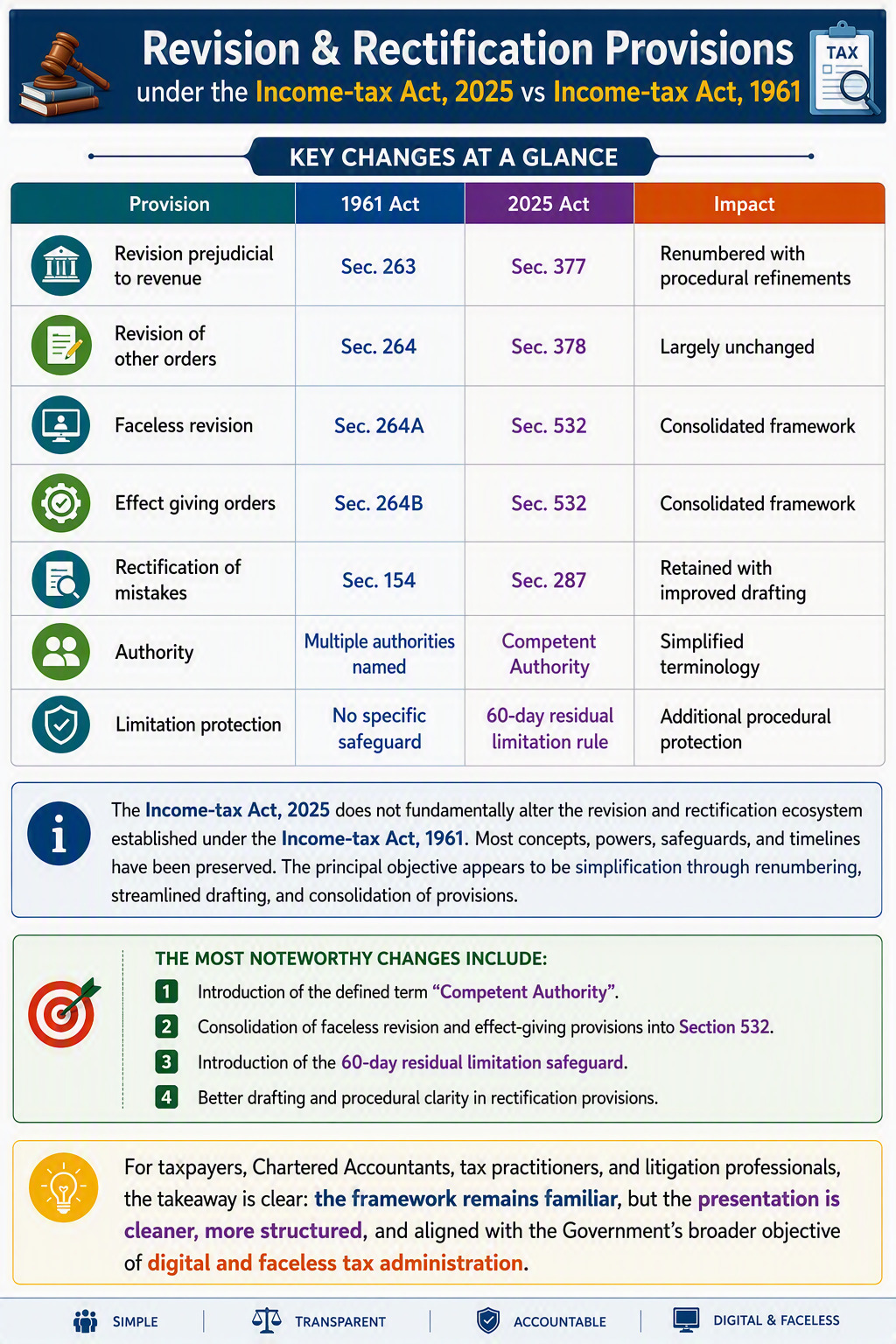
Revision & Rectification Provisions under the Income-tax Act, 2025 vs the Income-tax Act, 1961
Understanding the Key Changes in Revision and Rectification Framework
The Income-tax Act, 2025 aims to simplify, consolidate, and modernize India’s direct tax legislation. While the revision and rectification framework has largely been retained from the Income-tax Act, 1961, several provisions have been reorganized, renumbered, and redrafted for improved clarity. The new law introduces the concept of a “Competent Authority,” consolidates faceless schemes into a single provision, and provides additional procedural safeguards without materially altering taxpayers’ rights or the powers of the tax authorities.
This article provides a comparative analysis of the key revision and rectification provisions under the Income Tax Act, 1961 and the Income Tax Act, 2025.
Revision of Orders Prejudicial to the Interests of Revenue
Section 263 (1961 Act) vs Section 377 (2025 Act) : Section 263 has historically empowered the Commissioner to revise an assessment order that is both erroneous and prejudicial to the interests of the revenue. The corresponding provision under the Income-tax Act, 2025 is Section 377.
What remains unchanged?
The essential conditions for invoking revision continue to remain the same:
- The order must be erroneous.
- Error must be prejudicial to the interests of revenue.
- Opportunity of hearing must be provided to the taxpayer.
- Revisionary authority can enhance, modify, cancel, or direct a fresh assessment.
- The limitation period continues to be two years from the end of the financial year in which the original order was passed.
What has changed?
The most visible change is the replacement of multiple authorities such as Principal Commissioner, Commissioner, Chief Commissioner, etc., with the defined expression “Competent Authority.” This drafting change makes the statute shorter and easier to navigate.
Another notable amendment is the introduction of a new safeguard under Section 377(7), whereby if the remaining limitation period after excluding certain periods is less than 60 days, the limitation period automatically extends to 60 days.
Practical Impact : Taxpayers should not expect any significant change in the scope of revision under Section 377. The provision largely reproduces Section 263, with improved drafting and procedural clarity.
Comparative Table on Revision of Orders Prejudicial to Revenue
| Particulars | Income-tax Act, 1961 | Income-tax Act, 2025 | Key Change |
| Section | Section 263 | Section 377 | Renumbered provision |
| Authority | Principal CCIT / CCIT / PCIT / CIT | Defined as “Competent Authority” | New defined term introduced |
| Revision Power | Erroneous and prejudicial to revenue orders can be revised | Same | No substantive change |
| Time Limit | 2 years from end of FY | 2 years from end of FY | Unchanged |
| Revision of TP Orders | Covered u/s 92CA | Covered u/s 166 | Section reference changed |
| Deemed Erroneous Orders | Lack of inquiry, incorrect relief, violation of CBDT instructions | Same | Retained substantially |
| Limitation Exclusions | Available | Available | Retained |
| Additional Provision | Not available | Minimum residual limitation extended to 60 days | New provision in Sec. 377(7) |
Key Takeaway: Section 377 is largely a redrafted version of Section 263 with clearer drafting, defined terminology and a new 60-day residual limitation safeguard.
Revision of Other Orders
Section 264 (1961 Act) vs Section 378 (2025 Act) : Section 264 has long been regarded as a beneficial provision allowing taxpayers to seek revision of orders that are prejudicial to them. The corresponding provision in the 2025 Act is Section 378. Key Features Retained : The following provisions continue without substantive change:
- Revision can be initiated either suo motu or on assessee’s application.
- Application must be filed within one year.
- Delay can be condoned upon showing sufficient cause.
- Revision cannot be sought where the matter is appealable and the appeal period is still available.
- Revision cannot be exercised where the subject matter is already under appeal.
- Application fee remains ₹500.
- Revision order must be passed within one year from the end of the financial year in which the application is made.
Key Improvements: Similar to Section 377, the new Section 378 introduces a 60-day residual limitation safeguard. This ensures that the authority gets a minimum period to complete proceedings after excluding certain periods from limitation calculations.
Practical Impact: For taxpayers, Section 378 is essentially a continuation of Section 264. The substantive relief mechanism remains intact, ensuring that taxpayers continue to have a revisionary remedy even where no appeal is preferred.
Comparative Table on Revision of Other Orders
| Particulars | Income Tax Act, 1961 | Income Tax Act, 2025 | Key Change |
| Section | Section 264 | Section 378 | Renumbered provision |
| Nature | Revision beneficial to assessee | Same | No substantive change |
| Authority | PCIT / CIT | Competent Authority | Defined term introduced |
| Application Time | Within 1 year | Within 1 year | Unchanged |
| Delay Condonation | Available | Available | Retained |
| Appeal Restriction | Revision not allowed if appeal available or filed | Same | Retained |
| Revision Fee | ₹500 | ₹500 | Unchanged |
| Order Disposal | Within 1 year | Within 1 year | Unchanged |
| Exclusion of Limitation | Allowed | Allowed | Retained |
| Residual Limitation Extension | Not specifically provided | Extended to a minimum of 60 days | New provision |
Key Takeaway : Section 378 substantially reproduces Section 264 with better drafting and the introduction of a 60-day limitation protection.
Faceless Revision and Giving Effect Framework
Sections 264A & 264B (1961 Act) vs. Section 532 (2025 Act) : One of the most significant structural changes in the new law relates to faceless administration. Under the 1961 Act:
- Section 264A dealt with faceless revision proceedings.
- Section 264B dealt with faceless effect-giving proceedings.
The 2025 Act consolidates both provisions into a single comprehensive framework under Section 532.
Major Changes
- Single Omnibus Provision: Instead of maintaining separate provisions, a common section has been introduced for all schemes.
- Wider Scope: The new provision authorizes the government to frame faceless schemes for any purpose under the Act, rather than merely revision or effect-giving proceedings.
- Power to Modify Existing Schemes: Section 532 expressly empowers the Central Government to amend or modify already notified schemes. This authority was not specifically incorporated in the earlier provisions.
- Practical Impact: Section 532 significantly strengthens the framework for faceless tax administration and provides flexibility for further digital transformation of tax proceedings.
Comparative Table on Faceless Revision & Effect-Giving Schemes
| Particulars | Income Tax Act, 1961 | Income Tax Act, 2025 | Key Change |
| Faceless Revision | Section 264A | Section 532 | Consolidated into a common scheme section |
| Faceless Giving Effect | Section 264B | Section 532 | Merged into one omnibus provision |
| Scope | Limited to revision/effect giving | Applicable for any purpose under the Act | Significant expansion |
| Modification of Existing Schemes | Not specifically provided | Explicit power provided | New enabling provision |
Key Takeaway: Section 532 creates a comprehensive framework enabling faceless administration across the Act, replacing separate provisions.
Rectification of Mistakes Apparent from Record
Section 154 (1961 Act) vs Section 287 (2025 Act) : Rectification provisions allow correction of obvious and patent mistakes without undergoing lengthy appellate proceedings. Section 154 has been reintroduced as Section 287 under the 2025 Act.
Provisions Retained
The following principles remain unchanged:
- Rectification can be made for mistakes apparent from the record.
- Authorities may rectify errors suo motu.
- Assessees, deductors and collectors can request rectification.
- Refunds resulting from rectification continue to be admissible.
- Four-year limitation period remains unchanged.
- Rectification applications must be disposed of within six months.
Improvements in Drafting
The new law separately and explicitly provides:
- Requirement of notice before enhancement of liability.
- Opportunity of hearing before adverse rectification.
- Issuance of demand notice after rectification that enhances liability.
- Clearer ordering and presentation of procedural requirements.
Practical Impact: There is virtually no substantive change in the rectification mechanism. Section 287 is primarily a clearer and more structured version of Section 154.
Comparative Table on Rectification of Mistakes
| Particulars | Income Tax Act, 1961 | Income Tax Act, 2025 | Key Change |
| Section | Section 154 | Section 287 | Renumbered provision |
| Rectification Power | Mistake apparent from record | Same | No substantive change |
| Orders Covered | Orders, intimations u/s 143(1), 200A, 206CB | Orders and corresponding new Act intimations | References updated |
| Suo Moto Rectification | Permitted | Permitted | Unchanged |
| Rectification on Application | Allowed | Allowed | Unchanged |
| Opportunity of Hearing | Required before enhancement | Expressly and separately stated | Better drafting clarity |
| Rectification Order | Written order required | Written order required | Retained |
| Refund Consequent to Rectification | Allowed | Allowed | Retained |
| Demand Notice after Rectification | Provided | Explicitly elaborated | Improved drafting |
| Limitation Period | 4 years | 4 years | Unchanged |
| Disposal of Rectification Application | 6 months | 6 months | Retained and made explicit |
Key Takeaway: Section 287 largely mirrors Section 154. Changes are primarily drafting, restructuring, and clarification-oriented rather than substantive.
Conclusion
The Income-tax Act, 2025 does not fundamentally alter the revision and rectification ecosystem established under the Income-tax Act, 1961. Most concepts, powers, safeguards, and timelines have been preserved. The principal objective appears to be simplification through renumbering, streamlined drafting, and consolidation of provisions. The most noteworthy changes include:
- Introduction of the defined term “Competent Authority.”
- Consolidation of faceless revision and effect-giving provisions into Section 532.
- Introduction of the 60-day residual limitation safeguard.
- Better drafting and procedural clarity in rectification provisions.
For taxpayers, chartered accountants, tax practitioners, and litigation professionals, the takeaway is clear: the framework remains familiar, but the presentation is cleaner, more structured, and aligned with the government’s broader objective of digital and faceless tax administration. Comparative Chart – Revision & Rectification Provisions Income Tax Act, 1961 vs. Income Tax Act, 2025
| Provision | 1961 Act | 2025 Act | Impact |
| Revision prejudicial to revenue | Sec. 263 | Sec. 377 | Renumbered with procedural refinements |
| Revision of other orders | Sec. 264 | Sec. 378 | Largely unchanged |
| Faceless revision | Sec. 264A | Sec. 532 | Consolidated framework |
| Effect giving orders | Sec. 264B | Sec. 532 | Consolidated framework |
| Rectification of mistakes | Sec. 154 | Sec. 287 | Retained with improved drafting |
| Authority | Multiple authorities named | Competent Authority | Simplified terminology |
| Limitation protection | No specific safeguard | 60-day residual limitation rule | Additional procedural protection |