
Can Digital Transactions Trigger an Income Tax Notice?
Page Contents
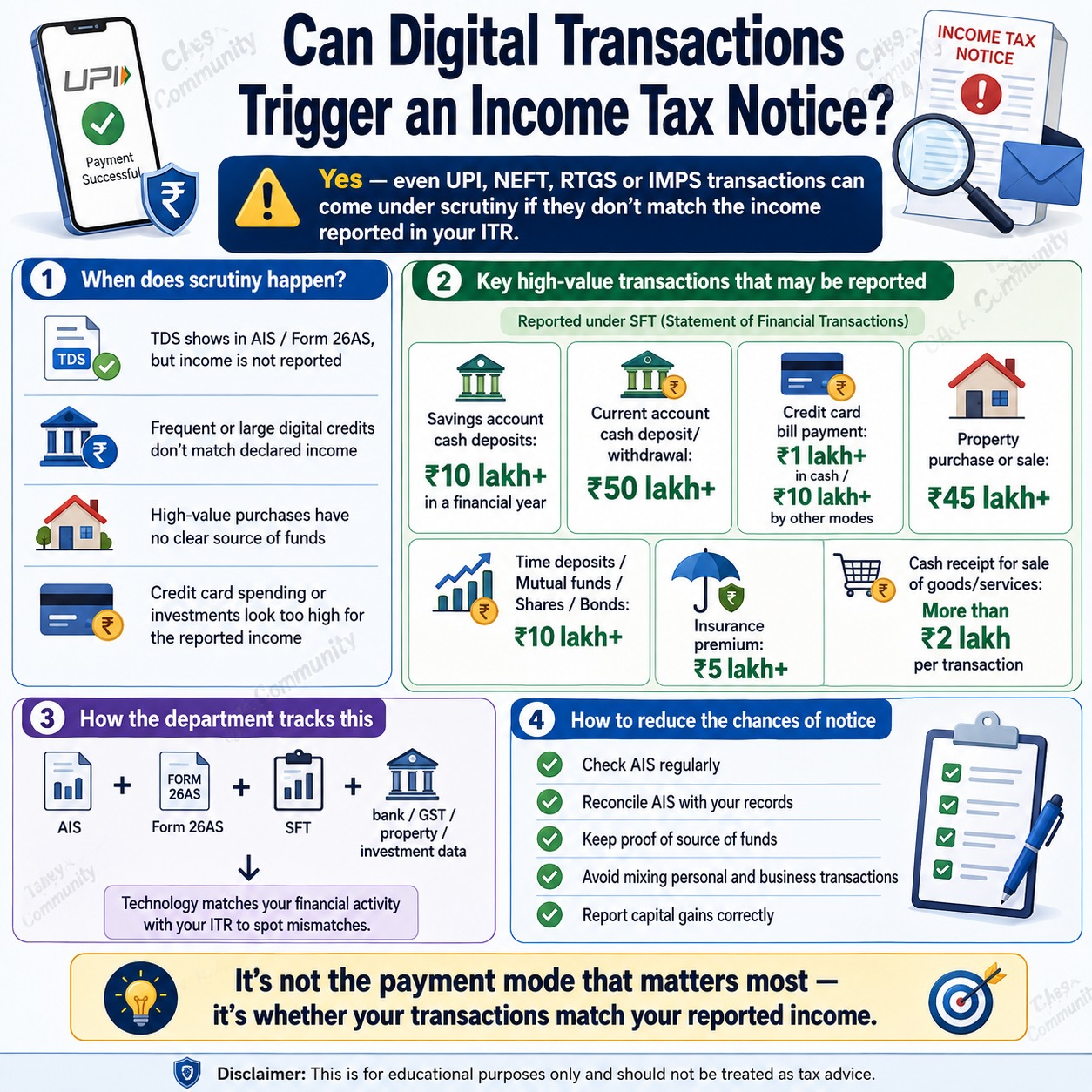
Can Digital Transactions Trigger an Income Tax Notice?
- For many years, taxpayers believed that income tax scrutiny was largely limited to large cash deposits and cash transactions. However, with the rapid digitization of financial transactions and advancements in data analytics, the Income Tax Department now monitors a much wider range of financial activities.
- Today, transactions carried out through UPI, NEFT, RTGS, IMPS, net banking, credit cards, and other digital channels can also attract attention if they are inconsistent with the income and financial details reported in your Income Tax Return (ITR).
The Department’s Focus Has Changed
- The Income Tax Department is no longer concerned primarily with how money is transferred. Instead, the focus is on whether a taxpayer’s financial transactions are adequately supported by the income disclosed in their tax returns.
- For example, if an individual reports an annual income of ₹8 lakh but regularly receives substantial digital credits, purchases high-value assets, or makes significant investments, the mismatch may prompt further verification by the tax authorities.
How Does the Income Tax Department Track Digital Transactions?
The tax department has access to information from multiple reporting systems, enabling it to create a comprehensive financial profile of taxpayers.
- Annual Information Statement (AIS) : The AIS captures a broad range of financial information, including Interest income, Dividend income, Securities transactions, Foreign remittances, Property transactions, High-value purchases and Tax deducted at source (TDS)
- Form 26AS : Form 26AS contains details relating to TDS deducted by employers and other deductors, Tax collected at source (TCS), Advance tax payments, refunds received, and Certain specified financial transactions
- Statement of Financial Transactions (SFT) : Financial institutions, banks, registrars, mutual fund houses, and other specified entities are required to report certain high-value transactions to the Income Tax Department through the SFT framework.
Using technology and data analytics, the department matches information reported in AIS, Form 26AS, SFT, GST records, property records, and ITRs to identify discrepancies and potential non-compliance.
Common Reasons Why Digital Transactions May Trigger Scrutiny
1. High-Value Digital Credits Not Matching Reported Income
Frequent or substantial receipts through UPI, bank transfers, payment gateways, or other digital channels may attract attention if they are not supported by the income disclosed in the tax return. This is particularly relevant for freelancers, consultants, professionals, online sellers, influencers, and small business owners. Where the volume of receipts appears significantly higher than the declared income, the department may seek an explanation.
2. TDS Appearing in AIS or Form 26AS but Income Not Reported
One of the most common reasons for notices is the existence of TDS entries in AIS or Form 26AS without corresponding income disclosure in the ITR. For example, professional fees subjected to TDS, interest income on deposits, commission income, and Contract receipts. If tax has been deducted on income, the department expects the related income to be reported in the return.
3. High-Value Asset Purchases Without a Clear Source of Funds
Major purchases such as residential or commercial property, luxury vehicles, expensive jewelry, and significant investments may attract scrutiny if the taxpayer cannot demonstrate a legitimate source of funds. Authorities often compare acquisition costs with past income declarations and available financial resources.
4. Business Receipts Not Matching Reported Turnover
Businesses and professionals receiving substantial digital payments may come under scrutiny if:
- Bank credits exceed reported turnover.
- GST filings are inconsistent with income tax returns.
- Digital receipts are not recorded in books of account.
Such mismatches can raise questions regarding unreported income.
5. Credit Card Spending Disproportionate to Income
High credit card spending, particularly when not supported by the taxpayer’s reported income, can also become a red flag during data-driven assessments and verification exercises.
High-Value Transactions Commonly Reported Under SFT
Certain transactions are mandatorily reported by financial institutions and other reporting entities. These include:
- Banking Transactions: Cash deposits of INR 10 lakh or more in savings accounts during a financial year. and cash deposits or withdrawals of INR 50 lakh or more in current accounts.
- Credit Card Payments: Cash payments of INR 1 lakh or more towards credit card bills. and total payments of ₹10 lakh or more through any mode during a financial year.
- Investments: Investments in mutual funds, bonds, shares, or time deposits exceeding prescribed thresholds, often starting from INR 10 lakh.
- Property Transactions: Purchase or sale of immovable property valued at ₹45 lakh or more.
- Insurance Premiums: Premium payments exceeding specified reporting limits, including transactions above INR 5 lakh in certain cases.
Although these transactions are legally permissible, they become part of the department’s information database and may be compared with the taxpayer’s reported income and financial disclosures.
How to Reduce the Risk of Receiving a Notice
Taxpayers should adopt good record-keeping and compliance practices, including:
- Regularly reviewing the AIS and Form 26AS.
- Reconciling all reported transactions before filing the ITR.
- Maintaining documentation supporting the source of funds.
- Properly disclosing business receipts and professional income.
- Reporting capital gains and investment income accurately.
- Avoiding the mixing of personal and business transactions in the same account.
- Preserving invoices, agreements, bank statements, and supporting records for significant transactions.
Key Takeaway: Digital Transactions Trigger an Income Tax Notice
Digital payments are not inherently suspicious, nor do they automatically result in an income tax notice. However, as the Income Tax Department increasingly relies on AIS, Form 26AS, SFT reporting, GST data, and advanced analytics, inconsistencies between your financial transactions and your reported income can quickly come to light.
The real risk is not the payment method, whether UPI, NEFT, RTGS, IMPS, or card payments. The real risk arises when your financial activity does not align with what is disclosed in your income tax return.