
Why Does USA Frequently Comment on India’s Domestic Laws?
Page Contents
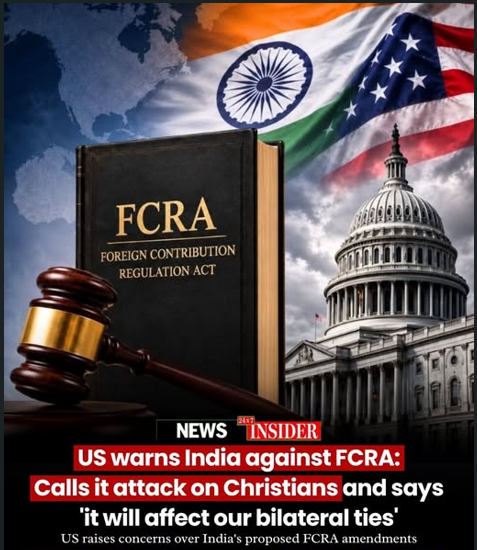
India has consistently maintained that the power to enact laws rests exclusively with its Parliament, acting within the framework of the Constitution and guided by the country’s democratic processes. As a sovereign nation, India believes that its domestic legislation should be assessed on the basis of its own legal standards, institutional mechanisms, and national priorities, rather than through the lens of external political opinions.
Why Does the United States Frequently Comment on India’s Domestic Laws?
The proposed Foreign Contribution (Regulation) Amendment Bill, 2026 (FCRA Amendment Bill) is aimed at enhancing the transparency, accountability, and regulatory oversight of organisations receiving foreign funding. The objective, according to its supporters, is to ensure that overseas contributions are utilised in a lawful, traceable, and transparent manner while safeguarding national interests and strengthening compliance requirements.
Importantly, regulations governing foreign funding are not unique to India. Many countries across the world have established legal frameworks to monitor and regulate foreign financial influence. The United States, for example, has laws such as the Foreign Agents Registration Act (FARA), which requires certain individuals and entities acting on behalf of foreign principals to disclose their activities and financial relationships. Similar regulatory measures can also be found in several other democratic nations.
This raises a broader policy question: if governments are entitled to regulate foreign financial influence within their own jurisdictions, should India be viewed differently when it seeks to pursue comparable regulatory objectives? Supporters of the proposed amendments argue that every sovereign nation has the right, and indeed the responsibility, to create legal safeguards that it considers necessary for transparency, national security, and public accountability.
At the heart of the debate lies the principle of sovereign equality among nations. Genuine respect for democracy involves acknowledging the right of elected legislatures to formulate laws in accordance with their constitutional mandates. While international discussion and constructive engagement have their place, many believe that the same standards of respect and non-interference should apply uniformly to all countries, regardless of their geopolitical influence.
India & the World: Regulating Foreign Influence Is a Global Practice
The regulation of foreign funding and foreign influence is not unique to India. Many of the world’s leading democracies have enacted laws requiring transparency and disclosure when foreign governments, organisations, or entities seek to influence domestic affairs.
Key Takeaways—Foreign Funding Global Practice
Global Democracies Have Similar Laws
- The United States (FARA, 1938), Australia (2018), United Kingdom (2025), Canada (2024), and the European Union have all adopted or strengthened frameworks to monitor foreign influence and funding.
Common Objective: Transparency
- These laws generally require registration, disclosure of funding sources, public reporting, and transparency regarding activities conducted on behalf of foreign entities.
Penalties for Non-Compliance
- Most jurisdictions impose civil, administrative, or criminal penalties for failing to register, concealing foreign funding, providing false information, or violating reporting requirements.
India’s FCRA Fits Within This Global Trend
- India’s Foreign Contribution (Regulation) Act (FCRA) requires registration or prior permission for receiving foreign contributions, annual disclosures, and compliance with prescribed conditions.
- It operates on principles similar to those found in foreign-influence laws elsewhere.
Growing International Consensus
- Governments increasingly view foreign funding transparency as necessary to protect democratic institutions, public policy, elections, and national sovereignty from undisclosed foreign influence.
Global Trend Is Strengthening, Not Weakening
Recent developments show that regulation of foreign influence is expanding worldwide:
- The UK’s Foreign Influence Registration Scheme came into force in 2025.
- Canada enacted its foreign influence registry law in 2024.
- European Union is developing a bloc-wide transparency framework.
- The United States has moved toward more assertive enforcement of its longstanding FARA regime.
Overall Takeaway of Foreign Contribution (Regulation) Act
The broader international trend is toward greater transparency and oversight of foreign funding, not less. In this context, India’s FCRA is presented as part of a wider global movement among democracies to ensure that foreign money and influence operating within national borders are disclosed, monitored, and regulated. The debate, therefore, is less about whether foreign funding should be regulated and more about how each democracy designs and implements its regulatory framework.
The Foreign Contribution (Regulation) Act framework is designed to regulate and monitor foreign contributions through transparency, accountability, and oversight, rather than prohibit legitimate foreign-funded activities. The Foreign Contribution (Regulation) Act 2026 reforms primarily seek to improve administrative clarity, strengthen compliance, and ensure that registered organisations remain active and accountable