
HRA Exemption under Old Tax Regime: New Rule w.e.f. 1.4.2026
Page Contents
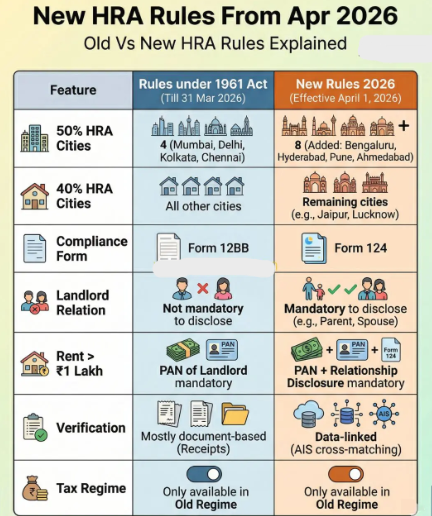
HRA Exemption under Old Tax Regime: New Rules Effective from 1 April 2026
Salaried Employees & HRA: New Rules Effective from 1 April 2026
The new House Rent Allowance framework, effective from 1 April 2026, introduces important changes for salaried employees claiming HRA exemption under the old tax regime. The revised provisions are aimed at enhancing transparency, improving verification mechanisms, and reducing false House Rent Allowance claims through increased data matching and disclosure requirements.
Key Changes in HRA Rules from 1 April 2026
Expansion of Metro Cities for Higher HRA Exemption
Up to 31 March 2026 : 50% HRA benefit was available only for Delhi, Mumbai, Kolkata and Chennai
From 1 April 2026
- Additional cities have been included Bengaluru, Hyderabad,Pune and Ahmedabad
- This increases the number of cities eligible for the 50% salary-based House Rent Allowance exemption calculation from 4 to 8.
New Compliance Form
Earlier: Form 12BB
Now: Form 124
Employees claiming House Rent Allowance benefits may be required to furnish details in the revised compliance form prescribed under the new rules.
Mandatory Landlord Relationship Disclosure
Earlier: Disclosure of a relationship with the landlord was generally not mandatory.
From 1 April 2026
- Employees must disclose the relationship with the landlord where applicable. This is particularly relevant where rent is paid to Parents, Spouse and Other relatives
Additional Information Required for Higher Rent Claims:
For rent exceeding prescribed limits:
Earlier, the permanent account number of the landlord was generally required.
Now, the Permanent Account Number of the landlord continues to be required. and relationship disclosure with the landlord is also mandatory.
Technology-Based Verification
Earlier, House Rent Allowance verification largely relied on Rent receipts, rent agreements, and Supporting documents
From 1 April 2026: Greater use of the Annual Information Statement, data analytics, cross-verification mechanisms, and digital matching of taxpayer information. This means HRA claims may be subject to increased scrutiny and automated verification.
Important Note: House Rent Allowance exemption continues to be available only under the Old Tax Regime.
Employees opting for the new tax regime cannot claim the house rent allowance exemption.
Impact of House Rent Allowance on Salaried Employees
The revised house rent allowance rules are intended to Strengthen compliance and reporting accuracy. Reduce mismatched or fictitious rent claims. Promote transparency in rent transactions, Improve tax administration through technology-driven verification and ensure genuine taxpayers continue to receive legitimate House Rent Allowance benefits.
Key Takeaway of House Rent Allowance change
Salaried taxpayers claiming House Rent Allowance should maintain proper rent documentation, ensure accurate landlord details are reported, and verify that Permanent Account Number, Aadhaar, and income tax records are consistent. With enhanced reporting and data-driven verification mechanisms, maintaining complete and accurate records will become more important than ever.
HRA Exemption Allowed Even if Employer Pays Rent Directly to Landlord
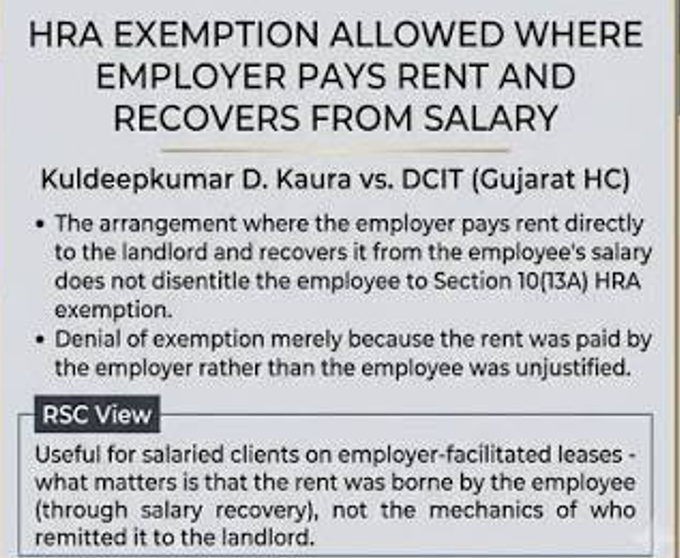
A significant ruling by the Gujarat High Court in the case of Kuldeepkumar D. Kaura vs. DCIT has provided important relief to salaried employees claiming House Rent Allowance exemption u/s 10(13A). Key Ruling on House Rent Allowance
- House rent allowance exemption cannot be denied merely because the employer directly pays the rent to the landlord and subsequently recovers the same amount from the employee’s salary.
- What is relevant for claiming a house rent allowance exemption is that the employee ultimately bears the rental expense.
- The method of payment, whether rent is paid directly by the employee or through an employer-facilitated arrangement, does not affect the employee’s eligibility for a house rent allowance exemption.
Practical Implications for Salaried Employees
Many organizations provide leased accommodation arrangements where:
- The employer enters into a lease agreement with the landlord.
- Rent is paid directly by the employer to the landlord.
- The corresponding amount is recovered from the employee’s salary.
In such cases, employees may still be eligible for a house rent allowance exemption, provided the following:
- The rental expenditure is effectively borne by the employee.
- Appropriate documentation is maintained.
- Other conditions prescribed u/s 10(13A) & Rule 2A are satisfied.
Why This Ruling is Important
- Clarifies the treatment of employer-facilitated lease arrangements.
- Reinforces the principle that the substance of the transaction is more important than the payment mechanism.
- Provides support for genuine house rent allowance claims where rent is recovered from salary.
- Reduces the risk of unjustified denial of HRA exemption solely on technical grounds.
- The following are key takeaways: For house rent allowance exemption purposes, the critical factor is who ultimately bears the rent cost, not who physically remits the rent to the landlord. Where the employee bears the rental burden through salary recovery or reimbursement arrangements, a house rent allowance exemption may still be available subject to fulfillment of other statutory requirements.