
Form 16A (Earlier Form 26AS) Now Shows Deductor PAN
Page Contents
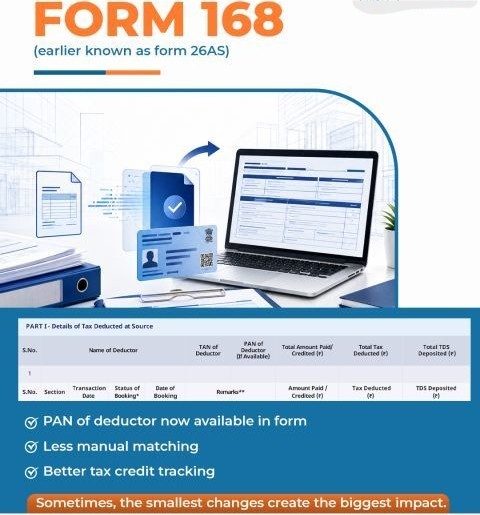
Form 16A (Earlier Reflected in Form 26AS) Now Shows Deductor PAN: A Small Change with a Big Impact on TDS Reconciliation
A seemingly minor enhancement in the income tax reporting ecosystem is set to deliver significant relief to accounting and finance teams across India. The updated Form 16A/Annual Tax Statement reporting framework (earlier reconciliation largely relied on Form 26AS) now additionally displays the Permanent Account Number of the deductor, making Tax Deducted at Source and Tax Collected at Source reconciliation considerably easier and more accurate.
What is Form 168?
Form 168 is prescribed under Section 510 of the Income-tax Act, 2025 read with Rule 245 of the Income-tax Rules, 2026. It serves as a central repository of tax-related information that helps taxpayers verify the accuracy of their income tax returns.
In simple terms, Form 168 acts as a comprehensive tax information statement that enables individuals and businesses to review information reported by employers, banks, financial institutions, brokers, mutual funds, property registrars, and other reporting entities.

Information Available in Form 168
Depending on a taxpayer’s financial activities during the year, Form 168 may contain the following details:
- Tax Deducted at Source (TDS) by employers, banks, tenants, clients, property purchasers, and other deductors.
- Tax Collected at Source (TCS) on specified transactions.
- Advance tax and self-assessment tax payments.
- Income-tax refunds processed or issued.
- Outstanding tax demands.
- Salary-related particulars reported by employers.
- Interest earned on savings accounts and fixed deposits.
- Dividend income received from companies or mutual funds.
- Mutual fund investments and redemption transactions.
- Listed equity and securities transactions.
- Purchase and sale of immovable property.
- Foreign remittances and foreign currency purchases.
- Other high-value financial transactions reported to the Income Tax Department.
The information visible in Form 168 depends entirely on what has been reported by third parties and the taxpayer’s financial dealings during the relevant financial year.
The Earlier Challenge: TAN Without PAN
For years, businesses and tax professionals faced an unnecessary reconciliation hurdle. While most organizations maintained their customer master data based on Permanent Account Number, the details appearing in Form 26AS primarily reflected the Tax Deduction Account Number of the deductor. As a result, matching TDS entries with customer records was often a tedious exercise.
The problem became even more pronounced in cases involving individual customers, proprietorship concerns, businesses operating under trade names and Situations where the deductor’s name in tax records differed from the name maintained in accounting systems.
Since Permanent Account Number was not readily visible, reconciliation frequently depended on matching customer names, which often did not align with the names reflected against the Tax Deduction Account Number.
Consequences for Accounting Teams
The absence of a deductor’s Permanent Account Number information led to several practical challenges:
- Accounting teams spent countless hours identifying the correct customer against each TDS credit entry. Manual verification was often required to establish a connection between Tax Deduction Account Number records and customer PAN databases.
- Name-based matching frequently resulted in mismatches, duplicate mapping, or incorrect identification of deductors.
- In some cases, businesses were unable to confidently identify the deductor and consequently failed to claim eligible Tax Deducted at Source or Tax Collected at Source credits, affecting cash flows and tax positions.
- Year-end reconciliations, audits, tax assessments, and return filings became more cumbersome due to incomplete identification information.
The New Improvement: Deductor PAN Visibility
The updated reporting format now includes the Permanent Account Number of the deductor along with the tax credit details. This enhancement allows organizations to:
- Match records directly with customer master databases
- Eliminate dependence on name-based reconciliation
- Reduce manual effort significantly
- Improve reconciliation accuracy
- Identify Tax Deducted at Source or Tax Collected at Source credits more efficiently
- Strengthen audit trails and compliance documentation
Why This Matters
For accounting professionals, the value of this change extends beyond convenience. Since Permanent Account Number serves as the primary identifier for taxpayers, having deductor PAN available in the tax statement creates a direct bridge between tax records and enterprise accounting systems.
Reconciliation processes that previously consumed hours can now be completed much faster with greater confidence. Organizations handling large volumes of customers, vendors, and tax deduction entries are likely to experience the most significant benefits.
A Welcome Step Towards Better Compliance
At a time when tax compliance is becoming increasingly digital and data-driven, such practical improvements can make a substantial difference in day-to-day operations.
While the change may appear small on the surface, its impact on TDS reconciliation, credit verification, audit readiness, and compliance efficiency is significant.
The inclusion of deductor PAN details is a thoughtful and much-appreciated enhancement by the Income Tax Dept that will help taxpayers, accountants, and finance teams save valuable time while ensuring more accurate tax credit reconciliation.
Why Form 168 is Important Before Filing an ITR
The Income Tax Department increasingly relies on third-party reporting for compliance monitoring and pre-filled returns.
If information relating to salary, bank interest, dividends, property transactions, capital gains, foreign remittances, or tax credits appears in Form 168 but is omitted from the ITR, the taxpayer may receive notices, queries, or compliance communications.
At the same time, Form 168 should not be treated as a substitute for tax computation. Information reported by third parties may be incomplete, duplicated, or require adjustments. Taxpayers must independently determine the correct taxable income based on applicable law.
Form 168 for NRIs
For Non-Resident Indians, Form 168 can be particularly useful in reconciling India-sourced income such as NRO account interest, fixed deposits, rental income, dividends, Mutual fund investments, share transactions, property sales, pension income, and professional or consultancy receipts.
NRIs should compare Form 168 with Form 16A, bank statements, broker reports, property records, and foreign tax documents to ensure proper reporting and tax credit claims.
They should also evaluate residential status, DTAA benefits, foreign tax credit claims, Form 67 compliance, Form 10F requirements, and Tax Residency Certificate (TRC) documentation.
For returning Indians and RNOR taxpayers, Form 168 provides useful information but does not determine residential status. Residential status must always be established independently under the applicable provisions of the Income-tax Act.
Conclusion
- The addition of deductor PAN information marks an important improvement in the tax reporting framework. By eliminating the long-standing challenge of matching Tax Deduction Account Number based records with PAN-based customer databases, the update simplifies reconciliation, reduces errors, and helps taxpayers claim their rightful Tax Deducted at Source or Tax Collected at Source credits with greater confidence.
- Sometimes, the most impactful reforms are not the largest ones, but the practical changes that solve everyday compliance challenges. This is certainly one such change.