
EBITDA-Earnings Before Interest, Taxes, Dep. & Amortization
Page Contents
All about EBITDA—Earnings Before Interest, Taxes, Dep. & Amortization
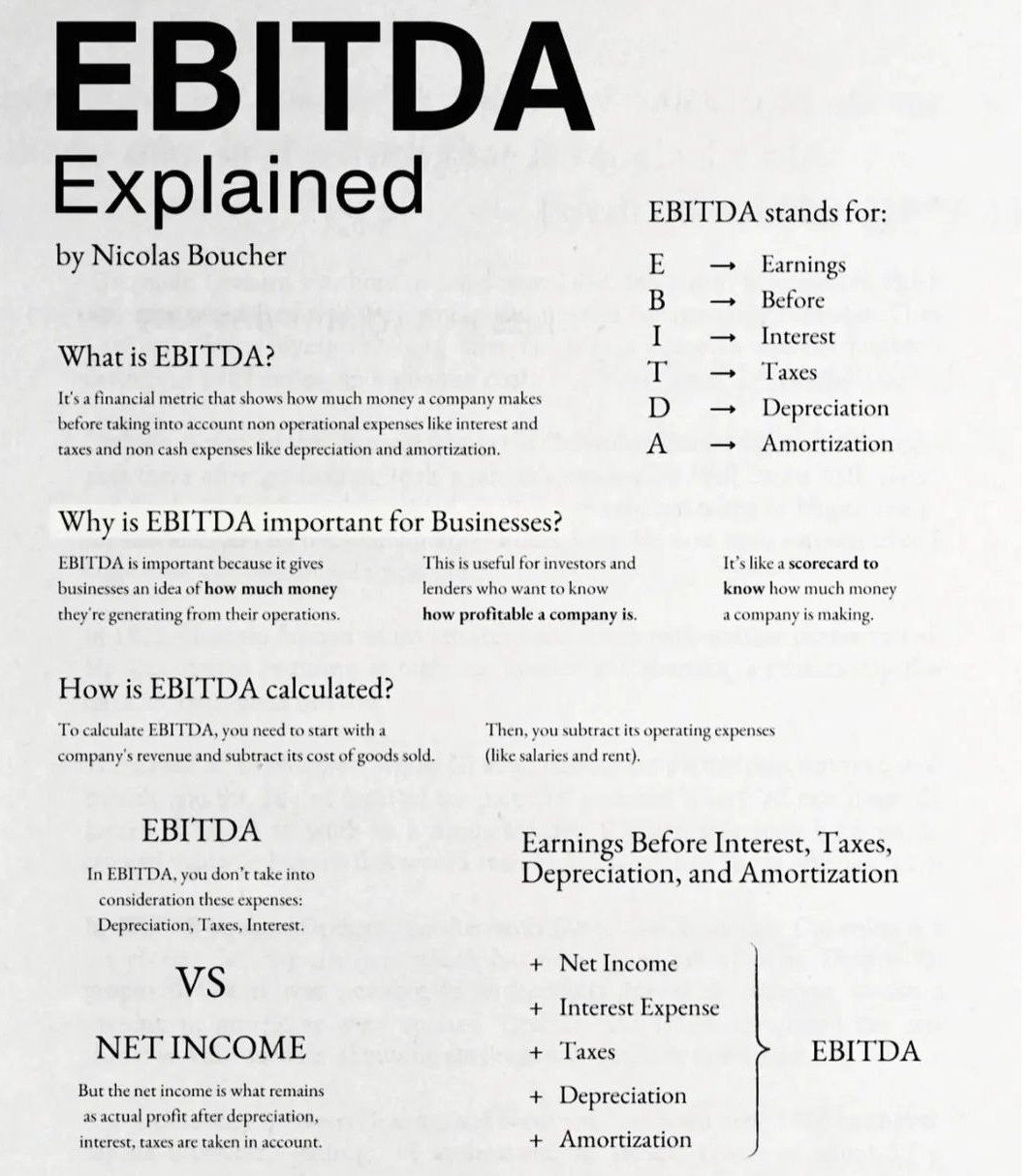
What is EBITDA?
EBITDA stands for Earnings Before Interest, Taxes, Depreciation, and Amortization. It is a financial metric that shows how much money a company makes before accounting for non-operational expenses like interest and taxes, and non-cash expenses like depreciation and amortization. EBITDA tells you how much money a company makes from its core operations, before financial decisions, tax impact, and non-cash charges.
Breaking Down the Term
- E → Earnings (Profit) – This is the company’s operating profit.
- B → Before Interest – Interest is excluded because it depends on how the company is financed (debt vs equity).
- T → Before Taxes – Taxes differ based on geography and tax laws, so they’re removed.
- D → Depreciation- Non-cash expense for wear & tear of physical assets (machines, buildings).
- A → Amortization – Non-cash expense for intangible assets (patents, trademarks, goodwill).
Why is EBITDA Important for Businesses?
- Gives insight into operational performance: Shows how much money is generated from core operations.
- Useful for investors and lenders: Helps assess how profitable a company is without the impact of financing and accounting decisions.
- Acts as a scorecard: Indicates how much money the company is making from its main business activities.
- Shows true operating performance—removes non-cash and non-operating items. Helps compare companies fairly.
- Widely used for business valuation (M&A)—EV/EBITDA is the most common valuation multiple.
- Helps lenders evaluate repayment ability—banks look at EBITDA to judge if the business can generate enough cash to service loans.
- Useful for internal decision-making—management tracks EBITDA growth to monitor efficiency.
Why Banks Use EBITDA
Banks commonly use the EBITDA method to judge whether your business can comfortably repay its debts. When you apply for a business loan or any financial assistance, lenders look at EBITDA because it helps them understand your company’s operating performance and repayment capacity.
EBITDA became popular in the 1980s leveraged buyout (LBO) era, where distressed companies were restructured and loaded with debt.
Investors needed a simple way to test whether the company generated enough cash & whether the business could at least pay interest costs. Today, banks still use EBITDA because it to Removes the effect of financing decisions, Removes tax differences, Removes non-cash expenses like depreciation and amortization, and shows core operational earning capacity
How is EBITDA calculated?
Start with Net Income, then add back Interest Expense, Taxes, Depreciation & Amortization Formula: EBITDA=Net Income+Interest+Taxes+Depreciation+Amortization\text{EBITDA} = \text{Net Income} + \text{Interest} + \text{Taxes} + \text{Depreciation} + \text{Amortization}
EBITDA Formula – Three Commonly Used Methods:
- From Profit Before Tax (PBT): EBITDA = PBT + Interest + Depreciation + Amortization + Taxes
- EBIT: EBITDA = EBIT + Depreciation + Amortization
- From Operating Profit (EBITDA is often same as Operating Profit): EBITDA = Operating Profit + Other Income (if applicable)
Depreciation and amortization are not included in operating expenses.
EBITDA vs Net Income
- EBITDA: Excludes depreciation, taxes, and interest.
- Net Income: Includes all expenses, giving actual profit after depreciation, interest, and taxes.
EBITDA is widely used for valuation, comparing companies, and assessing cash flow potential because it focuses on operational profitability. It measures a company’s operating performance by showing how much profit it makes from its core business, before accounting for financing costs, tax costs, and non-cash expenses.
Limitations of EBITDA
EBITDA is helpful but not perfect. It ignores interest (real cash outflow if debt is high), Ignores taxes, Ignores capital expenditure needs & Can overstate cash flow if depreciation is large. That’s why EBITDA ≠ Cash Flow.
EBITDA vs EBIT vs EBT
| Metric | Stands For | Meaning |
|---|---|---|
| EBITDA | Earnings Before Interest, Taxes, Depreciation & Amortization | Pure operating profit |
| EBIT | Earnings Before Interest & Taxes | Includes non-cash expenses (D&A) |
| EBT | Earnings Before Taxes | Includes interest and D&A |
EBITDA ≠ Cash Flow
| Basis | EBITDA | Cash Flow |
|---|---|---|
| Includes non-cash adjustments? | -No (adds back D&A) | -Yes |
| Considers working capital changes? | No | Yes (inventory, receivables, payables) |
| Includes interest? | -No | -Yes |
| its Includes taxes? | No | Yes |
| Reflects actual liquidity? | Partially | Fully |
| it Used for valuation? | ✔ Commonly (EV/EBITDA) | But less common |
| Used by banks to test repayment? | ✔ For profitability | For real cash coverage |
In simple terms, EBITDA shows profit from core operations (even if cash has not yet come in). & Cash flow shows actual money available to run the business.
-
EBITDA shows operating performance
-
Cash Flow shows the real money you have
-
Debt/EBITDA is used by banks to judge loan repayment capacity
-
High EBITDA does not guarantee strong cash flow
-
Strong cash flow is essential for survival
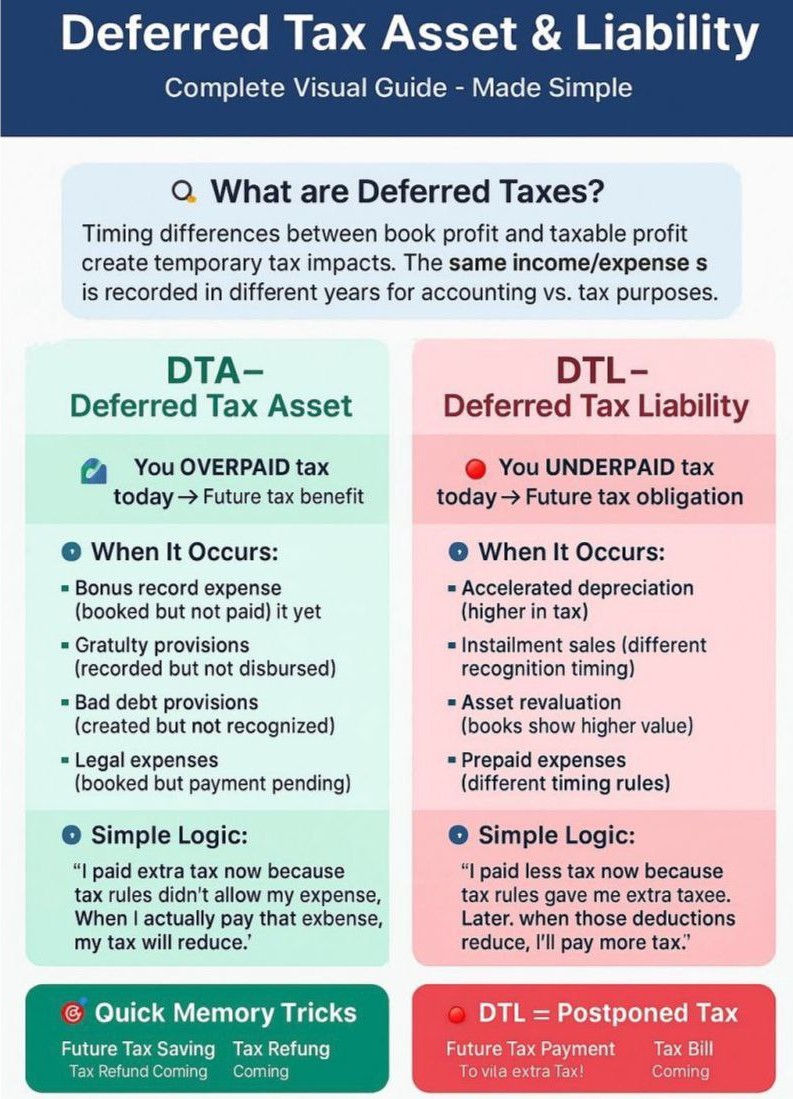
DTA and DTL
𝗧𝗵𝗲 𝘀𝗮𝗺𝗲 𝗯𝘂𝘀𝗶𝗻𝗲𝘀𝘀 𝗰𝗮𝗻 𝗹𝗼𝗼𝗸 𝘃𝗲𝗿𝘆 𝗱𝗶𝗳𝗳𝗲𝗿𝗲𝗻𝘁 𝗼𝗻 𝗮 𝗱𝗶𝗳𝗳𝗲𝗿𝗲𝗻𝘁 𝗱𝗮𝘁𝗲.
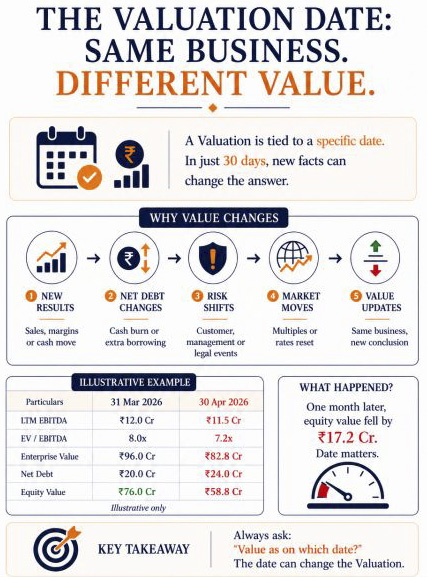
One of the most important principles in business valuation is that a valuation is not timeless; it is valid only as of a specific date.
Why does the valuation date matter?
When a valuation report states that a company is worth ₹100 crore, the immediate follow-up question should be, “INR 100 crore as on which date?” A valuation conclusion is based on the facts, financial information, market conditions, business risks, and assumptions that exist on the valuation date. Even if the business itself remains unchanged, changes occurring after that date can significantly affect value.
What can change a valuation within a short period?
1. New Financial Results:
Valuation is heavily influenced by revenue, profitability, cash flows, and growth expectations. For example Sales decline unexpectedly. Profit margins compress. EBITDA falls below projections. and Cash collections slow down. Even one quarter of weaker performance can reduce enterprise value.
2. Net Debt Changes:
Enterprise Value (EV) and Equity Value are not the same. Formula: Equity Value = Enterprise Value − Net Debt. If a company: takes additional loans, burns cash and incurs working capital losses, its net debt increases and equity value falls, even if enterprise value remains constant.
3. Risk Profile Changes:
Investors pay less for businesses that become riskier. Examples include the loss of a major customer. Regulatory investigations. Management disputes. Litigation. and supply chain disruptions. Higher risk generally means a higher discount rate and lower valuation.
4. Market Movements:
Valuation multiples depend on market conditions. For example, listed peers may trade at 10x EBITDA in March. And due to economic uncertainty, they may trade at 8x EBITDA in April. Even though the company is unchanged, the valuation multiple has declined, reducing value.
5. Updated Assumptions:
Valuations often depend on assumptions regarding growth rates, margins, capital expenditure, working capital requirements, and discount rates. A small change in assumptions can materially impact value.
Understanding the Example in the Infographic
The infographic compares the same company at two different dates:
| Particulars | 31 Mar 2026 | 30 Apr 2026 |
|---|---|---|
| LTM EBITDA | INR 12.0 Cr | INR 11.5 Cr |
| EV / EBITDA | 8.0x | 7.2x |
| Enterprise Value | INR 96.0 Cr | INR 82.8 Cr |
| Net Debt | INR 20.0 Cr | INR 24.0 Cr |
| Equity Value | INR 76.0 Cr | INR 58.8 Cr |
What happened?
- First impact: EBITDA declined from INR 12 crore to INR 11.5 crore.
- Second impact: Market multiple reduced from 8.0x to 7.2x.
- Third impact: Net debt increased from INR 20 crore to INR 24 crore.
As a result:
- Enterprise Value fell from INR 96 crore to INR 82.8 crore.
- Equity Value fell from INR 76 crore to INR 58.8 crore.
Loss in Equity Value: INR 17.2 crore in just one month.
This illustrates why valuation is dynamic rather than static.
Practical Importance of Valuation Date
- Mergers & Acquisitions (M&A): A buyer may agree on a valuation based on March financials. If business performance deteriorates before closing, the buyer may seek a lower valuation.
- Startup Fundraising: Investors assess value based on metrics and market conditions prevailing on the investment date. A delay of a few months can change the valuation significantly.
- Income Tax & FEMA Valuations: Valuation reports for Section 56(2)(viib), issue of shares, FEMA transactions, ESOPs, and mergers and demergers must clearly specify the valuation date because compliance depends on value determined as of that date.
- Litigation and Shareholder Disputes: Courts and tribunals often examine value as of a particular event date, not the current date.
- Financial Reporting: Fair value measurements under accounting standards are always measured at a specified reporting date.
Key Takeaway
- The same business can have different values on different dates without any fundamental change in its operations. Changes in earnings, debt levels, risk factors, market multiples, and assumptions can quickly alter both enterprise value and equity value.
- Therefore, whenever you read a valuation report, negotiate a transaction, review a fairness opinion, or discuss a company’s worth, always ask, “Value as of which date?” Because in valuation, the date is not just a formality. It is a critical component of the valuation conclusion itself.