
Overview of Limited Liability Partnership (LLP)
Page Contents
Complete Overview of Limited Liability Partnership (LLP) under the LLP Act, 2008
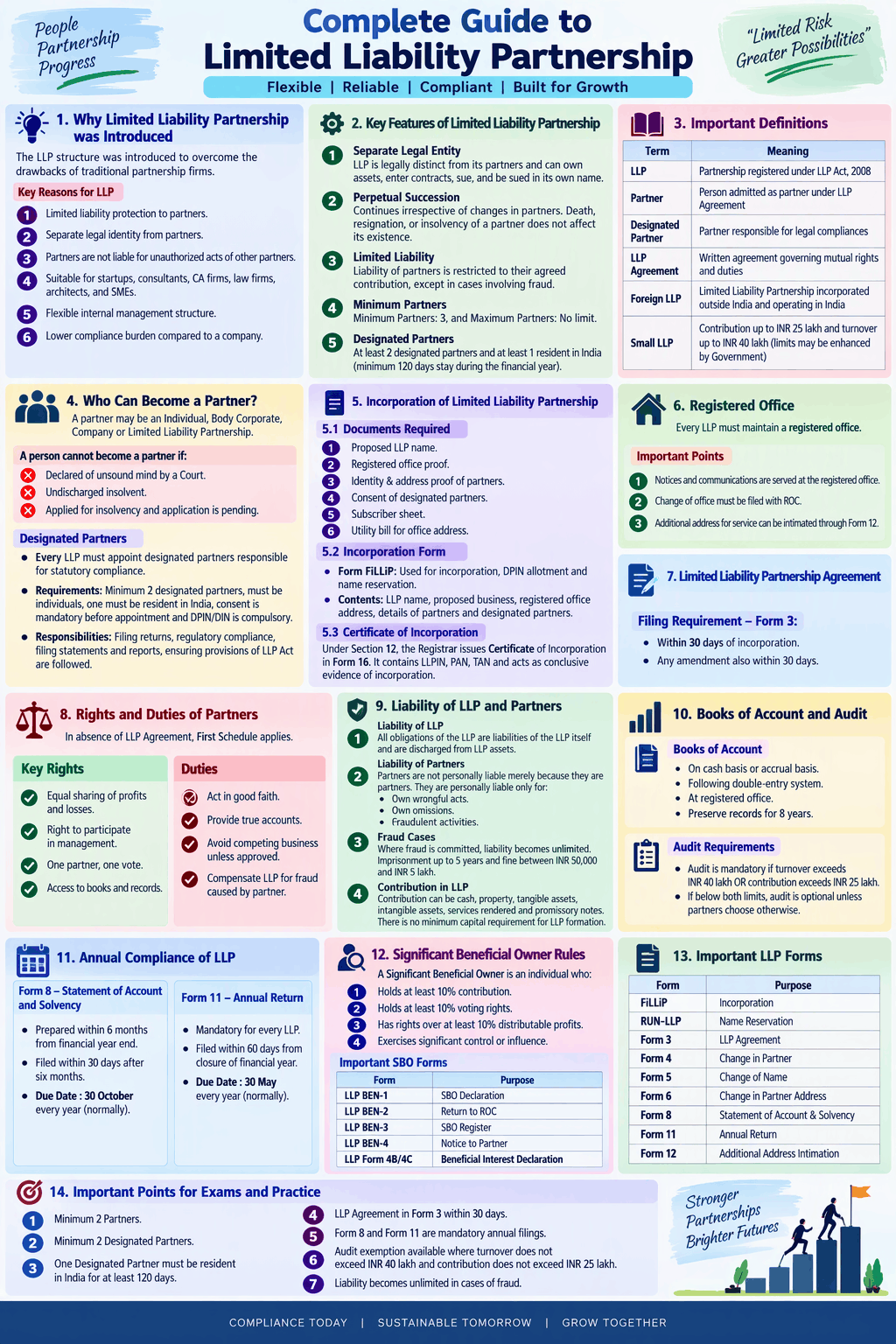
A Limited Liability Partnership (LLP) is a modern business vehicle that combines the flexibility of a conventional partnership with the advantage of limited liability protection generally associated with a company. It is regulated by the Limited Liability Partnership Act, 2008 and the LLP Rules, 2009. An LLP enjoys an independent legal status and perpetual existence, making it a preferred choice for professionals, entrepreneurs, consultants, startups, and small and medium-sized enterprises.
Purpose Behind the Introduction of LLP
The LLP framework was introduced to address the shortcomings of traditional partnership firms while retaining their operational flexibility.
Major Objectives
- To provide limited liability protection to partners.
- To establish a separate legal identity for the business.
- To ensure that one partner is not held responsible for the unauthorized actions of another partner.
- To provide an ideal structure for startups, consultants, professionals, architects, legal firms, and SMEs.
- To offer flexibility in business management.
- To reduce regulatory compliance as compared to companies.
Salient Features of LLP
1. Independent Legal Entity
An LLP possesses a legal identity distinct from its partners. It can hold property, enter into contracts, initiate legal proceedings, and be sued in its own name.
2. Perpetual Existence
The continuity of an LLP is not affected by changes in its partners. Admission, retirement, death, or insolvency of a partner does not result in dissolution.
3. Limited Responsibility of Partners
Partners are liable only to the extent of their agreed contribution to the LLP, except in cases involving fraud or wrongful conduct.
4. Number of Partners
- Minimum Partners Required: 2
- Maximum Number of Partners: No statutory limit
5. Designated Partners
Every LLP is required to appoint
- At least two Designated Partners.
- At least one Designated Partner who is resident in India and has stayed in India for a minimum of 120 days during the financial year.
Important Terminologies
| Term | Description |
|---|---|
| LLP | A partnership registered under the LLP Act, 2008 |
| Partner | A person admitted as a partner in accordance with the LLP Agreement |
| Designated Partner | A partner entrusted with statutory and compliance responsibilities |
| LLP Agreement | A formal agreement defining the rights, duties, and obligations of partners |
| Foreign LLP | An LLP incorporated outside India but carrying on business in India |
| Small LLP | LLP having contribution up to ₹25 lakh and turnover up to ₹40 lakh, subject to higher limits prescribed by the Government |
Eligibility to Become a Partner
The following entities can be admitted as partners in an LLP Individual persons, Companies, LLPs, Body Corporates. However, a person cannot become a partner if Declared of unsound mind by a competent court, An undischarged insolvent and An insolvency application filed by the person is pending adjudication.
Designated Partners and Their Role
Every LLP must appoint designated partners to ensure compliance with legal and regulatory requirements. Eligibility Conditions
- Minimum two designated partners.
- Must be natural persons.
- At least one should be resident in India.
- Prior consent is mandatory.
- DPIN/DIN is compulsory.
Responsibilities
- Filing statutory forms and returns.
- Ensuring compliance with LLP law.
- Submission of reports, documents, and statements to the Registrar.
- Managing legal obligations under the LLP Act.
Incorporation Process of LLP
Documents Required
- Proposed LLP name.
- Proof of registered office.
- Identity and address proofs of partners.
- Consent of designated partners.
- Subscriber’s declaration.
- Utility bill of business premises
Incorporation Form
Form FiLLiP serves multiple purposes:
- Incorporation of LLP.
- Allotment of DPIN.
- Reservation of LLP name.
Information Required in Incorporation Documents
- Proposed name of LLP.
- Business activities to be carried out.
- Registered office address.
- Details of partners.
- Details of designated partners.
Certificate of Incorporation
After successful registration, the Registrar issues a Certificate of Incorporation in Form 16. The certificate generally includes: LLP Identification Number (LLPIN), PAN, TAN. The Certificate serves as conclusive evidence that the LLP has been legally incorporated.
LLP Registered Office Requirements
Every LLP must maintain a registered office for receipt of notices and official communications.
Important Compliance Points
- All legal communications are sent to the registered office.
- Any change in office address must be intimated to ROC.
- Additional service addresses may be reported through Form 12
LLP Agreement
The LLP Agreement serves as the governing document of the LLP and regulates the relationship among partners and the LLP itself.
Matters Covered
- Sharing of profits and losses.
- Capital contribution.
- Rights and obligations of partners.
- Admission, retirement, and cessation of partners.
- Governance and management structure.
- Voting and decision-making procedures.
LLP ROC Filing Requirement
Form 3
- To be filed within 30 days of incorporation.
- Any subsequent amendment must also be filed within 30 days.
Rights and Obligations of Partners
In the absence of an LLP Agreement, the provisions of the First Schedule apply.
Rights
- Equal participation in profits and losses.
- Right to participate in management.
- One vote per partner.
- Access to books and records
Duties
- Acting honestly and in good faith.
- Maintaining transparent records.
- Avoiding competing businesses without approval.
- Indemnifying the LLP for losses arising from fraud.
Liability Provisions
- Liability of LLP : All liabilities and obligations are liabilities of the LLP itself and are satisfied from its assets.
- Liability of Partners : Partners are not personally liable merely by virtue of being partners. Personal liability arises only for Their own negligent acts, Their own wrongful omissions. and Fraudulent conduct
- Fraud Cases : Where fraud is committed Liability becomes unlimited, Imprisonment may extend up to five years, Fine may range from INR 50,000 to INR 5 lakh.
Capital Contribution
Contribution in an LLP may be made in the form of:
- Cash contribution.
- Immovable or movable property.
- Tangible assets.
- Intangible assets.
- Professional services.
- Promissory notes or agreements.
One of the unique advantages of an LLP is that there is no prescribed minimum capital requirement.
Books of Accounts
An LLP is required to maintain proper accounting records:
- On cash basis or accrual basis.
- Under the double-entry accounting system.
- At its registered office.
- Preserved for at least eight years.
Audit Requirements
Audit becomes compulsory when:
- Annual turnover exceeds INR 40 lakh, or
- Partner contribution exceeds INR 25 lakh.
- If both limits remain below the prescribed threshold, audit is generally not mandatory unless voluntarily opted by partners.
Annual Compliance Requirements
Form 8 – Statement of Account and Solvency
- Prepared within six months from the end of the financial year.
- Filed within thirty days thereafter.
- Normal Due Date: 30 October.
Form 11 – Annual Return
- Mandatory filing for every LLP.
- To be submitted within sixty days from financial year closure.
- Normal Due Date: 30 May.
Significant Beneficial Owner (SBO) Rules
A person is regarded as an SBO if the individual:
- Holds at least 10% contribution.
- Possesses at least 10% voting rights.
- Has right to at least 10% of distributable profits.
- Exercises significant influence or control over the LLP.
Benefits of LLP
- Separate legal identity.
- Limited liability protection.
- No minimum capital requirement.
- Reduced compliance burden compared to companies.
- Perpetual succession.
- Tax-efficient structure.
- Preferred by professionals and startups.
- Flexible governance framework.
Limitations of LLP
- Equity shares cannot be issued.
- Raising venture capital funding is comparatively difficult.
- Expansion opportunities may be restricted compared to companies.
- Significant penalties can arise due to delayed statutory filings.
Key Points to Remember
- Minimum two partners are mandatory.
- Minimum two designated partners are required.
- One designated partner must satisfy the Indian residency condition of 120 days.
- LLP Agreement is required to be filed through Form 3 within 30 days.
- Form 8 and Form 11 are mandatory annual filings.
- Audit exemption is available where turnover does not exceed ₹40 lakh and contribution does not exceed ₹25 lakh.
- Fraud results in unlimited liability for responsible partners.
Form Purpose FiLLiP Incorporation RUN-LLP Name Reservation Form 3 LLP Agreement LLP Form 4 Change in Partner Form 5 In case LLP required Change of Name LLP Form 6 Change in Partner Address Form 8 Statement of Account & Solvency LLP Form 11 Annual Return Form 12 Additional Address Intimation
Conclusion
A Limited Liability Partnership (LLP) remains one of the most practical and cost-effective business structures available in India. It offers the operational flexibility of a partnership while providing limited liability protection similar to a company. Due to lower compliance requirements, perpetual succession, separate legal status, and ease of management, LLPs continue to be a preferred option for professionals, consultants, startups, CA firms, law firms, and growing businesses seeking a balanced legal structure.
Popular Articles :