
GST Compliance for Pvt Ltd Companies: A Practical Guide
Page Contents

GST Compliance for Private Limited Companies: A Practical Guide
Introduction
Walking a business as a non-public restrained organisation in India comes with a set of legal, monetary, and operational responsibilities. Among these, personal restrained agency compliance is one of the most essential factors to make sure clean functioning and avoid penalties. Even as compliance covers numerous areas like annual filings, board meetings, and profits tax returns, one important element is GST compliance.
The products and offerings Tax (GST) is the unified indirect tax system in India, and each registered enterprise have to comply with its policies. For private limited businesses, GST compliance isn’t just about filing returns—it’s far approximately well timed registration, proper invoicing, accurate tax price, and transparent report-maintaining. This guide presents a practical approach to GST compliance, its position in non-public restricted employer compliance, commonplace challenges, penalties, and first-rate practices.
1. Know-how non-public restricted company Compliance in India
Earlier than diving into GST necessities, allow’s briefly understand what private restrained corporation compliance manner.
Personal limited businesses are ruled by means of the businesses Act, 2013, and have to comply with regulations laid down via regulatory bodies just like the Ministry of company Affairs (MCA), profits Tax department, and items and offerings Tax (GST) government.
Some not unusual compliance necessities include:
- Filing annual returns with MCA (shape MGT-7 and AOC-four).
- Holding board meetings and retaining statutory facts.
- Submitting income tax returns.
- GST registration and returns (if applicable).
For this reason, GST is an indispensable part of private limited business enterprise compliance, making sure companies stay tax-compliant even as also gaining credibility among clients and investors.
2. GST Registration for non-public restricted organizations
Each personal restricted business enterprise need to evaluate whether or not GST registration is required as a part of their compliance obligations.
A corporation is required to sign up underneath GST if:
- Annual turnover exceeds ₹20 lakhs (₹10 lakhs for special category states).
- The enterprise is involved in interstate delivery of products or offerings.
- The organization sells services or products via e-trade platforms.
- The commercial enterprise falls beneath specific categories requiring obligatory GST registration (like exporters, dealers, or opposite charge mechanism instances).
Once registered, the corporation is allotted a GSTIN (goods and offerings Tax identification quantity), which becomes part of each bill, return filing, and authentic conversation. Acquiring GST registration is step one closer to pleasant, private, confined organisation compliance duties.
3. GST filing necessities below personal constrained business enterprise Compliance
Submitting GST returns is one of the maximum regular and important parts of private restrained corporation compliance. The most important varieties of GST returns encompass:
- GSTR-1: information of outward resources (sales) filed monthly or quarterly.
- GSTR-3B: A monthly summary return of each outward and inward supplies with fee of tax.
- GSTR-nine: Annual GST return filed as soon as a 12 months.
- GSTR-9C: GST audit go back (required if turnover exceeds ₹5 crore).
Well timed submitting ensures compliance and helps the company maintain a clean economic report. Missing closing dates draws overdue charges and can even cause cancellation of GST registration, which without delay impacts personal constrained organization compliance status.
4. Importance of input Tax credit (ITC) in Compliance
Certainly one of the most important benefits of GST is the ability to assert input Tax credit score (ITC), where groups can offset the tax paid on purchases against their output tax liability.
To remain compliant:
- Claim ITC only on eligible purchases.
- Ensure suppliers also are submitting their returns, as ITC is permitted handiest if the bill is meditated in GSTR-2B.
- Preserve specific purchase information and reconcile regularly.
Right ITC management is a crucial part of private confined corporation compliance because incorrect claims can cause consequences and financial strain.
5. Common GST Compliance challenges for private confined agencies
Many non-public restricted companies war with GST compliance because of the complexity of tax guidelines. A few common troubles include:
- Lacking closing dates for filing GST returns.
- Submitting wrong records in GSTR-1 and GSTR-3B.
- Non-reconciliation of ITC with suppliers.
- Not updating GST registration after business adjustments.
- Mistakes in invoice formats, leading to rejection of ITC claims.
Those errors now not handiest affect personal restricted employer compliance but also can appeal to audits and scrutiny from tax authorities.
6. Penalties for Non-Compliance
Non-compliance with GST regulations can have serious consequences for private restrained businesses. Some penalties include:
- Overdue prices: ₹50 in line with day (₹25 every for CGST and SGST).
- Interest: 18% in step with annum on behind schedule tax bills.
- Wrongful ITC claims: Penalty as much as one hundred% of the wrongly claimed tax.
- Cancellation of GST registration: For continuous non-compliance.
In view that GST forms a center a part of personal confined company compliance, avoiding those penalties is critical for monetary fitness and reputation.
7. First-rate Practices for GST and personal restricted company Compliance
To make GST compliance easier and seamless, private confined agencies should undertake those practices:
- Automate GST filings the usage of accounting or compliance software program.
- Keep virtual records for as a minimum six years for future audits.
- Reconcile ITC monthly to avoid mismatches.
- Set reminders for submitting cut-off dates to avoid overdue charges.
- Seek advice from professionals like Chartered Accountants or GST practitioners for expert advice.
Incorporating these practices into compliance approach ensures that GST obligations are met smoothly while enhancing average non-public constrained business enterprise compliance.
8. Why GST Compliance Strengthens business Credibility
Past fending off consequences, keeping proper GST compliance underlines that your personal confined business enterprise is professionally managed and financially transparent. This builds agree with with:
- Customers and clients, who pick operating with GST-compliant companies.
- Buyers and banks, who view compliance as a measure of credibility.
- Authorities authorities, lowering the risk of audits and disputes.
As a result, GST compliance is not just a prison requirement but a enterprise gain that provides value on your personal restricted enterprise compliance framework.
9. The position of technology in Compliance management
With increasing GST complexities, era has come to be a game-changer in compliance. Cloud-based accounting platforms now:
- Vehicle-generate GST-compliant invoices.
- Song ITC eligibility.
- Document returns immediately on the GST portal.
- Ship computerized reminders for cut-off dates.
Adopting such equipment ensures that your private confined business enterprise compliance technique is streamlined, blunders-unfastened, and destiny-equipped.
10. Private constrained enterprise Compliance: beyond GST
Even as GST compliance is critical, businesses should no longer neglect different statutory necessities like:
- ROC filings under MCA.
- Director KYC filings.
- Tax Deducted at supply (TDS) compliance.
- Labour regulation compliance like EPF and ESI.
A holistic technique to personal confined business enterprise compliance ensures that all regulatory responsibilities are met, decreasing criminal risks and fostering long-term growth.
GST Limits — Simplified in One Easy Visual
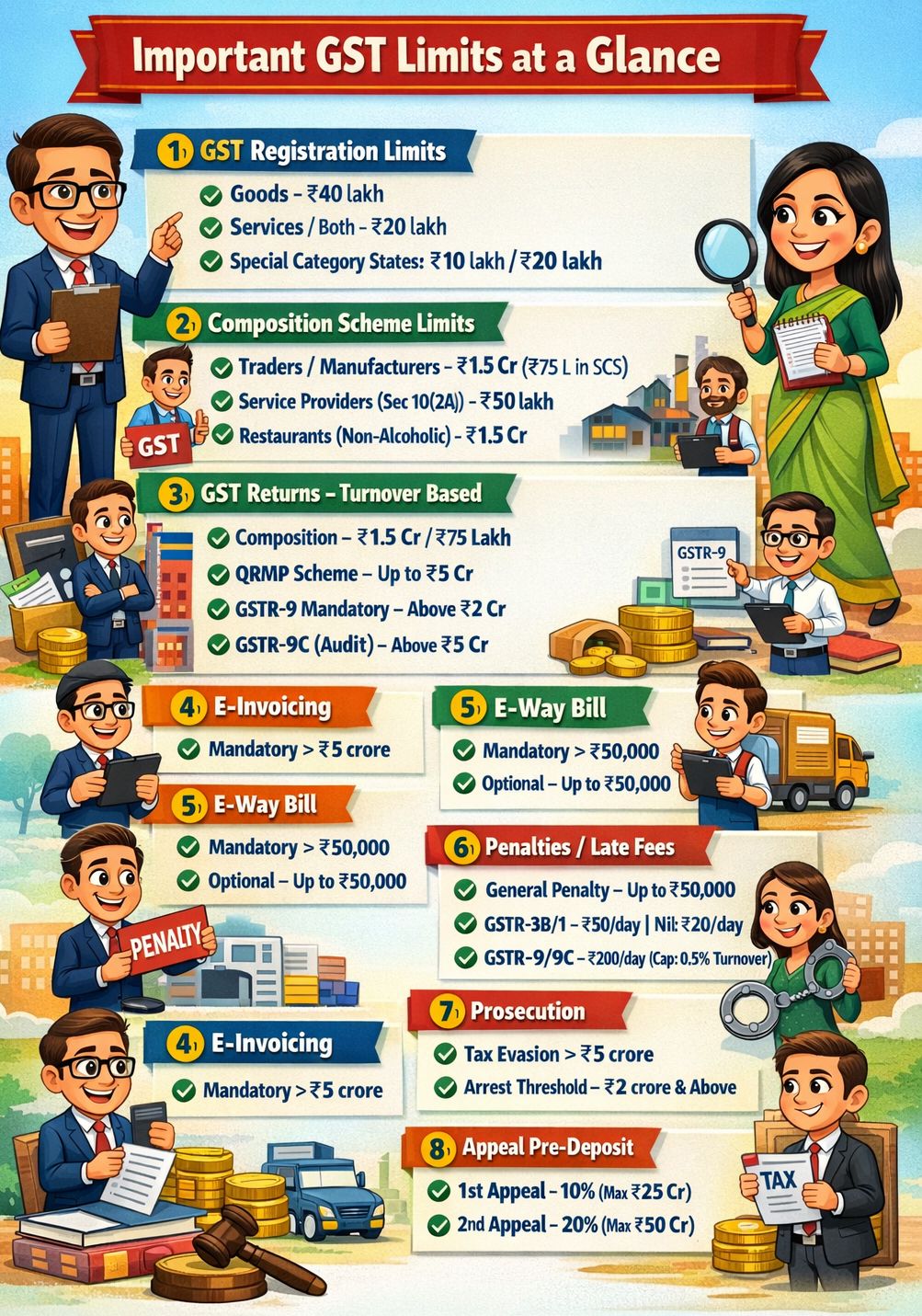
To make compliance quicker and reference simpler for professionals, businesses, and finance teams, I’ve put together a summarized visual covering all the key GST thresholds you should always keep handy. What’s Included
✔ GST Registration Limits
– Thresholds for goods & services
– Special category states
✔ Composition Scheme Limits
– Turnover applicability
– Rate slabs for traders, manufacturers & restaurants
✔ Return Filing Turnover Criteria
– Monthly vs. quarterly filing
– QRMP eligibility
✔ E‑Invoicing Applicability
– Turnover-based triggers
– Current phase‑wise limits
✔ E‑Way Bill Requirements
– Movement value limits
– State-specific relaxations
✔ Penalties, Appeals & Prosecution Limits
– Monetary thresholds
– Key compliance consequences
Often asked Questions (FAQs)
Q1. Is GST registration mandatory for all private limited organizations?
No, GST registration is mandatory only in case your turnover exceeds the edge limit or in case you meet specific conditions like interstate supply or e-commerce income.
Q2. What happens if a private constrained enterprise fails to report GST returns?
Failure to record returns results in overdue expenses, hobby on tax due, or even suspension or cancellation of GST registration.
Q3. Can a non-public limited corporation declare enter Tax credit (ITC) on all purchases?
No, ITC is allowed most effective on eligible commercial enterprise purchases. Sure costs like private use, blocked credit (motor motors, except exceptions follow), or non-enterprise charges are not eligible.
Q4. How does GST compliance affect private limited company compliance as a whole?
GST compliance bureaucracy a good sized a part of private restricted agency compliance. Non-compliance influences credibility, monetary fitness, and general statutory status.
Q5. What is the penalty for wrong ITC claims by way of non-public constrained corporations?
Wrong ITC claims can attract penalties up to 100% of the tax amount together with interest.
Conclusion
Private limited company compliance in India is incomplete with out GST compliance. From registration and invoicing to go back filing and ITC control, each step is important to keeping economic area and prison credibility. By using adopting first-rate practices, leveraging generation, and staying up to date with GST rules, private constrained organizations can make certain seamless compliance whilst constructing accept as true with with stakeholders.
Ultimately, GST compliance isn’t just a felony responsibility—it is a strategic tool that strengthens your business foundation and helps lengthy-term growth.