
Govt to Roll Out Revamped GST Registration from Nov 1, 2025
Page Contents

Govt to Roll Out Revamped GST Registration System from Nov 1, 2025
The Govt will launch a revamped Goods and Services Tax Registration system effective November 1, 2025, as part of the broader GST 2.0 reforms aimed at simplifying compliance and reducing processing delays.
Automated Approvals for Low-Risk Applicants
Under the new system, automated approvals will be granted to low-risk applicants, particularly those with a monthly output tax liability below ₹2.5 lakh. Registrations for such taxpayers are expected to be completed within three working days, covering nearly 96% of new applicants. This automation is expected to drastically reduce delays caused by manual verification and streamline onboarding for compliant taxpayers.
The reform is expected to streamline onboarding for small businesses and public sector units, minimising delays associated with manual verification. Tax authorities will be able to focus on high-risk cases, identified through data analytics and intelligence inputs, to strengthen fraud detection without burdening compliant taxpayers.
Part of Broader GST 2.0 Reforms
The registration revamp is part of a comprehensive GST 2.0 package, which also includes:
- A simplified two-slab rate structure of 5% and 18%, with a 40% rate on luxury and sin goods.
- Plans for automated refunds, rationalised return filings, and risk-based audits.
Announcing the initiative during the inauguration of the new CGST Bhawan in Ghaziabad, Union Finance Minister Nirmala Sitharaman said the reforms aim to make the GST system more efficient, transparent, and enforcement-focused. These initiatives are designed to make India’s indirect tax framework more efficient, technology-driven, and business-friendly.
Minister’s Remarks and Future Outlook
At the inauguration of the new CGST Bhawan in Ghaziabad, Union Finance Minister Nirmala Sitharaman said the reform would make the system faster, fairer, and more transparent, improving the ease of doing business while ensuring tighter enforcement against non-compliance.
Experts note that the success of the registration overhaul will depend on the smooth functioning of the GSTN platform and accurate risk categorisation, given past technical challenges during registration processes. The November rollout is expected to significantly ease compliance for most new registrants, aligning the GST regime with the operational realities of small and medium enterprises.
PRACTICAL GUIDE: GST FORMS MASTER CHEAT SHEET
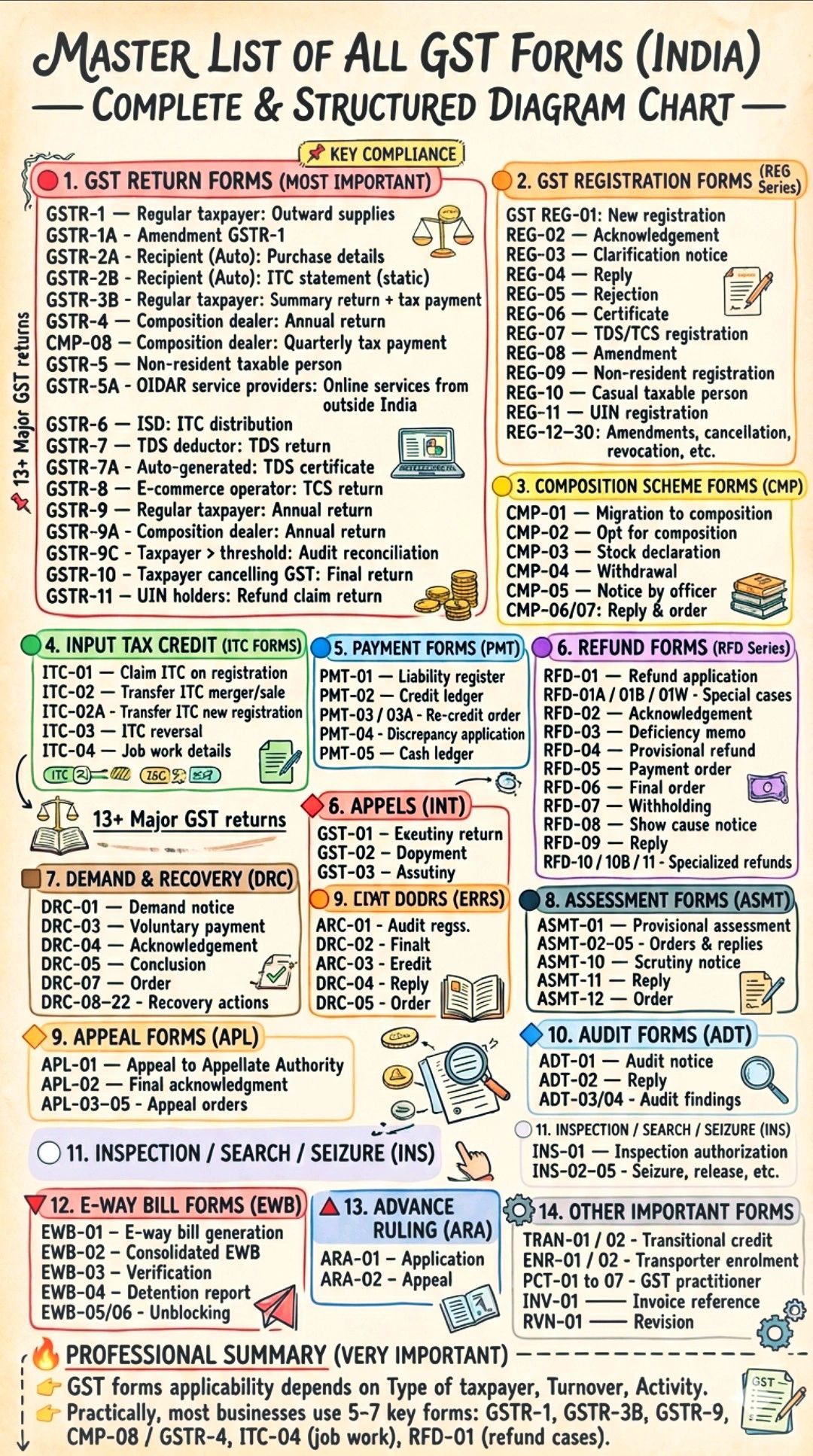
Whether you are a chartered accountant, tax consultant, or business owner, navigating GST compliance on the GST Portal can get confusing especially during scrutiny, audit, refunds, or demand proceedings. To make compliance easier, we have compiled a complete, structured list of GST forms that helps you quickly recall which form applies at which stage of GST proceedings. FOLLOWING KEY PRACTICAL OBSERVATIONS ON GST FROM REAL CASES
- Most GST notices, mismatches, and demands originate from GSTR‑1, GSTR‑2B and GSTR‑3B
- Form DRC‑03 is your best compliance and risk‑mitigation tool for Voluntary tax payment, Closing issues before escalation and Reducing interest, penalty, and litigation exposure.
- Form RFD‑01 should be treated as a single gateway for all GST refunds, including Export refunds, Inverted duty structure, Excess cash balance and Wrong tax payments.
Here’s a structured, simplified, and sorted master list of GST forms you’ll actually use in practice
THE “BIG 6” – CORE WORKING GST FORMS
These alone cover ~90% of GST compliance work
1️⃣ GSTR‑1 – Outward supplies (Sales reporting)
2️⃣ GSTR‑2B – Auto‑drafted ITC statement (basis for ITC eligibility)
3️⃣ GSTR‑3B – Summary return + tax payment
4️⃣ GSTR‑9 / GSTR‑9C – Annual return & reconciliation statement
5️⃣ CMP‑08 / GSTR‑4 – Composition scheme compliance
6️⃣ RFD‑01 – Universal refund application (exports, inverted duty, excess cash, etc.)
GST FORM SERIES – PRACTICAL BREAKDOWN
REG SERIES (Registration)
- REG‑01 – New GST registration
- REG‑06 – GST Registration Certificate
- REG‑16 – Application for cancellation of registration
ITC SERIES (Input Tax Credit)
- ITC‑01 – ITC claim on new registration / voluntary registration
- ITC‑03 – ITC reversal (shift to composition / exemption)
- ITC‑04 – Job work details (goods sent/received)
PMT SERIES (Payments & Ledgers)
- PMT‑01 – Electronic Liability Ledger
- PMT‑02 – Electronic Credit Ledger
- PMT‑05 – Electronic Cash Ledger
- PMT‑04 – Application for rectification of ledger discrepancies
RFD SERIES (Refunds)
- RFD‑01 – Refund application
- RFD‑03 – Deficiency memo (refund application found incomplete)
- RFD‑06 – Refund sanction / rejection order
DRC SERIES (Demand & Recovery)
- DRC‑01 – Summary of Show Cause Notice (SCN)
- DRC‑03 – Voluntary payment (interest/tax before or after SCN – very powerful compliance tool)
- DRC‑07 – Final demand order
ASMT SERIES (Assessment / Scrutiny)
- ASMT‑10 – Scrutiny notice
- Commonly for GSTR‑1 vs GSTR‑3B mismatch
- ASMT‑11 – Reply to scrutiny notice
APPEALS & AUDIT
- APL‑01 – Appeal before Appellate Authority
- ADT‑01 – GST Audit notice
- ADT‑02 – Audit reply / submissions
E‑WAY BILL (EWB SERIES)
- EWB‑01 – E‑way bill generation
- EWB‑03 – Proper officer’s inspection / verification report
SPECIALISED RETURNS (OFTEN IGNORED, BUT CRITICAL)
- GSTR‑5 – Non‑Resident Taxable Person (NRTP)
- GSTR‑6 – Input Service Distributor (ISD)
- GSTR‑7 – TDS under GST
- GSTR‑8 – E‑commerce operator (TCS under GST)
Conclusion
The success of the revamped GST registration process will hinge on the robust performance of the GSTN platform and the accuracy of risk categorisation. If implemented effectively, the November 2025 rollout could mark a major milestone in building a simpler, stronger, and taxpayer-friendly GST regime in India.