
Debate on Reservation System in CA, CS, & CMA
Page Contents
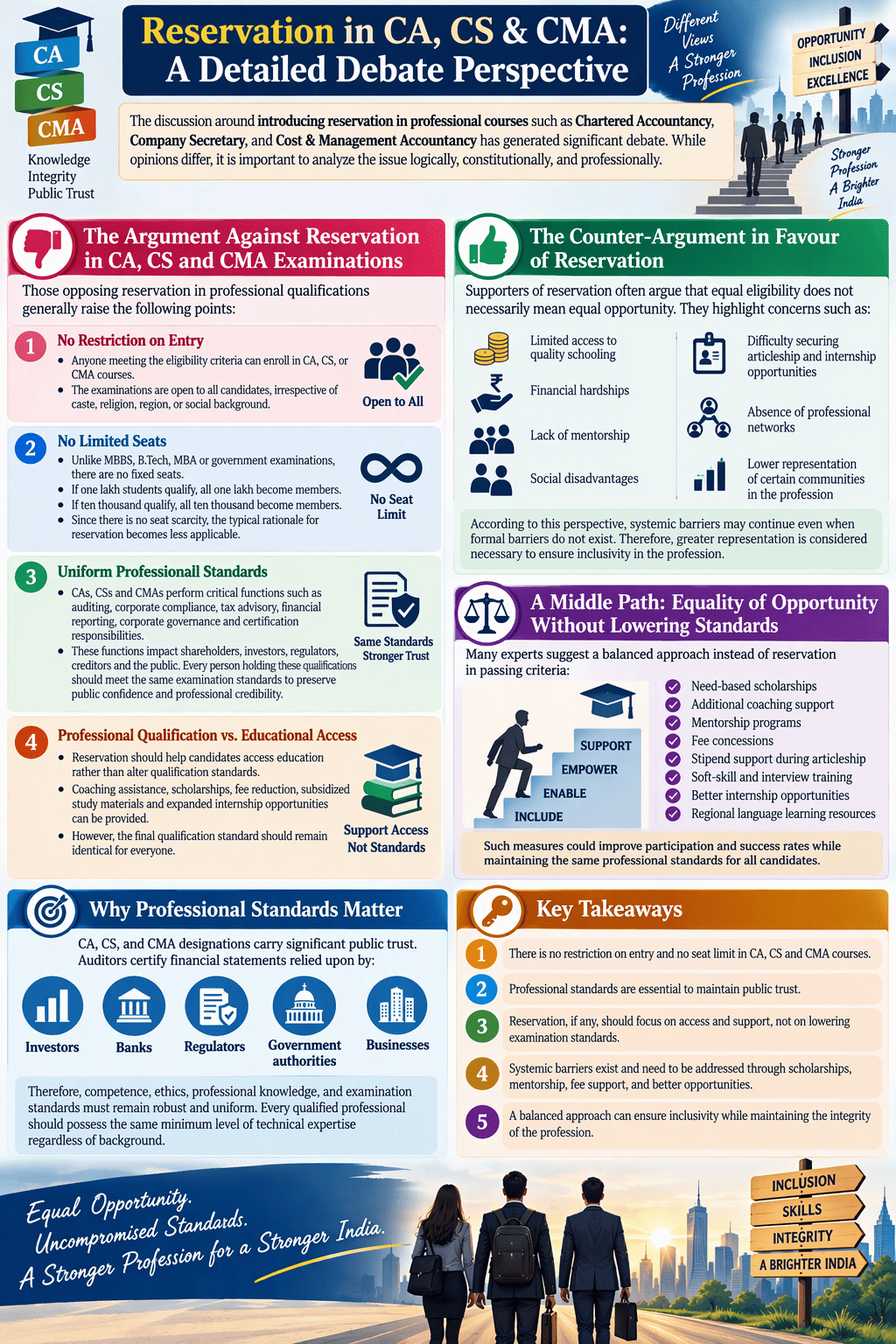
Reservation in CA, CS & CMA: A Detailed Debate Perspective
- The discussion around introducing reservation in professional courses such as Chartered Accountancy, Company Secretary , and Cost & Management Accountancy has generated significant debate. While opinions differ, it is important to analyze the issue logically, constitutionally, and professionally.
Understanding the Nature of CA, CS and CMA Courses
- CA (ICAI), CS (ICSI), and CMA (ICMAI) are professional qualifications rather than seat-based academic programs. Unlike engineering, medical, MBA, or government recruitment examinations where the number of seats is limited, these courses generally have no restriction on admissions.
- Any eligible student who has completed Class 12 can register for the foundation-level examination and pursue the course. There is no caste-based restriction, quota limitation, or seat cap at the entry stage. The primary challenge lies not in getting admission but in successfully clearing the examinations through consistent effort, technical knowledge, and professional competence.
Why Reservation Exists in Many Educational Institutions
- Reservation was originally introduced to provide historically disadvantaged communities with access to educational opportunities and public employment that were otherwise difficult to obtain due to social and economic barriers. In universities, IITs, medical colleges, and government services Seats are limited, Competition is for a fixed number of positions and Reservation ensures representation and access to educational institutions and government jobs. Therefore, reservation primarily addresses access to opportunities where scarcity exists.
The Argument Against Reservation in CA, CS and CMA Examinations
Those opposing reservation in professional qualifications generally raise the following points:
- No Restriction on Entry : Since anyone meeting the eligibility criteria can enroll in CA, CS, or CMA courses, there is no barrier preventing a student from entering the profession. The examinations are open to all candidates, irrespective of caste, religion, region, or social background.
- No Limited Seats : Unlike MBBS, B.Tech, MBA, or government examinations, there are no fixed seats in CA, CS, or CMA courses. If one lakh students qualify, all one lakh become members. If ten thousand qualify, all ten thousand become members. Since there is no seat scarcity, the typical rationale for reservation becomes less applicable.
- Uniform Professional Standards : Chartered Accountants, Company Secretaries, and Cost Accountants perform critical functions such as Auditing financial statements, Corporate compliance, Tax advisory, Financial reporting, Corporate governance and Certification responsibilities. These functions impact shareholders, investors, regulators, creditors, and the public. Many professionals believe that every person holding these qualifications should meet the same examination standards to preserve public confidence and professional credibility.
- Professional Qualification vs. Educational Access : A common argument is that reservation should help candidates access education rather than alter qualification standards. According to this view Coaching assistance can be provided, Scholarships can be granted, Examination fees can be reduced, Study materials can be subsidized and Internship opportunities can be expanded. However, the final qualification standard should remain identical for everyone.
The Counter-Argument in Favour of Reservation
- Supporters of reservation often argue that equal eligibility does not necessarily mean equal opportunity. They highlight concerns such as Limited access to quality schooling. Financial hardships, Lack of mentorship, Social disadvantages, Difficulty securing articleship and internship opportunities, Absence of professional networks.
- According to this perspective, representation within the profession remains low for certain communities despite open entry. Therefore, supporters argue that systemic barriers may continue even when formal barriers do not exist.
A Middle Path: Equality of Opportunity Without Lowering Standards
- Many experts suggest a balanced approach Instead of Reservation in Passing Criteria : Provide Need-based scholarships, Additional coaching support, Mentorship programs, Fee concessions, Stipend support during articleship, Soft-skill and interview training, Better internship opportunities, Regional language learning resources. Such measures could improve participation and success rates while maintaining the same professional standards for all candidates.
Why Professional Standards Matter
- CA, CS, and CMA designations carry significant public trust. Auditors certify financial statements relied upon by Investors, Banks, Regulators, Government authorities and Businesses. Therefore, most stakeholders agree that competence, ethics, professional knowledge, and examination standards must remain robust and uniform. Every qualified professional should possess the same minimum level of technical expertise regardless of background.
Conclusion
- The debate on reservation in CA, CS, and CMA is ultimately a discussion about balancing social justice and professional standards.
- On one side, there is a genuine concern for inclusiveness, representation, and equal opportunity. On the other side, there is a strong belief that professional qualifications must retain uniform examination standards to preserve credibility and public trust.
- A practical solution may lie not in altering qualification standards but in strengthening support systems such as scholarships, mentorship, training opportunities, fee concessions, and educational assistance. This approach can help disadvantaged students compete on an equal footing while ensuring that every Chartered Accountancy, Company Secretary, and Cost & Management Accountancy qualifies through the same benchmark of competence, knowledge, and professional integrity.
The key question is not whether opportunities should be equal, because they should be. The real debate is whether equality should be achieved through reservation in examinations or through stronger educational and financial support while keeping professional qualification standards identical for all candidates.