
DCF Is Out: Only NAV for Valuation of Unquoted Equity Shares
Page Contents
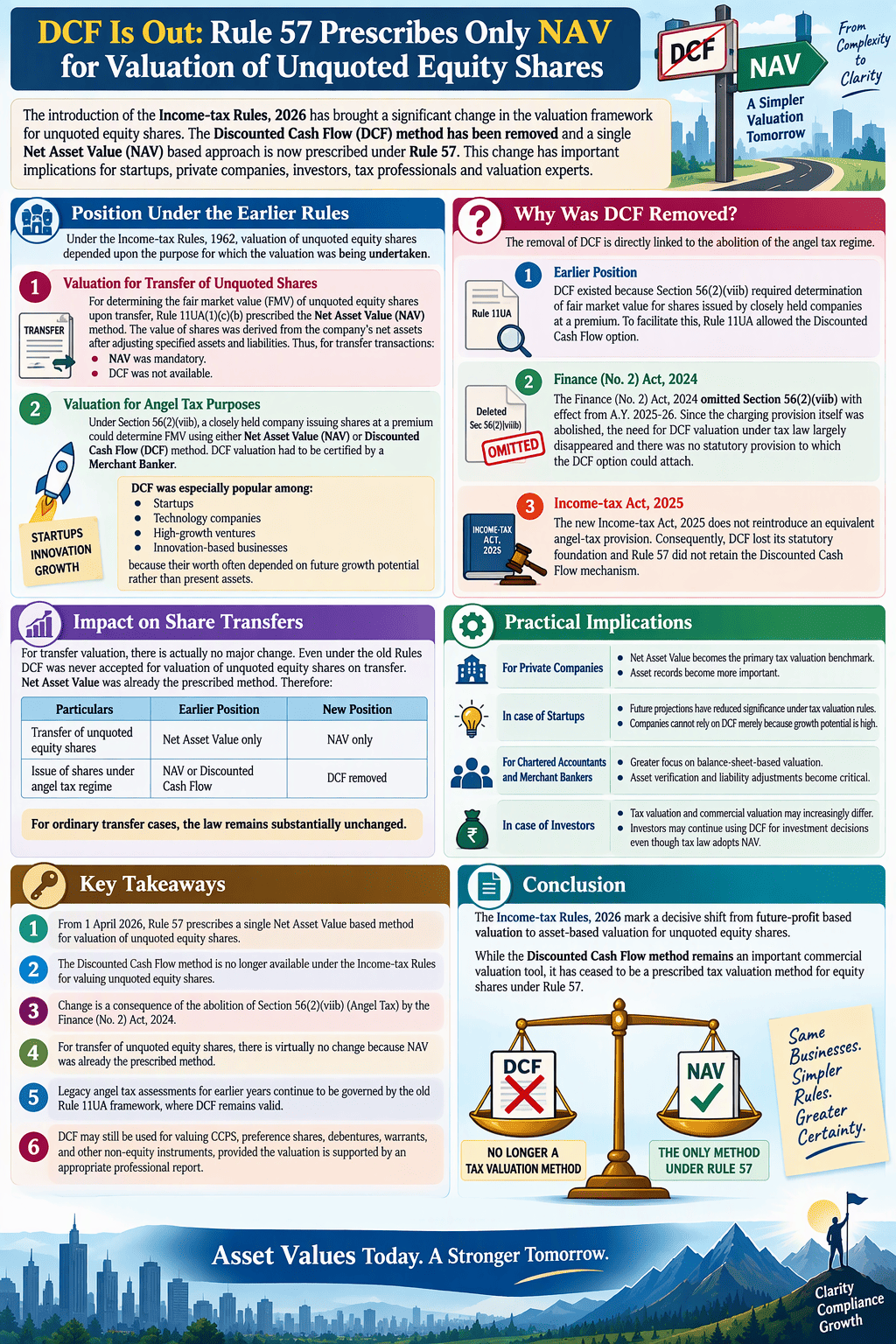
DCF Is Out: Rule 57 Prescribes Only NAV for Valuation of Unquoted Equity Shares
The introduction of the Income-tax Rules, 2026 has brought a significant change in the valuation framework for unquoted equity shares. One of the most important developments is the removal of the Discounted Cash Flow (DCF) method for income-tax valuation purposes and the adoption of a single Net Asset Value (NAV) based approach under Rule 57.
This change has important implications for startups, private companies, investors, tax professionals, and valuation experts.
Position Under the Earlier Rules
Under the Income-tax Rules, 1962, valuation of unquoted equity shares depended upon the purpose for which the valuation was being undertaken.
- Valuation for Transfer of Unquoted Shares
For determining the fair market value (FMV) of unquoted equity shares upon transfer, Rule 11UA(1)(c)(b) prescribed the Net Asset Value (NAV) method. Under this approach, the value of shares was derived primarily from the company’s net assets after adjusting specified assets and liabilities. Thus, for transfer transactions:
- NAV was mandatory.
- DCF was not available.
- Valuation for Angel Tax Purposes
A different approach was available U/S 56(2)(viib), popularly known as the Angel Tax provision. Where a closely held company issued shares at a premium, the company could determine fair market value using either Net Asset Value Method or Discounted Cash Flow (DCF) Method.
DCF valuation had to be certified by a Merchant Banker. The Discounted Cash Flow method was especially popular among:
- Startups
- Technology companies
- High-growth ventures
- Innovation-based businesses
because their actual worth often depended on future growth potential rather than present assets.
What Has Changed from 1 April 2026?
The Income-tax Rules, 2026 replaced the earlier valuation framework.
Under Rule 57, valuation of unquoted equity shares is now governed by a single prescribed formula:
where:
| Symbol | Meaning |
| A | Book value of assets |
| B | Certain specified assets |
| C | Fair value adjustments |
| D | Additional prescribed values |
| L | Book value of liabilities |
| PV | Paid-up value of shares being valued |
| PE | Total paid-up equity share capital |
This is fundamentally an asset-based valuation model. Notably:
- Rule 57 contains the Net Asset Value formula.
- Income tax Rule 57 contains no reference to Discounted Cash Flow .
- Rule 57 contains no earnings-based valuation method.
- Income tax Rule 57 contains no future cash flow valuation mechanism.
As a result, NAV has become the sole prescribed method for unquoted equity share valuation under the Rules.
Why Was DCF Removed?
The removal of DCF is directly linked to the abolition of the angel tax regime.
Earlier Position : DCF existed because Section 56(2)(viib) required determination of fair market value for Shares issued by closely held companies at a premium. To facilitate this, Rule 11UA allowed the Discounted Cash Flow option.
Finance (No. 2) Act, 2024 : The Finance (No. 2) Act, 2024 omitted:
Section 56(2)(viib) with effect from Assessment Year 2025-26. Since the charging provision itself was abolished The need for DCF valuation under tax law largely disappeared. And There was no statutory provision to which the DCF option could attach.
Income-tax Act, 2025
The new Income-tax Act, 2025 does not reintroduce an equivalent angel-tax provision. Consequently DCF lost its statutory foundation and Rule 57 did not retain the Discounted Cash Flow mechanism. Impact on Share Transfers
For transfer valuation, there is actually no major change. Even under the old Rules DCF was never accepted for valuation of unquoted equity shares on transfer. And Net Asset Value was already the prescribed method. Therefore:
| Particulars | Earlier Position | New Position |
| Transfer of unquoted equity shares | Net Asset Value only | NAV only |
| Issue of shares under angel tax regime | NAV or Discounted Cash Flow | DCF removed |
For ordinary transfer cases, the law remains substantially unchanged.
Impact on Startups and Growth Companies
The biggest impact will be felt by companies historically relying upon DCF valuations.
Under Discounted Cash Flow : A startup could justify valuation based on Future revenues, Business projections, Expected cash generation, Scalability, Technological innovation. For example: A technology startup with Assets of ₹50 lakh, Future projected revenues of ₹100 crore, could secure a much higher valuation through Discounted Cash Flow.
Under Net Asset Value : The valuation aligns closely with present net assets. Using the same example:
- Assets = ₹50 lakh
- Limited tangible assets
the NAV-based value may be significantly lower than the business’s economic potential. Thus, Rule 57 shifts valuation emphasis from: Future earning potential → Current net assets
What About Pending Angel Tax Litigations?
An important distinction must be understood. The omission of Section 56(2)(viib) does not affect past years. Legacy matters for AY 2024-25 and Earlier assessment years continue to be governed by the law applicable at that time. Therefore Rule 11UA remains relevant for those years. And DCF valuations validly adopted under the old regime remain legally enforceable.
Several judicial precedents have consistently held that: Once a taxpayer adopts a permissible Discounted Cash Flow valuation method supported by a valid merchant banker report, the Assessing Officer cannot reject it merely because the NAV value is lower. Accordingly, pre-2025 disputes involving DCF continue under the old provisions.
Does Discounted Cash Flow Disappear Completely?
No. DCF disappears only for valuation of unquoted equity shares under Rule 57. DCF may still remain relevant in other valuation contexts.
Valuation of CCPS, Preference Shares and Other Securities
Rule 57 deals specifically with unquoted equity shares. For instruments such as: Compulsorily Convertible Preference Shares (CCPS), Preference Shares, Convertible Securities, Debentures, Warrants and Hybrid Instruments. Rule 57 does not prescribe an Net Asset Value formula.
Instead, valuation is based on The price which the security would ordinarily fetch in the open market. Such valuation must generally be supported by a report from A Merchant Banker, or A Practising Chartered Accountant. For determining such open-market value:
- Discounted Cash Flow may still be used.
- Option-pricing models may be used.
- Yield-based valuation methods may be used.
- Other internationally accepted valuation techniques may be used.
Practical Implications
- For Private Companies: Net Asset Value becomes the primary tax valuation benchmark. Asset records become more important.
- In case of Startups : Future projections have reduced significance under tax valuation rules. Companies cannot rely on Discounted Cash Flow merely because growth potential is high.
- For Chartered Accountants and Merchant Bankers : Greater focus is required on balance-sheet-based valuation. And Asset verification and liability adjustments become critical.
- In case of Investors : Tax valuation and commercial valuation may increasingly differ. Investors may continue using DCF for investment decisions even though tax law adopts NAV.
Key Takeaways
- From 1 April 2026, Rule 57 prescribes a single Net Asset Value based method for valuation of unquoted equity shares.
- The Discounted Cash Flow method is no longer available under the Income-tax Rules for valuing unquoted equity shares.
- Change is a consequence of the abolition of Section 56(2)(viib) (Angel Tax) by the Finance (No. 2) Act, 2024.
- For transfer of unquoted equity shares, there is virtually no change because NAV was already the prescribed method.
- Legacy angel tax assessments for earlier years continue to be governed by the old Rule 11UA framework, where Discounted Cash Flow remains valid.
- DCF may still be used for valuing CCPS, preference shares, debentures, warrants, and other non-equity instruments, provided the valuation is supported by an appropriate professional report.
- The Income-tax Rules, 2026 mark a decisive shift from future-profit based valuation to asset-based valuation for unquoted equity shares. While Discounted Cash Flow remains an important commercial valuation tool, it has ceased to be a prescribed tax valuation method for equity shares under Rule 57.