
GST Council Proposes Major Measures to Simplify Compliance
Page Contents
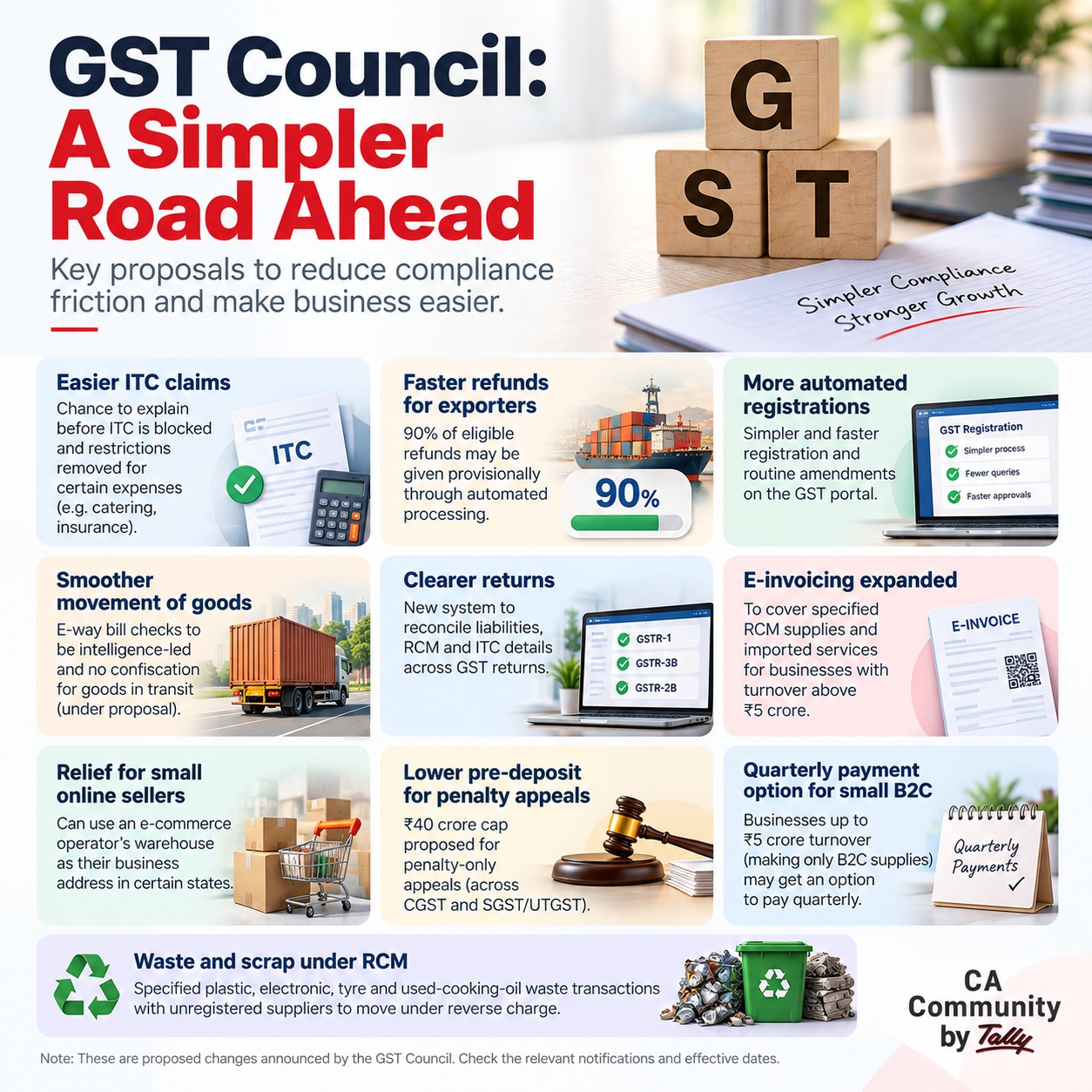
GST Council Proposes Major Measures to Simplify Compliance
The GST Council has recommended a series of reforms aimed at reducing compliance burden, improving ease of doing business, and making GST processes more taxpayer-friendly. Here are the key highlights:
🔹 Hearing Before ITC Blocking
- Current Position Electronic Credit Ledger may be blocked under Rule 86A.
- Proposed Change : Taxpayer may File objections and Seek personal hearing before final decision on blocked credit. Stronger natural justice and reduced arbitrary action.
🔹 Major Expansion of ITC Eligibility
- One of the biggest reforms proposed. ITC proposed to be allowed on Outdoor Catering, Health Insurance, Life Insurance, Telecom Towers, Pipelines outside factory, Free Samples and Goods written off due to expiry of shelf life.
- Which Impact that Many long-pending disputes under Section 17(5) may disappear. This will especially benefit FMCG companies, Telecom sector, Pharma companies, Manufacturing entities
🔹 Input Tax Credit (ITC) & Refunds
- Taxpayers may be provided an opportunity to present their case before any ITC is blocked.
- ITC restrictions on certain business expenses, such as outdoor catering, insurance services, and telecom tower-related expenditures, may be relaxed.
- Exporters may receive up to 90% of eligible GST refunds on a provisional basis through an automated mechanism, resulting in faster refund processing.
- Refund of accumulated ITC on capital goods and services may be permitted for specified zero-rated or notified supplies.
🔹 E-Commerce Seller Relief
- Small online sellers may use the e-commerce operator’s warehouse as Principal Place of Business in another State. Example A Delhi seller using an Amazon warehouse in Bengaluru. Current: Separate premises needed. Proposed: Warehouse can be used as registered address. Lower registration cost and easier expansion.
🔹 Registration & Amendment Made Easy
- Registration Portal-based automation and standard document requirements.
- Amendments Changes such as Legal name, Constitution, Additional places of business may become system-approved automatically.
- Cancellation : GST cancellation may also become fully automated where all returns and dues are cleared
🔹 GST Returns & Registration
- A new return reconciliation framework is proposed to automatically match tax liability, reverse charge liability (RCM), and ITC across various GST returns.
- GST registration approvals and amendment requests may become significantly more automated, reducing processing time and manual intervention.
- Eligible small online sellers could be permitted to use an e-commerce operator’s warehouse as their principal place of business in specified States/UTs.
🔹 E-Way Bills & Movement of Goods
- Physical inspection of vehicles may be restricted to intelligence-based cases and only after obtaining approval from senior authorities.
- Confiscation of goods during transit may be discontinued under the proposed framework, reducing hardship for transporters and businesses.
🔹 E-Invoicing Expansion
- The scope of e-invoicing may be expanded to cover specified reverse charge transactions and imported services for businesses having aggregate turnover exceeding INR 5 crore.
- Applicable to businesses above ₹5 crore turnover. E-invoicing may extend to Self-invoices under RCM and Imported services. Businesses should evaluate ERP systems for self-invoice e-invoicing compliance.
🔹 ARQP Scheme for Small Taxpayers
- Eligibility: Eligible B2C businesses with turnover up to INR 5 crore may be given the option to discharge GST liability on a quarterly basis. Turnover up to ₹5 crore and only B2C supplies. Proposed Benefit: Annual return filing with quarterly GST payments under an optional scheme. This may considerably reduce compliance burden for small businesses.
🔹 Hard Matching of GST Returns
- Applicable from April 2027. Proposed System GSTR-3B will automatically compare GSTR-1, GSTR-2B, IMS data before filing. Which Impact that Businesses must ensure supplier compliance. Businesses should start monthly GSTR-2B reconciliation, IMS verification and Vendor follow-up process
🔹 Export Benefits Expanded
- Branch Office Treated as Export Customer: Current law denies export benefit if service is provided to own overseas branch. Proposed Change will allow that This restriction may be removed. For Example, Indian IT Company → Singapore Branch and Current: Not export. Proposed: May qualify as export of service. Which create benefit that Substantial refunds for GCCs, IT companies and multinational groups.
🔹 Refund of Capital Goods ITC
- Existing Position No refund of accumulated ITC on capital goods.
- Proposed Position Refund allowed for Zero-rated supplies and Inverted duty supplies for ITC availed from 1 April 2027 onwards Condition is Refund will be spread over 60 months (5 years). Which Benefit that Huge relief for capital-intensive industries.
🔹 Other Key Proposals
- For appeals involving only penalties, the maximum pre-deposit requirement may be capped at INR 40 crore across CGST and SGST/UTGST.
- Reverse Charge Mechanism (RCM) may be introduced on specified purchases of waste and scrap from unregistered suppliers.
- Proposed amendments to place-of-supply provisions could make it easier for eligible service providers to qualify exports and claim related tax benefits.
In summary
These are currently recommendations/proposed changes of the GST Council and will become effective only after the necessary amendments, notifications, and implementation guidelines are issued by the government. The 57th GST Council Meeting is not about changing GST rates; it is about making GST simpler, less litigation-prone, and technology-driven. The biggest wins for taxpayers are:
- Removal of GST arrest powers. Removal of GST arrest powers
- No notices below INR 10,000.
- Refund of Input Service ITC.
- GST Refund on Capital Goods ITC. Refund of ITC on Input Services and Capital Goods
- Expanded ITC eligibility under Section 17(5). Major relaxation in Blocked ITC provisions
- Automatic refunds and registrations.
- Restriction on vehicle detention. Relief in vehicle interception and confiscation
- Hearing before ITC blocking. Hearing before ITC blocking
- Export benefits for overseas branch transactions. Easier export benefits
- Automated refunds and registrations
- Reduced penalties and litigation
If implemented as recommended, these reforms could represent the most significant taxpayer-friendly overhaul of GST compliance since the introduction of GST in 2017