
key changes in 57th GST Council Meeting held on 8 Oct 2026
Page Contents
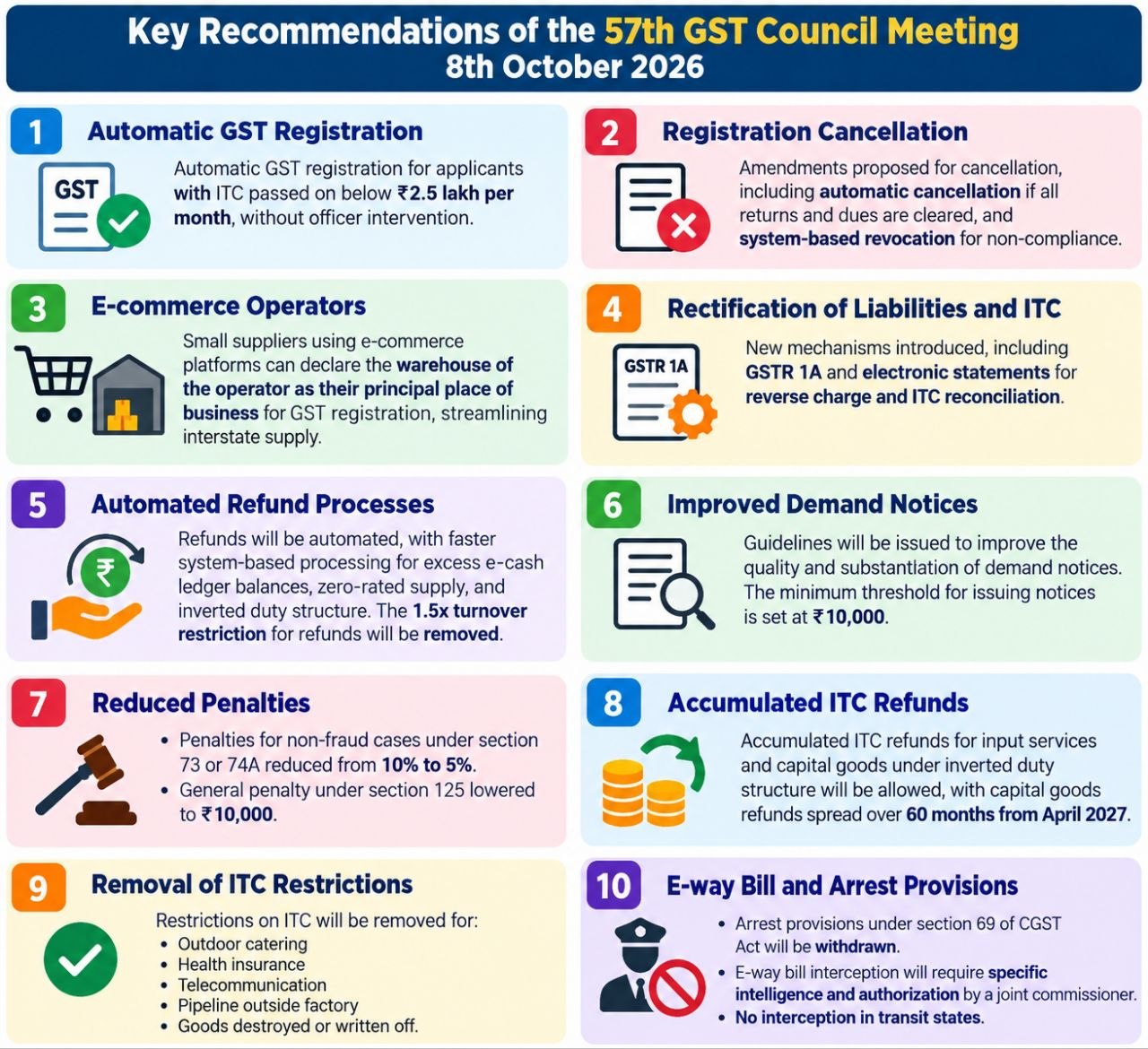
key recommendations of the 57th GST Council Meeting held on 8 October 2026.
The 57th GST Council recommendations indicate a clear shift from “officer-driven GST administration” → “Technology-driven GST administration.”
Major winners would be MSMEs, e-commerce sellers, exporters, manufacturing companies facing inverted duty structures, businesses suffering from refund delays, and taxpayers facing minor compliance defaults.
The most impactful proposals are likely to be automatic GST registration, refund of ITC on input services and capital goods, removal of ITC restrictions, reduction in penalties, and restricting GST arrests and vehicle interceptions.
If implemented through statutory amendments and notifications, these changes could become some of the most taxpayer-friendly GST reforms since the introduction of GST in 2017.
key recommendations of the 57th GST Council Meeting held on 8 October 2026. If these recommendations are notified and implemented, they would significantly reduce compliance burden, automate processes, and make GST administration more taxpayer-friendly. we break down the major upcoming changes across various sectors:
Automatic GST Registration
What is proposed? : GST registration will be granted automatically where the applicant’s Income Tax Return (ITR) shows income below INR 2.5 lakh per month (approximately INR 30 lakh annually).
Impact
- No officer verification in eligible cases.
- Faster GST registration.
- Reduced delays and discretionary interventions.
- Beneficial for startups, freelancers, and small businesses.
Simplified Cancellation and Revocation of GST Registration
Registrations & Compliance: Faster registrations within three working days and simpler amendments for business locations, partners, and directors.
What is proposed?
- Automatic cancellation where legal conditions are fulfilled.
- Automatic revocation through system-driven processes after compliance is restored.
Impact
- Taxpayers need not repeatedly approach GST officers.
- Faster restoration of registration after filing pending returns.
- Reduction in litigation.
Relief for E-commerce Sellers
E-Commerce & Small Businesses: E-commerce operators’ warehouses can be used as additional places of business in other states, and businesses up to ₹5 crore can expect simplified annual returns with quarterly payments.
What is proposed?
Small suppliers selling through platforms such as Amazon, Flipkart, Meesho, etc., may use the warehouse of the e-commerce operator as their principal place of Business.
Current Problem : Many small sellers do not have a separate business premises in every state.Benefit
- Simplified interstate GST registration.
- Easier expansion through e-commerce platforms.
- Reduced compliance costs.
Rectification of GST Liability and ITC
What is proposed?
Introduction of a GSTR-1A-based correction mechanism. Electronic statements for Reverse Charge Mechanism (RCM) and Input Tax Credit (ITC) reconciliation
Impact
-
- Easier error correction.
- Less mismatch between supplier and recipient records.
- Better ITC management.
Automated Refund Process
What is proposed?
System-driven refund processing for:
-
- Excess balance in Electronic Cash Ledger.
- Zero-rated supplies (exports and SEZ).
- Inverted duty structure refunds.
Major Relief: The existing 1.5 times turnover cap for refund processing will be removed.
Benefit
-
- Faster release of refunds.
- Better working capital management.
- Reduced departmental intervention.
Improvement in Demand Notices
What is proposed?
-
-
- Better guidelines for issuing GST notices.
- Enhanced quality and justification of notices.
- Minimum threshold for issuing notices fixed at INR 10,000.
-
Benefit
-
-
- Fewer frivolous notices.
- Reduced harassment of taxpayers.
- More focused departmental action.
-
Reduction in Penalties
- Section 73 & 74A Cases
- For non-fraud cases: Penalty reduced from 10% to 5% of tax.
- Section 125 General Penalty : Maximum penalty reduced to INR 10,000.
- Benefit
-
-
- Significant relief for genuine errors.
- GST becomes less punitive and more compliance-oriented.
-
Refund of Accumulated ITC under Inverted Duty Structure
ITC & Blocked Credit: Relief from criminal proceedings for interpretation and classification disputes, plus expected easing on blocked credits like telecom towers, life insurance, and free samples.
Major Change: Refund of accumulated ITC will be allowed on input services and capital goods
Current Position: Traditionally, refunds were largely restricted to inputs.
Additional Proposal: Refund relating to capital goods may be spread over 60 months from April 2027.
Benefit
-
-
-
- Huge relief to manufacturing sectors.
- Better cash flow for capital-intensive industries.
-
-
Removal of ITC Restrictions
- ITC proposed to be allowed on Outdoor Catering, Health Insurance, Telecommunication Services, Pipeline outside Factory Premises and Goods destroyed or written off
- Why Important: These items are presently subject to restrictions or frequent litigation.
- Impact
-
- Wider ITC eligibility.
- Reduction in disputes.
- Lower business costs.
-
E-Way Bill and Arrest Provisions
- Arrest Provision: The recommendation states that arrest provisions under Section 69 of the CGST Act may be withdrawn.
- E-Way Bill Interception: Interception of vehicles would require specific intelligence and prior authorization by a joint commissioner.
- No Transit-State Interception: A state through which goods merely pass would generally not stop the movement unnecessarily.
- Benefit
- Reduced harassment during transportation.
- Greater ease of doing business.
- Focus on serious tax evasion cases only.
Arrest & Prosecution
Potential changes to arrest powers under Section 69 and an expected increase in the prosecution threshold from ₹1 crore to ₹5 crore.
Litigation & Disputes:
Show-cause notices and litigation for amounts below INR 10,000 could be done away with
Overall, these recommendations reflect a significant shift towards a more efficient, automated, and trust-based GST ecosystem that supports businesses while strengthening compliance through technology rather than extensive departmental intervention.
SUMMARY OF THE NEW ERA OF SIMPLIFIED GST TAXATION
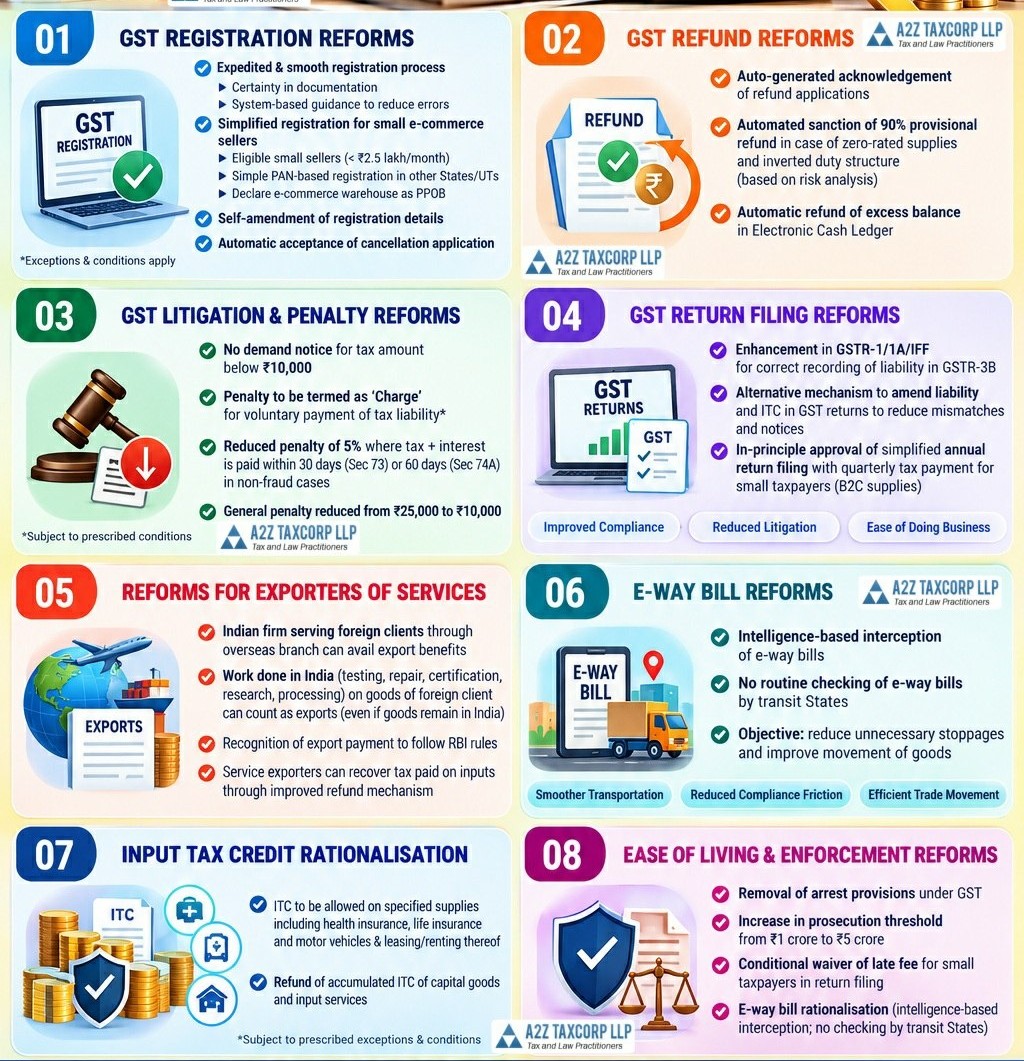
The proposed GST reforms are designed to make the GST framework more transparent, technology-driven, and taxpayer-friendly by reducing compliance burdens, accelerating refunds, minimizing litigation, and improving ease of doing business across sectors.
- Faster and hassle-free GST registration through automated approval mechanisms.
- Automated refund processing, including faster disbursement and provisional refunds of up to 90% in eligible cases.
- Reduced penalties for compliance lapses and introduction of a INR 10,000 threshold for issuance of demand notices.
- Simplified GST return filing, along with improved mechanisms for rectification of liabilities and Input Tax Credit (ITC) mismatches.
- Enhanced benefits and smoother refund procedures for service exporters.
- Risk-based and intelligence-driven E-Way Bill verification to reduce unnecessary inspections.
- Rationalization and expansion of Input Tax Credit eligibility, reducing long-standing disputes.
- Proposal to withdraw arrest powers in specified cases and increase the prosecution threshold to ₹5 crore, providing greater certainty and protection to genuine taxpayers.