
What is UPI MDR) and Why Is It Being Introduced?
Page Contents
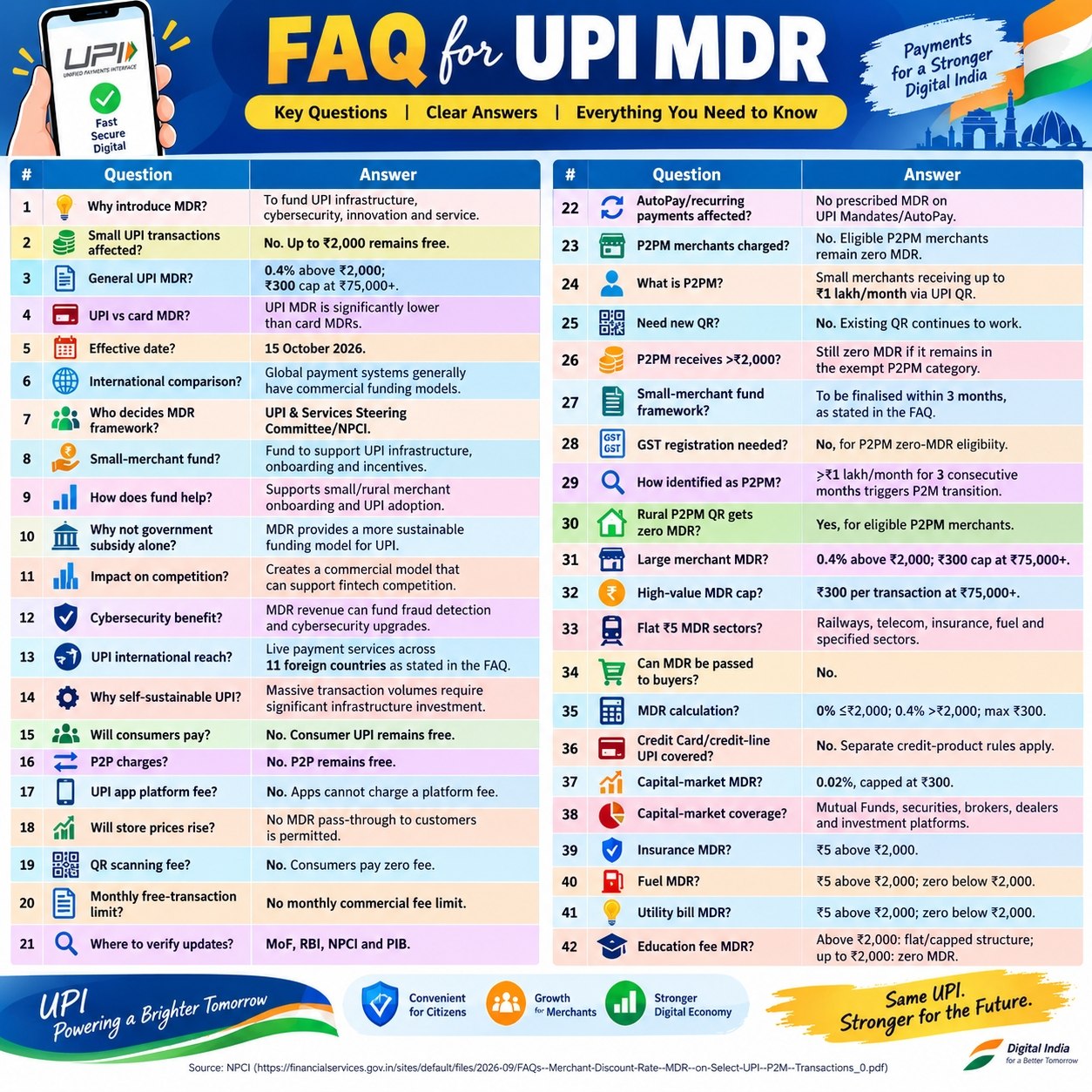
What is UPI MDR (Merchant Discount Rate), and why is it being introduced?
What is MDR?
Merchant Discount Rate (MDR) is a fee paid by merchants to banks and payment service providers for processing digital payment transactions. The proposed MDR framework aims to support:
- UPI infrastructure development
- Cybersecurity enhancements
- Fraud monitoring systems
- Merchant onboarding and support
- Sustainable growth of the UPI ecosystem
The objective is to create a long-term funding model for managing the rapidly growing UPI transaction network
What remains FREE?
UPI remains completely free for consumers. The proposed MDR framework does not impose any charges on individual users making UPI payments. Customers will continue enjoying free UPI services just as they do today. Consumer UPI Payments : here we clearly states: Consumer UPI remains free, P2P (Person-to-Person) transfers remain free, UPI apps cannot charge users a platform fee. QR code scanning remains free for customers. Examples Free: Sending INR 50,000 to a friend. And Paying rent to a family member. Transferring money between your own bank accounts.
Small Merchant Protection:
Special relief for small merchants.: Small Merchant Category (P2PM) : Merchants receiving up to INR 1 lakh per month through UPI QR continue to enjoy: Zero MDR : This means Kirana stores, Small retailers, Local businesses and Rural merchants remain unaffected if they fall within the prescribed limit.
Large Merchant MDR
For larger merchants: MDR = 0.4%. Applicable on Merchant payments above INR 2,000, However, 0% MDR up to INR 2,000 and 0.4% MDR above INR 2,000. Maximum MDR capped at INR 300 per transaction. For Example
| Transaction Value | MDR |
| INR 1,500 | Nil |
| INR 5,000 | INR 20 |
| INR 25,000 | INR 100 |
| INR 75,000 | INR 300 |
| INR 1,00,000 | INR 300 (capped) |
Therefore, MDR cannot exceed INR 300 per transaction.
Special Sectors:
certain sectors where a flat INR 5 MDR may apply on transactions above INR 2,000: Railways, Telecom, Insurance, Fuel and Certain specified sectors. Example: Insurance premium paid through UPI: INR 1,500 premium → No MDR and if INR 10,000 premium → INR 5 MDR to merchant/service provider.
Capital Market Transactions:
For mutual funds, stockbrokers, securities, and investment platforms: MDR = 0.02% with a cap of INR 300. Example: Investment through UPI: INR 100,000 mutual fund investment, then MDR = INR 20
Important Clarification:
Customers do NOT pay MDR. The MDR is a merchant-side charge, paid by businesses receiving payments and not to be recovered from customers. Effective Date: Proposed Effective Date: 15 October 2026
Why is it being introduced?
- UPI transaction volumes have grown enormously.
- Infrastructure, fraud monitoring, and cybersecurity costs continue to rise.
- A sustainable funding model is needed for long-term expansion of UPI.
UPI ≠ New Charges for Everyone! | Complete Explanation
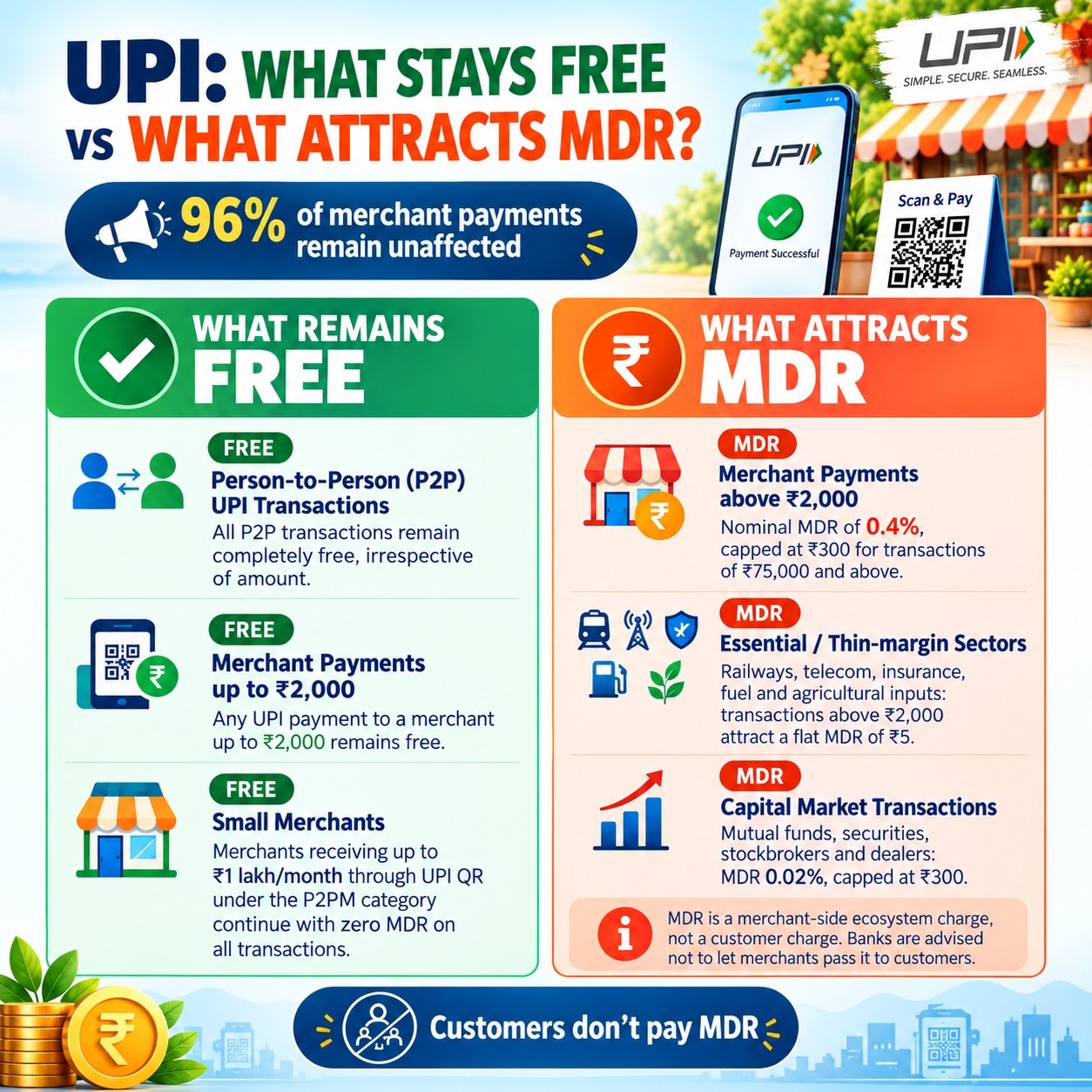
- Recently, many news headlines and social media posts have created the impression that UPI transactions will become chargeable from 15 October 2026. However, the proposal is being widely misunderstood. The most important point is UPI remains free for consumers.
- The proposed changes relate to Merchant Discount Rate (MDR) on certain merchant transactions and do not introduce charges for ordinary UPI users. If you use PhonePe, Google Pay, Paytm, BHIM, or any other UPI app for personal payments, your experience remains largely unchanged.
What Does “96% of Merchant Payments Remain Unaffected” Mean?
According to the proposal, approximately 96% of merchant UPI transactions will continue without MDR. This is because Small merchants remain exempt. Transactions up to ₹2,000 remain exempt. and Person-to-person transfers remain exempt. As a result, most day-to-day UPI payments made by consumers will continue exactly as before.
What Remains Completely Free?
For Individual Users
- Sending money to friends
- Transferring money to family members
- Paying rent to relatives
- Bank-to-bank transfers through UPI
- QR code scanning
- Receiving money
- Using UPI apps without any platform fee
Examples
- Sending ₹50,000 to a friend → Free
- Transferring money between own accounts → Free
- Paying a family member → Free
- Scanning a QR code at a local shop → Free
Protection for Small Merchants
- One of the key features of the proposal is the protection given to small businesses. Merchants receiving up to ₹1 lakh per month through UPI QR payments under the Small Merchant (P2PM) category will continue to enjoy:
- Zero MDR : This benefits Kirana stores, Local retailers, Street vendors, Small service providers and Rural businesses. Therefore, most small merchants will not face any additional burden. MDR may apply only to certain larger merchants.
- Many people are asking “Will customers have to pay extra while making UPI payments?” The answer is NO. Customers do not pay MDR, UPI apps cannot charge consumers a platform fee and Person-to-person transfers do not attract MDR. MDR is a merchant-side cost. It is paid by eligible businesses receiving payments. and The proposal specifically intends that the cost should not be passed on to customers.
- The headline “UPI Charges From October 15” is incomplete and misleading. A more accurate statement would be UPI remains free for consumers. Small merchants continue to enjoy Zero MDR. Only certain larger merchant transactions above ₹2,000 may attract MDR, which is payable by the merchant and not by the customer.
Key Takeaway – Practical Conclusion
The headline “UPI Charges from October 15” can be misleading. The proposal does not mean that UPI users will start paying fees. Instead: Consumers continue to use UPI free of cost, Small merchants remain largely unaffected. Only certain larger merchants may pay a 0.4% MDR on UPI receipts above INR 2,000. The charge is a merchant-side cost, not a customer-side charge.
For the average UPI user, nothing changes. Sending money to friends remains free. Receiving money remains free. Paying small merchants remains free. No charge on QR scanning and No platform fee on UPI apps. Only certain large merchant transactions exceeding INR 2,000 may attract a 0.4% MDR, while small merchants continue to enjoy zero MDR. The infographic’s overall message is that UPI remains free for consumers, with MDR proposed only as a merchant ecosystem charge for selected categories.
UPI MDR: FREE ERA ENDS | MONEY TRAIL BEGINS
From 15 Oct 2026, UPI P2M (Person-to-Merchant) transactions above ₹2,000 will attract 0.40% MDR, capped at INR 300/transaction.
INR 10,000 UPI payment = INR 40 MDR
• Issuer Bank: INR 16 (40%)
• Acquirer Bank: INR 12 (30%)
• UPI App: INR 8 (20%)
• Partner Bank: INR 4 (10%)
Cost comparison: UPI 0.40% | Debit Card up to 0.90% | Credit Card typically 1.5–2.5%
Market Intelligence: The bigger shift is UPI monetisation. Banks, acquirers and payment apps now get a direct revenue stream from India’s largest digital-payment rail.
Merchant pays; customer officially doesn’t. Selected categories have separate capped/special MDR structures.
UPI remains cheaper than cards, but the era of “free UPI” is entering a new chapter.
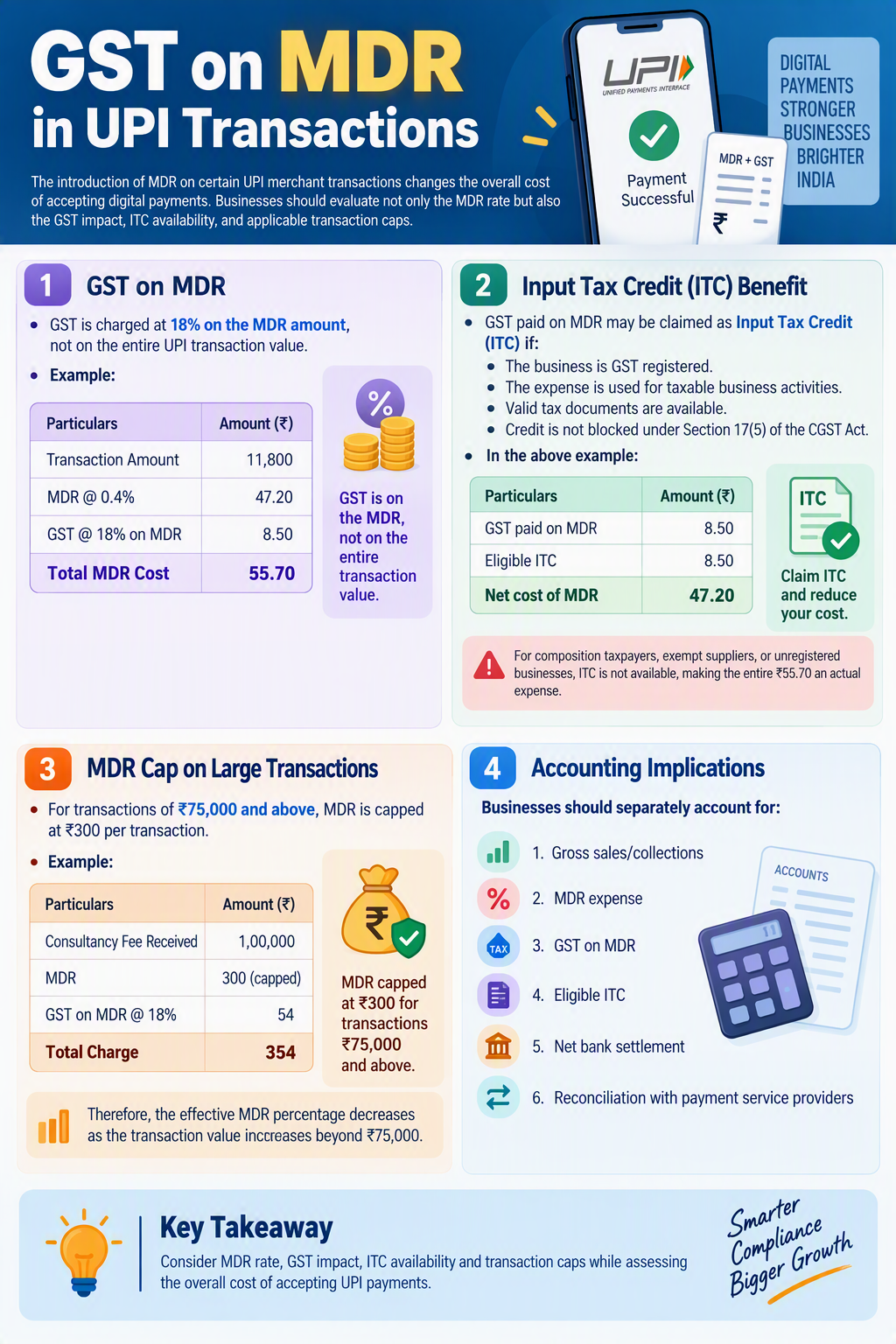
Bottom Line
For the average UPI user:
- No charge on sending money
- No charge on receiving money
- No charge on QR scanning
- No charge on paying friends or family
- No charge on small merchant payments
UPI is still free for consumers. The proposed MDR is primarily a merchant ecosystem charge affecting only selected categories of larger merchants.