
ITR filling for Salaried Individual for AY 2026-27
Page Contents

Income Tax Return filling for Salaried Individuals for AY 2026-27
Income Tax Return (ITR) Forms
-
ITR-1 (Sahaj)
ITR-1 (Sahaj) is a simplified return form applicable to resident individuals (other than Resident Not Ordinarily Resident – RNOR) whose total income does not exceed ₹50 lakh during the financial year. The form can be used by taxpayers earning income from salary or pension, one house property, and other sources such as interest income, dividend income, and family pension. It is also available to individuals having agricultural income up to ₹5,000 and long-term capital gains u/s 112A up to ₹1.25 lakh.
However, ITR-1 cannot be filed by certain categories of taxpayers. The form is not applicable to individuals who are directors in a company, have held unlisted equity shares at any time during the year, possess foreign assets or foreign income, have signing authority in any foreign account, or earn income from a business or profession. Further, taxpayers having short-term capital gains, long-term capital gains under Section 112A exceeding ₹1.25 lakh, brought-forward losses or losses to be carried forward, or whose total income exceeds ₹50 lakh are also not eligible to file ITR-1. In such cases, the taxpayer is required to file the appropriate return form such as ITR-2 or ITR-3, depending upon the nature of income and transactions.
ITR-2
ITR-2 is applicable to individuals and Hindu Undivided Families (HUFs) who do not have income chargeable under the head “Profits and Gains of Business or Profession.” This return form is generally used by taxpayers having income from sources such as salary or pension, multiple house properties, capital gains, foreign assets or foreign income, and other sources but who are not carrying on any business or professional activity.
Further, ITR-2 is required to be filed by taxpayers who are not eligible to file ITR-1 (Sahaj). For example, individuals having capital gains exceeding the limits prescribed for ITR-1, income exceeding ₹50 lakh, foreign assets or signing authority in foreign accounts, directorship in a company, investment in unlisted equity shares, or brought-forward losses and losses to be carried forward are required to file ITR-2, provided they do not have any business or professional income.
In simple terms, ITR-2 serves as the appropriate return form for taxpayers with relatively complex income sources and financial transactions, but without any income from a business or profession.
ITR-3
ITR-3 is applicable to Individuals and Hindu Undivided Families (HUFs) who earn income from a business or Profession. This return form is generally used by proprietors, professionals, freelancers, consultants, traders, and other taxpayers whose income is chargeable under the head “Profits and Gains of Business or Profession.”
Apart from business or professional income, taxpayers filing ITR-3 can also report income from salary or pension, house property, capital gains, and other sources such as interest, dividends, and family pension. The form is suitable for individuals and HUFs who are not eligible to file ITR-1, ITR-2, or ITR-4 due to the nature and complexity of their income. Since ITR-3 requires detailed disclosures relating to business operations, financial statements, and tax computations, it is the prescribed return form for taxpayers carrying on regular business or professional activities.
ITR-4 (Sugam)
ITR-4 (Sugam) is a simplified return form applicable to resident individuals, resident Hindu undivided families (HUFs), and resident firms (other than limited liability partnerships – LLPs) who have opted for the presumptive taxation scheme under Section 44AD, Section 44ADA, or Section 44AE of the Income Tax Act, 1961.
In addition to presumptive business or professional income, taxpayers filing ITR-4 can also have income from salary or pension, one house property, and other sources such as interest, dividends, and family pensions. Further, the form can be used where agricultural income does not exceed ₹5,000 and Long-Term Capital Gains (LTCG) under Section 112A do not exceed ₹1.25 lakh.
However, ITR-4 cannot be used by certain categories of taxpayers. It is not applicable to persons who are directors in a company; have held unlisted equity shares, possess foreign assets or foreign income; have signing authority in any foreign account; earn short-term capital gains; have brought-forward losses or losses to be carried forward; or whose total income exceeds ₹50 lakh. Such taxpayers are required to file the appropriate return form, such as ITR-2 or ITR-3, depending upon their nature of income and eligibility.
ITR-4 is optional and serves as a simplified compliance mechanism for eligible taxpayers choosing the presumptive taxation scheme, thereby reducing the burden of maintaining detailed books of account and audit requirements, subject to the conditions prescribed under the Income-tax Act, 1961.
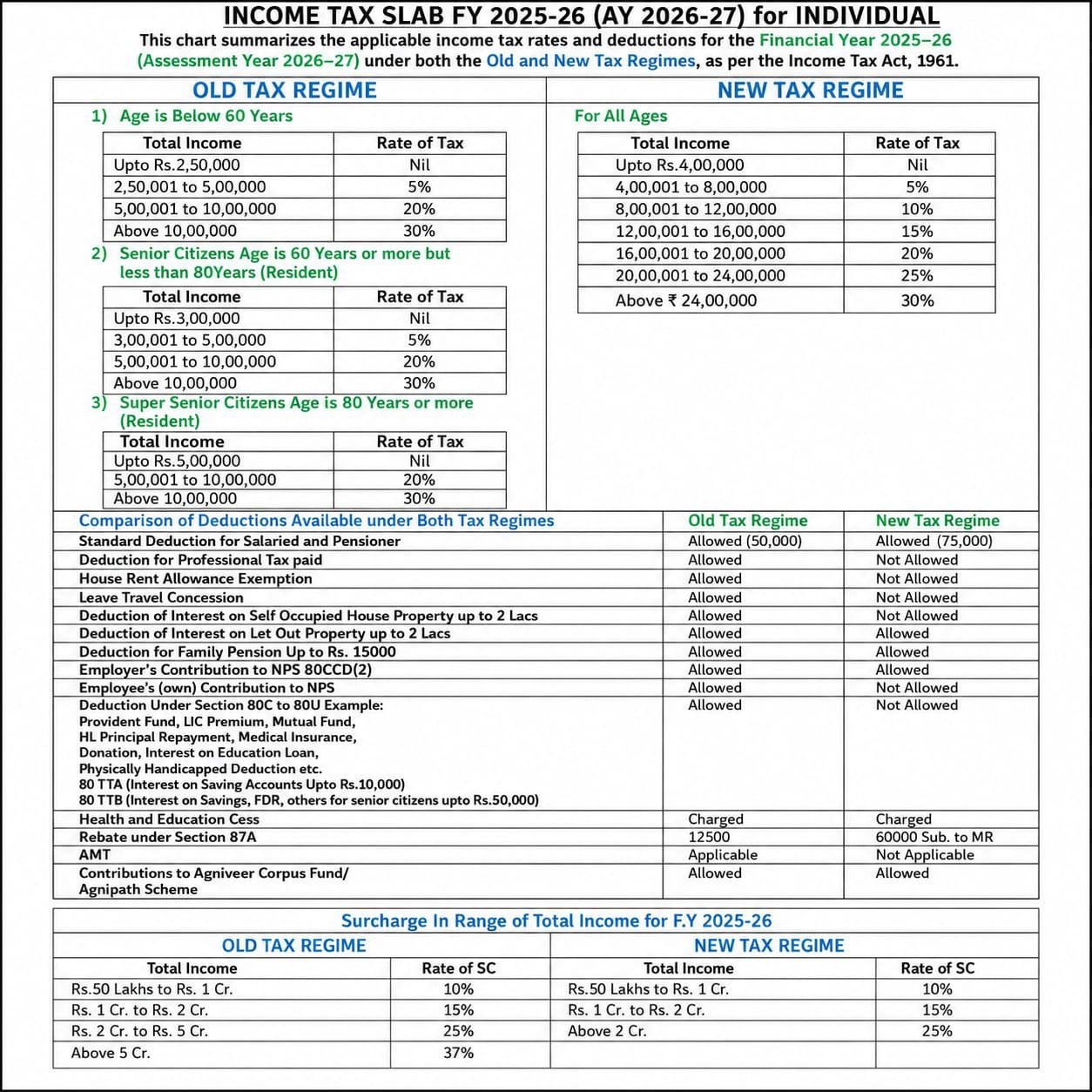
New Tax Regime (Default Regime)
| Total Income | Tax Rate |
| Up to INR 4,00,000 | Nil |
| INR 4,00,001 – INR 8,00,000 | 5% |
| INR 8,00,001 – INR 12,00,000 | 10% |
| INR 12,00,001 – INR 16,00,000 | 15% |
| INR 16,00,001 – INR 20,00,000 | 20% |
| INR 20,00,001 – INR 24,00,000 | 25% |
| Above INR 24,00,000 | 30% |
Key Features:
- Standard Deduction: INR 75,000
- Rebate u/s 87A available up to specified income limits under the new regime.
- Most deductions under Chapter VI-A (80C, 80D, etc.) are not available.
- Lower surcharge rate cap of 25%.
Old Tax Regime
Below 60 Years
| Total Income | Tax Rate |
| Up to INR 2.5 lakh | Nil |
| INR 2.5 lakh – INR 5 lakh | 5% |
| INR 5 lakh – INR 10 lakh | 20% |
| Above INR 10 lakh | 30% |
Senior Citizens (60-80 years)
| Total Income | Tax Rate |
| Up to INR 3 lakh | Nil |
| INR 3 lakh – INR 5 lakh | 5% |
| INR 5 lakh – INR 10 lakh | 20% |
| Above INR 10 lakh | 30% |
Super Senior Citizens (80+ years)
| Total Income | Tax Rate |
| Up to INR 5 lakh | Nil |
| INR 5 lakh – INR 10 lakh | 20% |
| Above INR 10 lakh | 30% |
Deductions Comparison
✅ Available under Old Regime
- 80C (PF, LIC, ELSS, Principal Repayment, etc.)
- 80D (Medical Insurance)
- HRA Exemption
- LTA
- Home Loan Interest on SOP (up to INR 2 lakh)
- Employee’s NPS Contribution
- Professional Tax
- Various Chapter VI-A deductions
✅ Available under New Regime
- Standard Deduction INR 75,000
- Employer’s NPS Contribution u/s 80CCD(2)
- Interest on Let-Out Property
- Family Pension Deduction
- Agniveer Corpus Fund Deduction
Important Practical Point for FY 2025-26
For most salaried taxpayers having:
- Limited deductions,
- No substantial HRA benefit,
- No large housing loan interest,
the New Tax Regime generally results in lower tax liability.
However, taxpayers claiming substantial benefits under:
- 80C,
- 80D,
- HRA,
- Home Loan Interest,
- NPS (employee contribution),
should perform a comparative calculation before choosing the regime.
Surcharge Rates
| Income | Old Regime | New Regime |
| INR 50L – INR 1 Cr | 10% | 10% |
| INR 1 Cr – INR 2 Cr | 15% | 15% |
| INR 2 Cr – INR 5 Cr | 25% | 25% |
| Above INR 5 Cr | 37% | 25% |
Major advantage: Under the New Tax Regime, the maximum surcharge is capped at 25%, making it more beneficial for high-income taxpayers.
Key Forms for Salaried Employees
While filing the Income Tax Return (ITR), salaried taxpayers should keep various tax forms and statements readily available, as these documents help in verifying income, claiming deductions, reconciling taxes, and ensuring accurate reporting in the return.
Form 12BB
Form 12BB is a declaration submitted by an employee to the employer for claiming various tax benefits and deductions while calculating Tax Deducted at Source (TDS) on salary. It contains details and supporting evidence relating to House Rent Allowance (HRA), Leave Travel Concession (LTC), interest on housing loan, and deductions under Chapter VI-A, such as investments and payments eligible under Sections 80C, 80D, and other applicable provisions.
Form 16
Form 16 is a TDS certificate issued by an employer to an employee after the end of the financial year. It provides a comprehensive summary of the employee’s salary income, exemptions, deductions claimed, taxable income, and tax deducted and deposited with the Income Tax Department. Form 16 serves as one of the most important documents for preparing and filing an income tax return.
Form 16A
Form 16A is a TDS certificate issued in respect of income other than salary. It contains details of the nature of income, amount paid or credited, and tax deducted at the source. Common examples include TDS on interest income, professional fees, commission, rent, and other specified payments.
Form 67
Form 67 is required to be furnished by taxpayers who wish to claim Foreign Tax Credit (FTC) in respect of taxes paid in a foreign country or specified territory. The form contains details of foreign income earned and the corresponding taxes paid outside India and must generally be submitted on or before the due date prescribed for filing the income tax return.
Form 26AS and Annual Information Statement (AIS)
Before filing the return, taxpayers should carefully review Form 26AS and the Annual Information Statement (AIS) available on the Income Tax e-Filing Portal. Form 26AS provides details relating to:
- Tax Deducted at Source (TDS)
- Tax Collected at Source (TCS)
- Advance Tax and Self-Assessment Tax payments
The AIS offers a broader view of financial transactions and includes:
- TDS and TCS information
- Tax payments
- Specified Financial Transactions (SFT)
- Refunds and outstanding demands
- Foreign remittance and foreign income information
- GST-related information and other data available with the Income Tax Department
These statements help taxpayers reconcile their income and taxes before filing the return.
Form 15G and Form 15H
Form 15G and Form 15H are self-declarations submitted to banks and other deductors for requesting non-deduction of TDS on interest income where the taxpayer satisfies the prescribed conditions.
- Form 15G can be submitted by resident individuals below 60 years of age, HUFs, and certain other eligible persons.
- Form 15H can be submitted by resident senior citizens aged 60 years or above.
These forms are generally used when the taxpayer’s estimated total income is below the taxable limit or when the tax liability is expected to be nil.
Form 10E
Form 10E is required for claiming relief under Section 89(1) of the Income-tax Act, 1961, where salary is received in arrears or in advance. It is also applicable in respect of certain lump-sum receipts such as Arrears of salary, Advance salary, Gratuity, Compensation on termination of employment, and commuted pension
Submission of Form 10E is mandatory before claiming relief under Section 89(1) in the Income Tax Return.
Tax Regimes for AY 2026-27:
New Tax Regime (Default) : Tax Slabs
| Income | Tax Rate |
| Up to INR 4 lakh | Nil |
| INR 4 lakh – INR 8 lakh | 5% |
| INR 8 lakh – INR 12 lakh | 10% |
| INR 12 lakh – INR 16 lakh | 15% |
| INR 16 lakh – INR 20 lakh | 20% |
| INR 20 lakh – INR 24 lakh | 25% |
| Above INR 24 lakh | 30% |
Rebate u/s87A
- Available if taxable income does not exceed INR 12 lakh.
- Maximum rebate: INR 60,000.
- Effectively no tax up to INR 12 lakh (subject to conditions).
Old Tax Regime : Basic Exemption Limits
| Category | Basic Exemption |
| Below 60 years | INR 2.5 lakh |
| Senior Citizen (60-80 years) | INR 3 lakh |
| Super Senior Citizen (80+ years) | INR 5 lakh |
Rebate u/s 87A
- Available up to taxable income of INR 5 lakh.
- Maximum rebate: INR 12,500.
Surcharge Rates
| Total Income | Surcharge |
| Up to INR 50 lakh | Nil |
| INR 50 lakh – INR 1 crore | 10% |
| INR 1 crore – INR 2 crore | 15% |
| INR 2 crore – INR 5 crore | 25% |
| Above INR 5 crore | 25% (New Regime) / 37% (Old Regime) |
Health & Education Cess: 4%
Marginal Relief available where surcharge causes excess tax burden. Deductions Available Under New Tax Regime
- Limited deductions are allowed : Section 24(b) : Interest on let-out property: Allowed.
- Section 80CCD(2) : Employer contribution to NPS: Up to 14% of salary.
- Section 80CCH : Agniveer Corpus Fund contributions.
Major Deductions Available Under Old Tax Regime
For Salaried Employees
- For Salaried Employees – New Tax Regime is default from AY 2026-27
- No tax up to INR 12 lakh taxable income under the new regime due to enhanced rebate for Salaried Employees
- Choose Old Regime if you claim substantial deductions such as 80C investments, NPS (80CCD(1B)), Home loan interest, Health insurance (80D), Other Chapter VI-A deductions.
- Verify Form 16 with AIS and Form 26AS before filing the return.
- Select the correct ITR form to avoid defective return notices.
Deductions Available Under Old Tax Regime
Section 80C / 80CCC / 80CCD(1): Maximum combined deduction: INR 1.5 lakh Includes LIC premium, PF, ELSS, NSC, Tuition fees, home loan principal, Pension schemes
Section 80CCD(1B) : Additional NPS deduction Up to INR 50,000
Section 80CCD(2) : Employer NPS contribution
- 10% of salary (private sector)
- 14% of salary (Government employees)
Section 80D : Medical insurance deduction:
| Particulars | Limit |
| Self/Family | INR 25,000 |
| Senior Citizen | INR 50,000 |
| Parents | INR 25,000 / INR 50,000 |
Section 80DD : Disabled dependent:
- INR 75,000 (normal disability)
- INR 1,25,000 (severe disability)
Section 80DDB : Specified diseases:
- INR 40,000
- INR 1,00,000 for senior citizens
Section 80E : Education loan interest: Entire interest paid deductible.
Home Loan Interest Benefits
| Section | Limit |
| 24(b) | INR 2 lakh |
| 80EE | INR 50,000 |
| 80EEA | INR 1.5 lakh |
Section 80EEB : Electric Vehicle Loan Interest: Up to INR 1.5 lakh
Section 80G : Donations to approved funds/charities.
Section 80GG : Rent paid where HRA is not received. Requires filing Form 10BA.
Section 80TTA : Savings account interest: Up to INR 10,000
Section 80TTB : Senior Citizen interest deduction: Up to INR 50,000
Section 80U : Self disability deduction:
- INR 75,000 (disability)
- INR 1,25,000 (severe disability)