
MCA Changes in Indian Company formation- 2026
Page Contents
MCA Changes in Indian Company formation- 2026
A series of reforms measures put forth by the Ministry of Corporate Affairs are anticipated to drastically alter India’s business formation environment. These steps are intended to streamline processes, lessen the burden of compliance, and improve the convenience of conducting business across industries.
Impact on Businesses due to Changes in Indian Company formation process
Startups
- Accelerated incorporation timelines
- Lower compliance and administrative costs
- Enhanced flexibility in selecting registered office premises, including co‑working spaces
Small & Medium Enterprises (SMEs)
- Significant reduction in paperwork and duplication
- Streamlined and simplified filing processes
- Greater regulatory clarity and consistency
Professionals
- Elimination of repetitive and overlapping filings
- Expanded opportunities for advisory and consulting services
- Shift from routine compliance towards strategic, value‑driven engagements
New Approach of MCA to Company Incorporation Compliance
- With the introduction of the proposed incorporation reforms, compliance practices must evolve to align with the simplified and integrated regulatory framework. Businesses and professionals will need to proactively adapt their processes to ensure seamless incorporation and ongoing compliance.
- While incorporation processes are becoming simpler, professional expertise remains critical to ensure accuracy, timely filings, and risk mitigation. At Rajput Jain and associates Chartered accountants, businesses gain access to Expert guidance on navigating evolving MCA regulations, Precise and timely compliance filings, Reduced exposure to penalties and regulatory risks and Comprehensive, end‑to‑end compliance solutions
Step‑by‑Step New Approach to Company Incorporation Compliance Roadmap
- Familiarize with new consolidated forms such as E‑CHNG and E‑CON, and incorporate them into standard operating procedures
- Upgrade internal documentation and compliance systems to reflect revised regulatory requirements
- Effectively leverage SPICe+ for faster, integrated, and hassle‑free company incorporation
- Maintain accurate, complete, and well‑organised statutory records to support compliance and future audits
- Continuously monitor Ministry of Corporate Affairs notifications, circulars, and regulatory updates to ensure timely implementation of changes
Massive ROC Form Consolidation:
To streamline procedures and get rid of unnecessary filings:
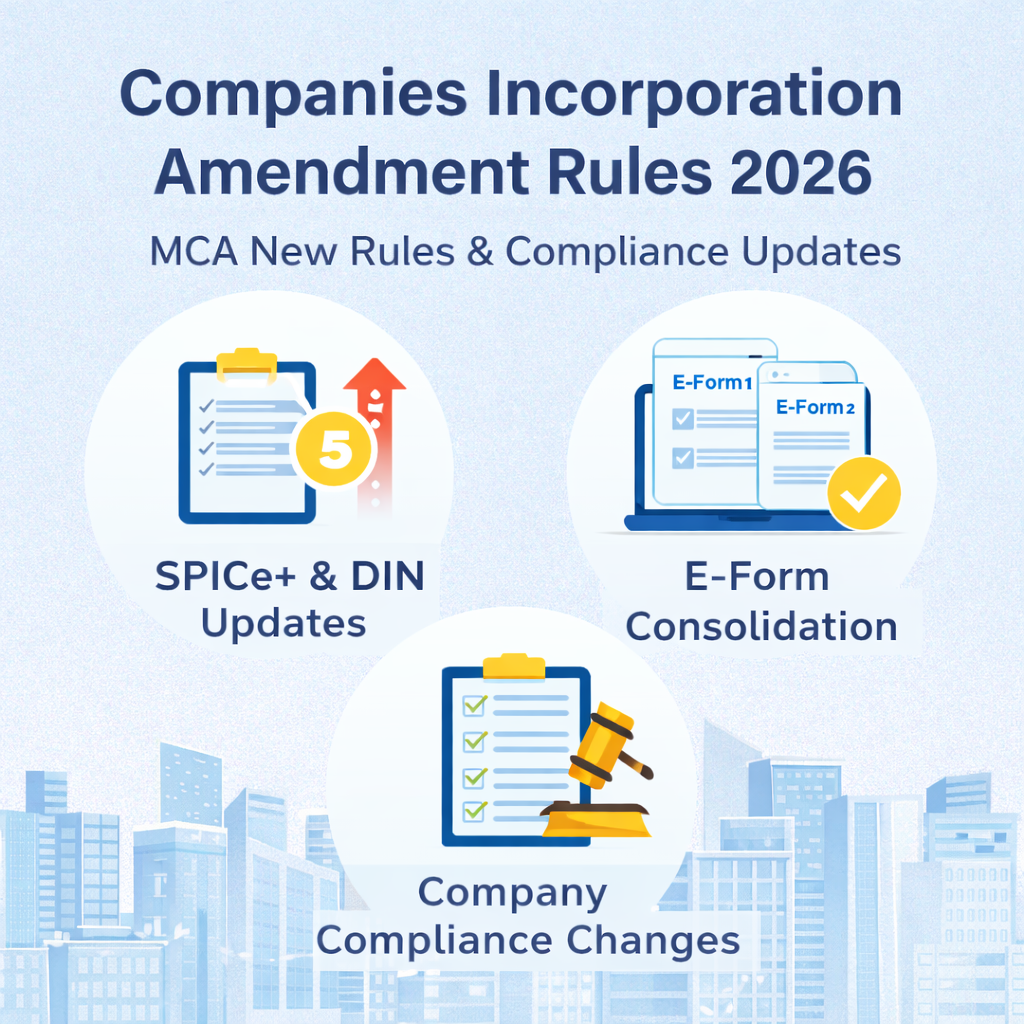
- ROC Form E-CHNG: Ministry of Corporate Affairs Merger of ROC INC-4, INC-22, INC-23, and INC-24, which addresses modifications to the company name and registered office
- ROC E-CON: Ministry of Corporate Affairs Merger of ROC INC-6, INC-12, INC-18, INC-20, INC-27, INC-28, and RD-1, which Addresses Regulatory Approvals and Conversions
- The Ministry of Corporate Affairs will see a significant decrease in form complexity and filing redundancy as a result of this move.
Reforms for SPICe+ and DIN
- DIN Limit Increase: During incorporation, up to 5 DINs are permitted (previously 3).
- Deemed Director Consent: MoA subscribers are automatically regarded as directors, doing away with the need for separate consent paperwork.
- Removing DIR-12 (for first directors): Since SPICe+ already records information, redundancy is avoided.
- The impact of this Ministry of Corporate Affairs move is a quicker incorporation with less paperwork.
Verification & Registered Office
- Flexible Address Proof (Rule 25 update): Accepts more general papers (such as utility bills and municipal records) and covers owned, leased, and co-working spaces.
- Risk-Based Physical Verification: Replace mandated verification with a risk-based method, and the registrar may only call in local witnesses or law enforcement when necessary.
- The impact of this MCA modification is a decreased burden of compliance with focused enforcement.
Important Changes in MCA Law and Compliance
- OPC Simplification: Elimination of some criminal liabilities under Rule 7A and removal of the affidavit requirement for conversion.
- New Rule 23B: Deceased Subscribers: In the event that a subscriber passes away prior to share payment, legal representatives may take over.
- Modern Communication Techniques: Email and Speed Post have taken the position of “Registered Post.”
- AGILE-PRO-S Relaxation: Bank account, ESIC, and EPFO registration are now optional
• Greater adaptability and practical alignment with contemporary business operations are the results of this MCA modification.
The 2026 incorporation reforms signal a decisive move towards faster, simpler, and more efficient business setup in India. However, long‑term success will depend on how effectively businesses adapt their processes and leverage professional expertise to stay compliant and competitive.