
India’s Most Serious Startups Select a Pvt Ltd Business
Page Contents
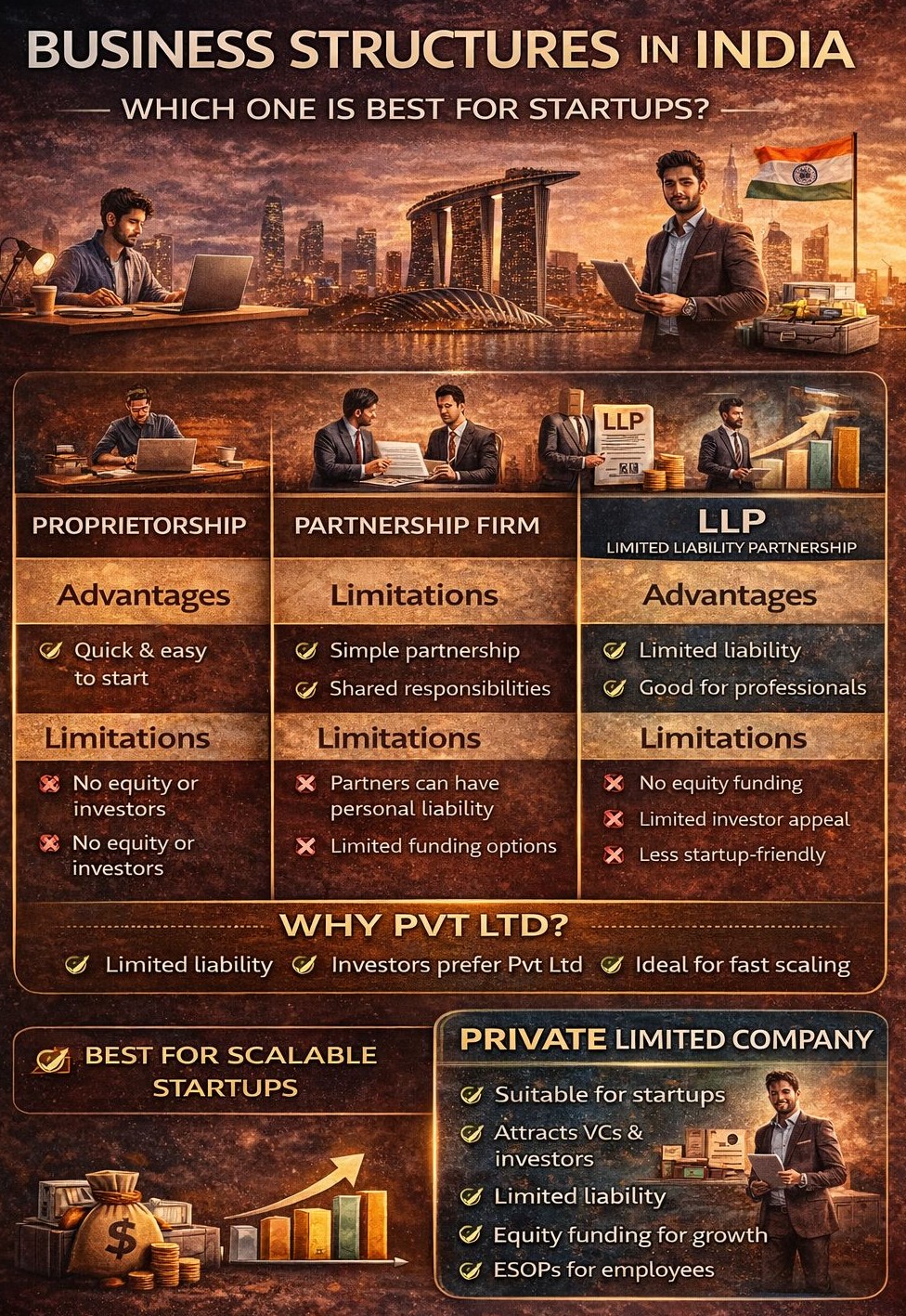
Top Reasons Why Startups Prefer the Pvt. Ltd. Company structure
Starting a business is exciting—but one of the first and most important decisions founders face is which business structure should they choose.
Choosing the appropriate business structure is one of the most important choices founders must make as they start their entrepreneurial journey. Proprietorship, partnership firms, limited liability partnerships (LLPs), and private limited companies are common choices. For serious, growth-oriented startups, a private limited company is not just a choice; it’s a strategic advantage.
In India, many startups register as a private limited company under the Ministry of Corporate Affairs—and this choice is driven by strong practical and strategic reasons. Based on real experiences with founders across industries (tech, food, digital services, etc.), here are the top reasons why startups prefer this structure
Serious, scalable, and investment-driven startups overwhelmingly favor a private limited company, even if each form has a function. Here’s why preference of investors: The majority of institutional funds, angel investors, venture capitalists, and incubators favor businesses that are registered as private limited corporations with the MCA. Many founders realize this after starting: “Choosing a private limited company made our business more structured, credible, and scalable.”
Partnerships and proprietorships are not appropriate for venture investment because they are unable to issue equity.
Benefits for Startups in India:
Scalable structures like private limited companies are generally supported by government incentives. Startups can gain access to the following through the Startup India initiative:
- Section 80-IAC tax holiday
- Quicker review of patents
- Availability of government funding programs and grants
- Acknowledgment and regulatory backing.
A Pvt. Ltd. is the recommended structure for fundraising and scaling, even though LLPs are acceptable.
Protection from Limited Liability:

Limited liability is provided by a private limited company, which means the following:
- The personal assets of the founders are safeguarded
• Only shareholding is subject to liability.
Contrast: - Unlimited liability due to proprietorship
• Partnership → Partners’ personal liabilitiesBecause of this, a Pvt Ltd is a safer structure for companies that are willing to take risks.
Increased Business Credibility: Banks, investors, big corporations, and international partners have more faith in private limited companies. Better contract prospects, easier loan approvals, stronger vendor relationships, and international business acceptance result from this.
Scalability and Easier Capital Raising: A private limited company is designed to expand. Angel and venture capital funding, equity dilution, ESOPs for talent retention, strategic investments, and share buybacks and exits are all made possible by it. This structure facilitates a smooth transition if your goal is to grow from INR 5 crore to INR 500 crore.
Quick Comparison
| Proprietorship
|
Partnership Firm
|
LLP
|
Private Limited Company
|
| · Easy to start
· No equity structure · Unlimited liability · Not investor-friendly |
· Suitable for small businesses
· Limited scalability · No equity flexibility
|
· Limited liability
· Good for professionals · Limited VC compatibility · No standard equity structure |
· Investor-friendly
· Equity-based funding possible · ESOP-ready · Scalable and globally recognized |
Other forms can be appropriate if your objective is to run a small or local firm. However, if your goal is to create a high-growth firm, raise capital, issue equity, and expand internationally. In India, a private limited company is the most forward-thinking and strategic option.
Most high-growth startups begin as private limited companies for this reason. This makes it a secure structure for risk-taking ventures. A private limited company signals professionalism and stability. Ensures continuity and operational stability. And Ideal for dynamic and growing startups. Many startups optimize taxes better after shifting to Pvt. Ltd. Helps in long-term sustainability and investor readiness.