
Changes Proposed in Corporate Laws (Amendment) Bill, 2026
Page Contents
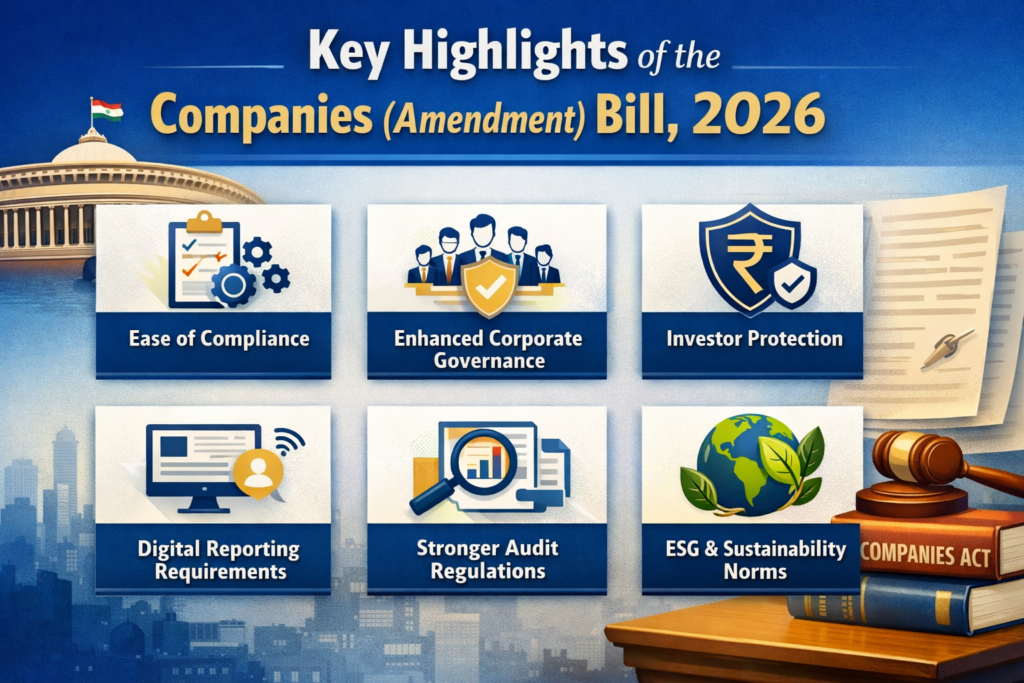
Major Changes Proposed & Impact of Corporate Laws (Amendment) Bill, 2026
A major reform initiative, the Corporate Laws (Amendment) Bill, 2026, aims to strengthen regulatory accountability, facilitate a digital-first corporate governance structure, and improve ease of doing business. The government’s ongoing transition from punitive regulation to compliance-based, technology-driven oversight is reflected in the bill.
Objective of the Bill of The Corporate Laws (Amendment) Bill, 2026
The Bill’s main objectives are to decriminalize minor offenses, rationalize CSR responsibilities, make compliance easier for small businesses, permanently recognize virtual meetings, and improve director and auditor responsibility. The Corporate Laws (Amendment) Bill, 2026 (Bill No. 85 of 2026), aims to promote ease of doing business in India. Reduce procedural and criminal compliance burden; Encourage flexibility through digital governance and strengthen regulatory architecture while simplifying routine corporate actions
Key Changes Proposed & Impact of Corporate Laws (Amendment) Bill, 2026 Structured Explanation
Small Company Expanded Thresholds
Small companies expanded thresholds, like paid-up capital, which increased from INR 10 crore to INR 20 crore, and the turnover limit, which increased from INR 100 crore to INR 200 crore. The impact of the Corporate Laws (Amendment) Bill, 2026, is to more companies qualify as small companies, benefiting from lesser compliance & relaxed filing & meeting requirements.
Buy-back of Securities
Increased frequency of certain prescribed companies is permitted to undertake 2 buy-back offers per year. & Mandatory 6-month gap between closures. The impact of the Corporate Laws (Amendment) Bill, 2026, is to better capital restructuring flexibility for companies.
Registration of Charges – Extended Timeline
Time limit extended from 120 days to 180 days for prescribed companies. The impact of the Corporate Laws (Amendment) Bill, 2026 is to reduce risk of invalid charge registration due to technical delays.
Virtual / Hybrid General Meetings
The Corporate Laws (Amendment) Bill, 2026, introduces AGMs & EGMs allowed via VC / AVM. However, at least one physical AGM every 3 years is mandatory. The impact of the Corporate Laws (Amendment) Bill, 2026, is to balance digital flexibility with shareholder physical participation.
EGM Notice Period (VC-Only)
The Corporate Laws (Amendment) Bill, 2026, is introduced. The notice period is reduced to 7 days, where EGM is conducted only through VC. The impact of the Corporate Laws (Amendment) Bill, 2026, is to faster decision-making in urgent corporate matters.
Board Meetings – Relaxation
The Corporate Laws (Amendment) Bill, 2026, introduces the OPC, small & dormant companies required to hold only one board meeting per calendar year. The impact of change in Company law is to major compliance relief for smaller entities
Disclosure of Interest under Section 184
The Corporate Laws (Amendment) Bill, 2026, is introduced. Disclosure is now required only on a change in interest, and annual repetitive disclosures are removed. The impact of this change is to avoid redundant formalities.
Additional Directors & Casual Vacancy
The Corporate Laws (Amendment) Bill, 2026, allows appointments valid only till the next general meeting OR 3 months, whichever is earlier. Impact of The Corporate Laws (Amendment) Bill, 2026 change Prevents prolonged interim directorships
NCLT Jurisdiction Simplification :
In mergers involving multiple states without adjudication, only an NCLT of the transferee/resulting company will handle the matter. Impact of the Corporate Laws (Amendment) Bill, 2026, is faster approvals and less jurisdictional overlap.
Secretarial Audit via Multidisciplinary Firms
The Corporate Laws (Amendment) Bill, 2026, allows secretarial audits permitted by multidisciplinary firms, and the basic condition for that is that majority partners must be PCS. The impact of the Corporate Laws (Amendment) Bill, 2026 is to align with evolving professional practices.
Treasury Stock
The Corporate Laws (Amendment) Bill, 2026, introduces a sunset clause, like a 3-year sunset period. and Treasury shares will lose voting rights beyond this period. The impact of The Corporate Laws (Amendment) Bill, 2026, is to prevent perpetual control through treasury holdings.
CSR Provisions – Rationalization
The CSR applicability threshold of net profit rose from INR 5 crore to INR 10 crore. Time for transferring unspent CSR (ongoing projects) is 30 days to 90 days. The impact of this change in corporate law is greater operational flexibility for CSR execution.
Decriminalization of Offenses
Minor procedural defaults converted from criminal offense → Monetary penalty . The impact of the Corporate Laws (Amendment) Bill, 2026, is to reduce unnecessary litigation and prosecutions.
Trust to LLP Conversion
SEBI-registered private trusts are allowed to convert into LLPs, with an automatic deemed transfer of assets & liabilities. The impact of the Corporate Laws (Amendment) Bill, 2026, is to facilitate structural reorganization.
Audit Exemptions:
The central government is empowered to exempt specific classes of companies from mandatory statutory audits. The impact of the Corporate Laws (Amendment) Bill, 2026, is targeted compliance relaxation.
IFSC Companies & LLPs
The Corporate Laws (Amendment) Bill, 2026, allows maintaining books and undertaking transactions in permitted foreign currencies. The impact of this change in The Corporate Laws (Amendment) Bill, 2026, is to align the IFSC regime with global financial practices.
M&A & Regulatory Enhancements
Simplified M&A process including fast-track mergers, the Corporate Laws (Amendment) Bill, 2026, and enhanced role of Regional Directors (RDs) & NFRA. The Corporate Laws (Amendment) Bill, 2026, also introduces valuation profession regulation. Impact of this change in The corporate Laws (Amendment) Bill, 2026, is to make stronger governance + faster approvals